Paid voting for an audience-choice award is legal in most cases, provided it avoids the legal definition of an unauthorized lottery. The Gambling Commission and the FTC both look at the same trigger: payment combined with pure chance. Keep a free-entry route or a genuine skill element in place, disclose your pricing clearly, and paid voting stays on the right side of the law.
TL;DR:
- A vote tally based on audience totals differs from a random prize draw; payment that buys entry or raises draw odds can trigger lottery rules.
- Put per vote and bundle prices beside the voting button, explain what payment changes, and publish eligibility, vote counting, tie breaking, fraud, and refund rules.
- EU member states regulate lotteries individually, while some Australian states require permits above local prize thresholds; international campaigns must check each target jurisdiction’s rules.
- Keep timestamped vote and payment records, document every fraud decision, and investigate suspicious spikes promptly; use identity checks proportionate to the risk.
- For youth contests, state the minimum age beside pricing and consider age verification or parental consent; minors generally cannot make binding payment transactions.
Table of Contents
- How Regulators Separate Lawful Competitions From Illegal Lotteries
- How to Structure Paid Voting So It Stays Legal
- Transparency and Fairness Practices That Hold Up to Scrutiny
- Paid Voting Rules Outside the US and UK
- Data Protection and Privacy Rules for Paid Voting
- Consumer Protection Considerations in Paid Voting
- Handling Disputes and Complaints About Paid Voting Results
- Age Restrictions and Minors in Paid Voting
- Tax Implications of Revenue From Paid Voting
- Balancing Engagement, Fundraising, and Compliance
- How Izivote Helps You Run Paid Voting Without the Legal Guesswork
- FAQ
- Sources
How Regulators Separate Lawful Competitions From Illegal Lotteries
Most paid promotion law boils down to a three-part test: is there a payment, a prize, and an element of chance? When all three are present without an escape hatch, regulators treat the promotion as a lottery, and in most jurisdictions, unlicensed lotteries are illegal. Audience-choice voting usually avoids this because the outcome depends on who gets more votes, not a random draw, but the moment a paid vote functions as an entry ticket into a randomized prize or materially raises someone’s odds, you cross into lottery territory.
The UK and US apply this test with different emphasis. In the UK, the Gambling Commission’s guidance on free draws and prize competitions states that prize competitions are lawful when they rely on skill or when a genuine free-entry route exists alongside the paid one. A 2025 government market study on online prize draws found that some instant-win products and prize draws cross into illegal lottery territory when their free-entry routes or skill requirements turn out to be token gestures rather than real alternatives.
In the US, the FTC’s priority is deception rather than licensing. Promoters must disclose that no purchase is necessary to enter or win, and they cannot imply that paying improves someone’s chances unless a skill-based format makes that explicit. The agency has backed this up with real penalties:
- Publishers Clearing House paid an $18.5 million settlement with the FTC in 2023 after misleading consumers about sweepstakes entry requirements.
- UK advertisers have faced ASA adjudications when their voting or prize mechanics lacked clear terms or appeared to disadvantage non-paying entrants.
- Historical FTC pay-per-call enforcement has penalized organizers for missing required disclosures in paid voting services.
The pattern across both regulators is consistent: paid voting is fine as a revenue mechanic, but it cannot be the only door into winning, and it cannot hide its own rules.
How to Structure Paid Voting So It Stays Legal
Turning paid voting into a compliant mechanic is less about legal theory and more about a handful of concrete build decisions you make before launch.
- Offer a free-entry or free-voting route. This is the single most reliable way to avoid the lottery classification. A free daily vote, a social-share-to-vote option, or a mail-in entry satisfies the “no purchase necessary” principle regulators look for.
- Or build a genuine skill element instead. If you skip the free route, the contest needs real skill, such as a judged component feeding into the audience score, not a disguised random draw dressed up as a competition.
- Write conspicuous pricing and disclosure language. State the cost per vote, any vote packages, and what the payment does and does not affect, right next to the voting button, not buried in a footer link.
- Never imply payment improves odds unless your rules say so explicitly. The FTC’s consumer guidance on sweepstakes scams is blunt on this: if paying raises someone’s odds of winning, regulators may treat it as a scam pattern rather than a legitimate promotion.
- Draft full terms and conditions. Cover eligibility, how votes are counted, fraud rules, tie-breaker procedures, and refund policy for paid votes before you ever collect a payment.
- Avoid premium-rate call mechanics unless you meet disclosure rules. The FTC’s Pay-Per-Call Rule guidance requires specific preamble and cost disclosures, and past enforcement included a $40,000 fine for a voting service that skipped them.
- Log every vote and offer identity verification where it matters. An audit trail with timestamps, payment references, and optional identity checks is what regulators and adjudicators ask to see first when a dispute arises.
- Plan your dispute process in advance. Decide who reviews flagged votes, how fast you respond, and what evidence you require before a complaint ever lands.
Pro Tip: Publish your free-entry instructions in the same font size and placement as your paid-vote button. Regulators and adjudicators both read a buried free option as evidence of intent to mislead.
Transparency and Fairness Practices That Hold Up to Scrutiny
Legal compliance is the floor. Regulators and advertising watchdogs reward promotions that go further and make fairness visible.
- State your prize selection method and voting purpose plainly in every piece of promotional material, not just the fine print.
- Use identity-based or double opt-in voting where it fits your event, and publish an anonymized summary of vote activity once voting closes.
- Keep paid perks separate from vote weighting if you are fundraising: a $5 donation can unlock a badge or shoutout, but it should never buy extra votes unless your rules say so clearly.
- Watch for IP clustering and velocity spikes that suggest bot or bulk-vote activity, and document every decision to discount or disqualify votes.
- Bring in an independent adjudicator for subjective categories where the winner isn’t a pure vote count.
ASA adjudications against promoters like Co-operative Group Ltd and Twentieth Century Fox repeatedly cite unclear voting mechanics or weak fraud monitoring as grounds for rulings against the organizer. Treat your audit log as your first line of defense if a complaint ever reaches a regulator.
For a deeper technical breakdown of detection methods, the campaign fraud prevention playbook covers practical steps for spotting manipulated voting patterns on any platform.
Paid Voting Rules Outside the US and UK
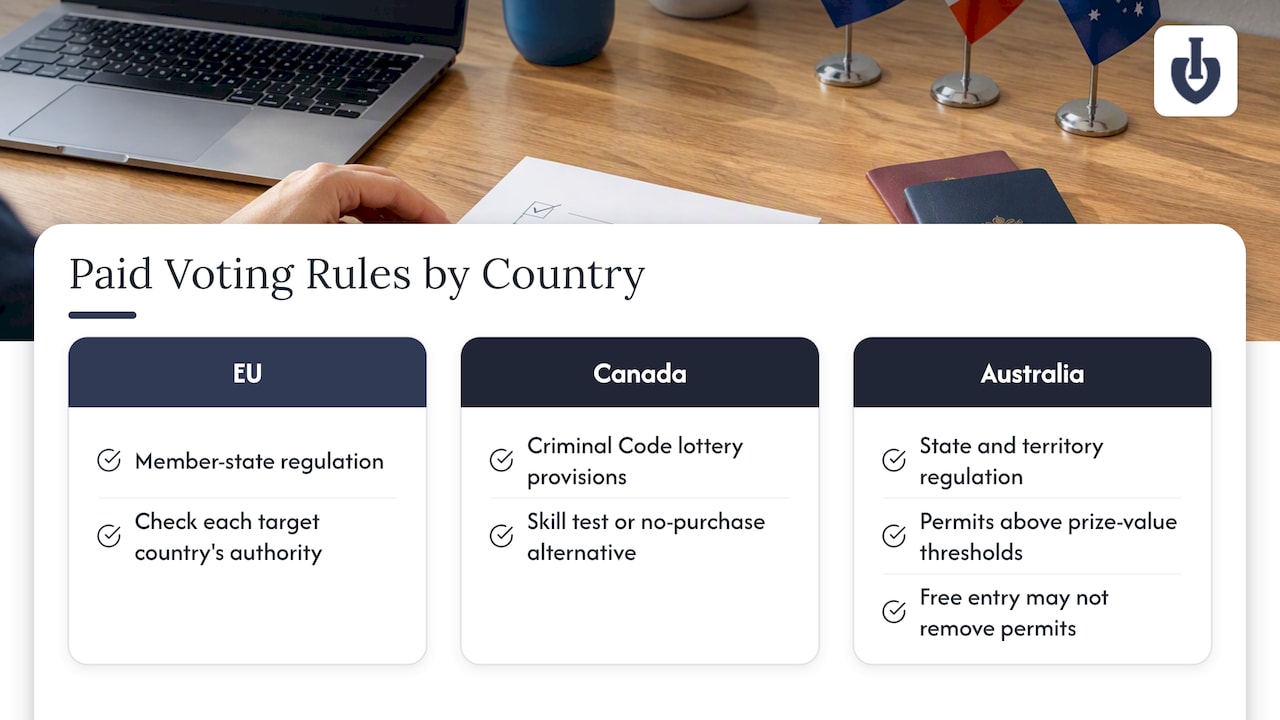
Outside the US and UK, paid voting law tends to follow the same underlying logic, payment plus pure chance equals a regulated lottery, but the licensing thresholds and enforcement bodies differ by country. In the European Union, gambling and lottery regulation is handled at the member-state level rather than centrally, so a paid voting promotion that’s fine in one EU country can require a license or registration in another. Organizers running pan-European campaigns should check each target country’s consumer protection and gambling authority rather than assuming one EU-wide standard applies.
Canada treats contests involving payment and chance under its Criminal Code lottery provisions, with a long-standing requirement that promotions include a skill test or a no-purchase alternative to avoid being classified as an illegal lottery scheme. Australia regulates trade promotions and lotteries at the state and territory level, and several states require a permit for promotions above certain prize value thresholds, even when a free-entry route exists.
The practical takeaway for any organizer running an international audience vote is the same everywhere: build in a free-entry or skill-based alternative by default, since it satisfies the strictest version of nearly every jurisdiction’s test at once, rather than designing separate rules per country.
Data Protection and Privacy Rules for Paid Voting
Paid voting systems collect more personal data than a simple poll: names, email addresses, payment details, and sometimes identity verification records. That data footprint brings privacy law into play alongside gambling and consumer protection rules. In the EU and UK, the GDPR framework requires a lawful basis for processing voter data, clear notice about what’s collected and why, and limits on how long payment and identity records are retained after an event ends.
Voter identity checks, when used to prevent duplicate or fraudulent votes, should be proportionate to the risk. Collecting a full government ID to verify a $2 vote is harder to justify than requiring email confirmation, and privacy regulators generally expect organizers to use the least invasive verification method that still protects vote integrity.
Payment processing also triggers its own compliance layer, since card data handling generally falls under PCI DSS standards regardless of the country you operate in. Organizers who route payments through an established platform shift much of this burden to a processor built for it, rather than building compliant payment handling and data retention policies from scratch for a single event.
Consumer Protection Considerations in Paid Voting
Consumer protection law treats paid voting as a commercial transaction, which means the same rules that govern any paid product or service apply. Voters need to know exactly what they’re paying for, what it buys them, and what happens if something goes wrong, before they hand over payment details.
Clear pricing is the baseline: a flat per-vote cost or a bundle price, stated before checkout, with no hidden fees added at the payment step. Refund policy matters too. Most consumer protection regimes expect organizers to state upfront whether paid votes are refundable, since a silent policy tends to be read against the organizer in a dispute.
Misleading claims about odds, prize value, or vote impact are the most common source of consumer complaints and regulatory action in this space. The FTC’s guidance on fake prize and sweepstakes scams is explicit that implying a payment increases someone’s chances of winning, when it does not, is treated as deceptive. Advertising claims about the award itself, such as “biggest fan vote of the year,” should also be defensible with real numbers if challenged.
Handling Disputes and Complaints About Paid Voting Results
Every paid voting campaign eventually gets a complaint, whether it’s a voter who thinks their payment didn’t register or a nominee who suspects bulk voting tipped a category. How you handle that moment determines whether it stays a minor support ticket or becomes a public credibility problem.
Set a clear complaints process before voting opens: a named contact or inbox, a response time commitment, and a defined escalation path for disputes that can’t be resolved quickly. Keep your audit log detailed enough to answer the two questions every complaint eventually asks: was this vote legitimate, and was it counted correctly?
When a dispute involves suspected fraud, document your investigation and decision in writing, even for small cases. ASA adjudications consistently reference whether an organizer could show clear records of how a flagged vote was reviewed, not just what the final decision was. A documented, consistent process protects you whether the complaint stays internal or escalates to a regulator or advertising watchdog.
Age Restrictions and Minors in Paid Voting
Paid voting campaigns that accept payment from minors carry extra legal exposure, since most jurisdictions limit a minor’s capacity to enter binding payment transactions. If your award category or audience is likely to include voters under 18, such as school competitions or youth talent contests, build age verification or a parental consent step into the paid voting flow rather than assuming it won’t come up.
The safer default for any campaign with a known youth audience is to offer the free-entry voting route prominently and let paid voting be an optional add-on for voters who are clearly adults, such as parents, family members, or general audience members rather than the contestants themselves. Some jurisdictions also restrict marketing paid promotions directly to children, so review your promotional channels and messaging if minors are part of your expected audience.
Keep your terms and conditions explicit about minimum age to participate in paid voting, and state it in the same visible location as your pricing disclosure, not buried in a general eligibility clause.
Tax Implications of Revenue From Paid Voting
Revenue collected through paid votes is taxable income for the organizing entity in most jurisdictions, whether that organizer is a business, a school, or a nonprofit. The tax treatment depends heavily on your organization’s structure: a registered nonprofit may have different reporting obligations than a for-profit event producer, and rules vary by country, so check with a tax professional or your local tax authority before assuming a blanket exemption applies.
If you’re using a platform that takes a percentage fee from each paid vote, keep records that separate gross vote revenue from the platform fee and any payment processing costs, since you’ll typically need the gross figure for tax reporting even though your net proceeds are lower. Sales tax or VAT treatment of paid votes also varies by jurisdiction and sometimes by whether the “prize” has a cash value, so this is another area where a local accountant’s input is worth the cost before your campaign launches, not after.
Balancing Engagement, Fundraising, and Compliance
The hardest part of running paid voting isn’t the legal test, it’s resisting the urge to let revenue quietly shape the rules. Every organizer eventually faces the same temptation: a vote package that nudges a little too close to buying the outcome. The campaigns that hold up are the ones where the rules were written before anyone calculated how much the paid votes might bring in, not after.
Clear rules matter more than clever mechanics. A voter who understands exactly what their payment does, and doesn’t do, rarely complains even when their favorite loses. A voter who suspects the rules bent for a paying nominee complains loudly, and that complaint is what draws regulator attention in the first place.
Having watched paid voting roll out across 500+ events in 20+ countries, the operational lesson that holds up every time is speed: fast analytics and a fast fraud response matter more than any single rule on paper. A spike in votes from one IP range at 2 a.m. needs a same-day answer, not a post-event investigation.
Treat your voting rules as the product, not the paperwork around it.
— Joshua
How Izivote Helps You Run Paid Voting Without the Legal Guesswork
We built our paid voting platform specifically so organizers don’t have to engineer compliance from scratch for every event. Payment handling, configurable terms and conditions, identity-based voting, and automatic audit logs come built into the setup, which means the free-entry route, pricing disclosures, and fraud monitoring this article covers are controls you configure, not code you write.

- We process paid votes with built-in payment handling and a platform fee per vote.
- We give you identity-based voting options for stronger fraud protection where needed.
- We surface real-time analytics to help catch suspicious voting activity quickly.
| What you need | Where to find it |
|---|---|
| Paid voting setup | Paid voting platform |
| Audience-choice award format | People’s choice voting |
| Plan and fee details | Pricing |
Pro Tip: Start with our Free plan to test your voting rules and disclosures on a small category before launching paid voting on your full award lineup.
Our plans run from Free through Pro at $6 a month ($60 a year) and Premium at $14 a month ($140 a year), so you can match the setup to the size of your award. Check our paid voting page and talk to our team about the right configuration for your next audience-choice campaign.
FAQ
Is paid voting legal for an online contest or award?
Paid voting is generally legal when it avoids the legal definition of a lottery, meaning it offers a free-entry route or a genuine skill element alongside the paid option. The Gambling Commission and the FTC both use this same basic test, though specific requirements vary by country.
Can you pay for votes without it becoming an illegal lottery?
Yes, as long as payment doesn’t function as the only entry method and doesn’t increase someone’s odds of winning through pure chance. Keeping a free alternative and disclosing pricing clearly is what separates a lawful paid vote from an unlicensed lottery.
What disclosures does the FTC require for paid voting in the US?
The FTC requires promoters to disclose that no purchase is necessary to enter or win, and to avoid implying that payment improves someone’s chances unless that’s explicitly part of the rules. Past enforcement, including an $18.5 million settlement against Publishers Clearing House, shows regulators take missing disclosures seriously.
Do minors need special protections in paid voting campaigns?
Yes, since minors generally can’t enter binding payment transactions in most jurisdictions, campaigns with a youth audience should offer a prominent free-entry route and consider age verification before accepting payment. Terms and conditions should state the minimum age to participate in paid voting clearly.
Is revenue from paid voting taxable?
Revenue from paid votes is generally taxable income for the organizing entity, though the exact treatment depends on your organization’s structure and local tax rules. Keep records separating gross vote revenue from platform fees, and confirm reporting obligations with a tax professional in your jurisdiction.
Sources
- Gambling Commission — Free draws and prize competitions
- FTC press release — action against Publishers Clearing House
- UK government research report — online prize draws and competitions (market study)
- FTC guidance on pay‑per‑call rules
Leave a Reply