Author: Joshua

  • Award Nomination Forms Online: 6 Fields, When to Add Voting

    Award Nomination Forms Online: 6 Fields, When to Add Voting

    Use a ready-to-use no-code nomination form template, or a downloadable Word or PDF template, to collect consistent, judge-ready nominations. These options cover most internal, school, and community awards without extra setup. Upgrade to a full platform only when you need reviewer scoring workflows, public voting, or paid-vote fundraising built into the same process.


    TL;DR:

    • Word and PDF forms suit low volume awards collected by email or in person, while builder templates add uploads, conditional questions, and automatic closing.
    • Require nominee and nominator details, a fixed award category, achievement statement, timeframe, and optional evidence; set upload limits and obtain publication consent.
    • Define eligibility rules, scoring criteria, and a retention period before launch, then restrict reviewer exports to evaluation fields and track disqualifications separately.
    • Verify nominator emails, add a bot check, and flag duplicates with a unique nominee identifier; publish only approved nominees for any public vote.
    • Send a reminder about a week before the deadline, since nominations often arrive in the final 48 hours; include examples of strong achievement statements.

    Izivote
    izivote.com
    Move from Nominations to Voting
    When your award is ready for public voting, Izivote helps organizers run secure, transparent votes and monitor results with real-time analytics.

    Explore the voting platform

    Table of Contents

    Where to find ready-to-use nomination form templates

    Three types of templates cover almost every award program, and each one fits a different scale of event.

    Downloadable Word and PDF templates work best for low-volume or internal awards where you collect nominations by email or in person. They print well, require no software setup, and are easy to adapt for a staff recognition program or a small club award.

    No-code form-builder templates handle higher volume and more complex requirements. Pages like Typeform’s awards nomination form template, Jotform’s awards nomination form, and Formpl support file uploads, conditional logic, and automatic form closing at a set deadline. You can publish one of these in under an hour and share it by link, embed, or QR code.

    Template libraries and AI-assisted generators sit between the two. They let you start from a near-finished layout and adjust fields, wording, and branding quickly, which suits organizers running an annual award who want a fresh look without rebuilding the form from scratch.

    • Internal or small-scale awards: a Word or PDF template distributed by email is usually enough.
    • Community, school, or industry awards with many nominators: a no-code builder template handles volume and file uploads better.
    • Public or fan-voted awards: a template still works for intake, but you will need a separate voting step once nominations close.

    The right starting point depends less on how “official” the award feels and more on how many nominations you expect and whether reviewers need to score or compare them side by side.

    What fields belong on a judge-ready nomination form

    A nomination form only works if every submission gives reviewers the same information in the same format. Based on the field sets used across major template providers, a solid form includes:

    1. Nominee details: full name, title or role, organization or department.
    2. Nominator contact information: name, email, and relationship to the nominee.
    3. Award category, selected from a dropdown rather than typed in freely.
    4. A concise achievement statement describing why the nominee qualifies.
    5. The relevant timeframe (the period the achievement or contribution covers).
    6. Optional supporting evidence: a letter of endorsement, a short CV, or images.

    Typeform’s template guidance confirms these fields as standard across employee, student, member, and community award forms. For supporting documents, set clear file-type and size limits upfront. The Zayed Award for Human Fraternity nomination form caps its letter of endorsement at 1,000 words and specifies accepted upload formats, which is a useful benchmark for your own limits.

    Word limits and short hint text under each field push nominators toward focused, comparable answers instead of long, unstructured essays. Add a plain-language checkbox asking for permission to publish the nomination and use any submitted photos if the nominee wins.

    Pro Tip: Cap the achievement statement at a moderate length to ensure succinct and focused entries. Reviewers read faster, and nominators write tighter, more specific entries.

    Customizing and sharing your nomination form

    Once your fields are set, a few configuration choices determine whether the form feels easy or clunky to fill out.

    • Use conditional logic so category-specific questions only appear after the nominator selects a category, keeping the form short for everyone.
    • Match the form’s branding, colors, and header image to your event or organization to build trust and reduce drop-off.
    • Set a visible deadline with a stated time zone, an automatic close date, and a confirmation email sent to each nominator.
    • Share the form through whichever channel reaches your audience fastest: a direct link, an embedded widget on your event page, a QR code on printed materials, or a line in an email newsletter.

    Formpl.us and Cognito Forms both note that templates publish quickly, but larger programs still need reviewer access controls, scheduled notifications, and export options once nominations start arriving. Build those settings in before you share the link, not after submissions begin.

    From nomination to final decision: the typical workflow

    Most award programs, regardless of size, move through the same sequence of stages. The HRSA condition nomination process is a useful public example of how a staged review structure works in practice: intake, eligibility screening, committee evaluation, and a final recommendation.

    For a public or member-voted award, the stages typically look like this:

    • Nomination intake: the form collects entries until the deadline closes.
    • Eligibility and administrative review: staff check for completeness and basic qualification.
    • Committee scoring: reviewers rate nominees against a shared rubric.
    • Shortlist publication: qualifying nominees move forward with public profiles.
    • Voting or ranking: the audience or a judging panel ranks the shortlist.
    • Final approval: results are confirmed and winners are notified.

    A staged review and voting process like this gives large or high-stakes award programs a documented, auditable path from first submission to final decision.

    A template handles the first stage well on its own. You need a platform once reviewer scoring, public voting, paid voting, audit logs, or real-time dashboards become part of the requirement, because stitching those features onto a basic form usually means manual spreadsheet work and lost data.

    A quick pre-launch checklist worth running every time

    Before publishing any nomination form, I run three checks: are categories and evaluation criteria clearly defined, are file and word limits set so submissions stay comparable, and is the close date locked to a stated time zone with a notification flow in place for nominators and reviewers.

    A platform with built-in reviewer controls and live dashboards removes most of the manual tracking that makes nomination season stressful for organizers.

    — Joshua

    Verifying eligibility and catching duplicate nominations

    Eligibility problems and duplicate entries cause most of the late-stage headaches in award programs, so it pays to design the form to catch them early.

    Ask nominators to confirm eligibility criteria directly on the form, such as tenure, membership status, or geographic region, rather than assuming they have checked the rules elsewhere. A required checkbox or short eligibility question filters out a share of ineligible entries before they ever reach a reviewer.

    For duplicates, require a unique identifier for each nominee, such as an employee ID, member number, or email address, so your form or spreadsheet can flag repeat entries automatically. Many no-code builders support a duplicate-detection rule based on a specific field; set this up before the form goes live rather than cleaning duplicates manually afterward.

    Keep a running list of nominees as submissions arrive, and cross-check new entries against that list weekly rather than waiting until the deadline. This catches both duplicate nominations for the same person and nominations submitted under slightly different name spellings. For larger programs, assign one reviewer to eligibility screening specifically, separate from the committee members scoring the content of each nomination, so eligibility checks don’t bottleneck the scoring process.

    Keeping your nomination form secure from fraudulent entries

    A nomination form that collects names, contact details, and sometimes photos needs basic safeguards against spam and manipulated submissions.

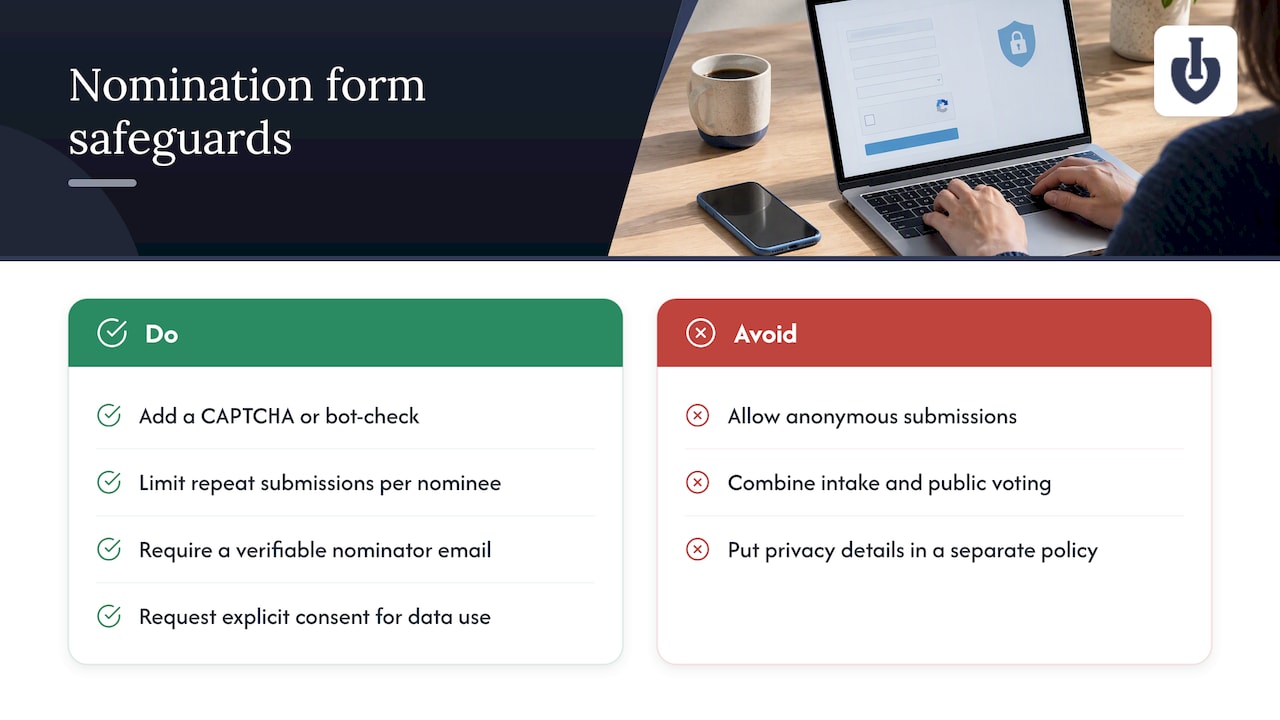
    Add a CAPTCHA or similar bot-check to block automated spam submissions, which is standard on most no-code form builders without extra cost. Limit one submission per nominator per nominee where your form tool supports it, which cuts down on repeat or coordinated entries meant to inflate a single nominee’s visibility.

    Require a verifiable nominator email address rather than allowing anonymous submissions. This single step discourages most fraudulent entries, since nominators know their submission is traceable. For public or fan-facing awards, keep nomination intake and any public voting completely separate: verify and shortlist nominees first, then publish only the approved shortlist for voting. Cognito Forms’ guidance on award nomination workflows recommends this separation specifically to prevent unverified or low-quality entries from appearing in a public ballot.

    Finally, request explicit consent for data use and publication at the point of submission. The National Privacy Commission’s nomination form guidance notes that a clear privacy statement, stated retention period, and contact point for data correction all belong on the form itself, not in a separate policy document nominators have to go looking for.
    Keeping your nomination form secure from fraudulent entries — overview diagram

    Moving from nomination intake to the voting phase

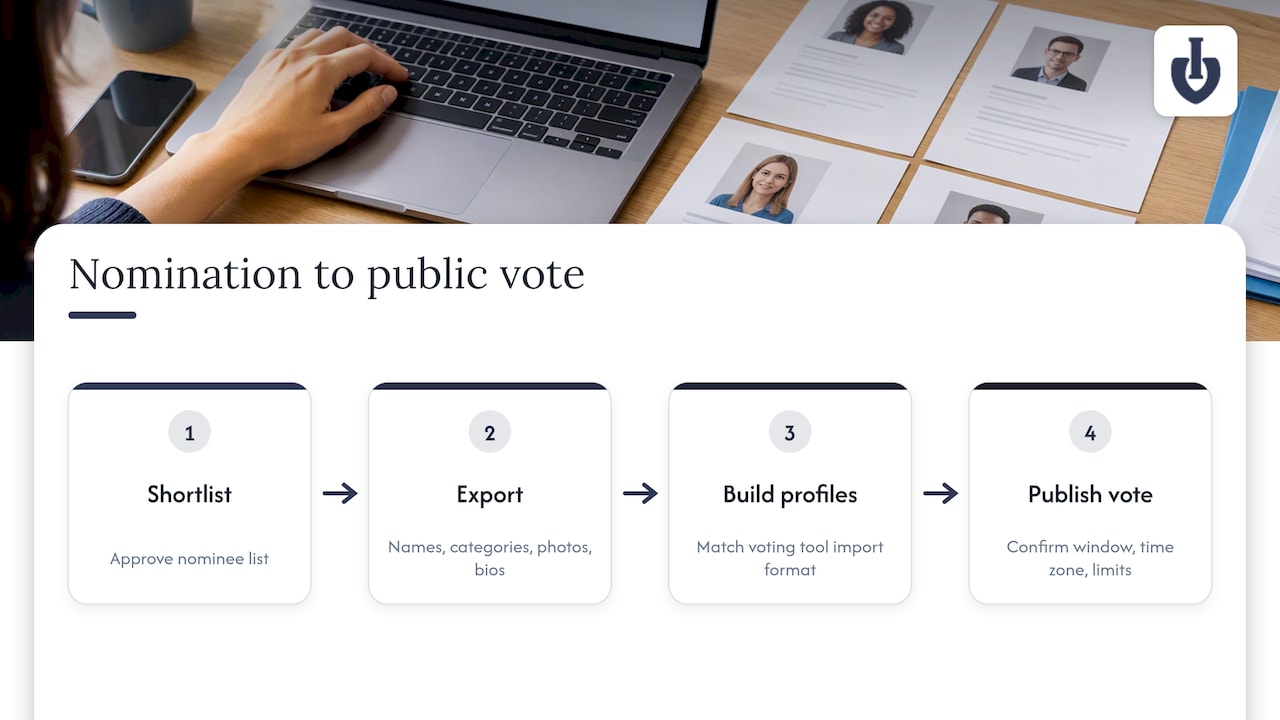
    Once your shortlist is finalized, the transition to voting works best as a distinct second step rather than an extension of the same form. Export your approved nominee list, including names, categories, and any photos or profile text you plan to display publicly.

    A spreadsheet export from your nomination form typically includes everything you need to build voting profiles: nominee name, category, submitted bio or achievement statement, and any uploaded image. Match this data against your voting tool’s import format before the shortlist goes live, since reformatting after voting opens creates delays.

    If your award includes a public or fan vote, this is the point where a dedicated voting setup, rather than a second form, becomes worth considering. A platform built for online voting for awards and competitions can take an approved shortlist directly into a branded voting page with photos, categories, and live results, without requiring a second round of manual data entry. Confirm your voting window, time zone, and any vote-limit rules before publishing the shortlist publicly, since changing these mid-vote undermines trust in the result.
    Award nominations moving into public voting

    Promoting your nomination form to get enough entries

    A well-built form still needs visibility, and most award programs underestimate how much reminder communication nominations actually require.

    Share the form link across every channel your audience already uses: email newsletters, social posts, and any event or organization website where you can embed the form directly rather than linking out. A QR code on printed flyers or at in-person events works well for awards tied to a physical venue or conference.

    Send at least one reminder email roughly a week before the deadline, since a meaningful share of nominations typically arrive in the final 48 hours of any open call. Give nominators a short list of example achievement statements or past winners (where privacy allows) so they understand what a strong nomination looks like before they start writing. Clear, specific hint text on the form itself does some of this work automatically, as Typeform’s design guidance notes: shorter prompts and category-specific questions tend to increase both completion rates and the usability of what gets submitted.

    If your award program runs annually, keep a short list of past promotion channels that worked and skip the ones that didn’t, so each cycle gets faster to launch than the last.

    Managing nomination data after submissions close

    Once the deadline passes, how you handle the incoming data determines how smoothly the review stage goes.

    Export all submissions into a single spreadsheet or dashboard view as soon as the form closes, rather than letting entries sit scattered across email and form-tool exports. Most no-code builders support a direct CSV or Excel export, which should include every field plus a timestamp and submission ID for tracking.

    Build a simple reviewer-facing version of this export with only the fields judges need to see: nominee name, category, achievement statement, and any supporting files. Strip out nominator contact details from the reviewer copy unless your process specifically calls for reviewers to know who submitted each entry.

    Keep a separate record of eligibility decisions and duplicate flags, so you can explain any disqualification later if a nominator asks. Set a clear data retention period for nomination records, consistent with the privacy statement on your form, and delete or archive entries once that period ends. This keeps your records manageable for next year’s cycle and avoids holding onto personal data longer than your stated policy allows.

    What most nomination-form advice gets wrong

    Most guidance on award nominations spends its energy on form design: field order, button colors, how many questions is too many. That matters, but it is not where programs actually run into trouble. The real failure point is the gap between intake and decision: nominations arrive, pile up in a spreadsheet, and nobody has a clear rule for scoring, eligibility, or what happens to the data afterward.

    A good template solves the first problem. It does nothing for the second. If you only remember one thing from this guide, make it this: decide your scoring rubric and your data retention rule before you publish the form, not after nominations start arriving. Everything else, branding, word limits, file formats, is secondary to having a reviewer process that can actually handle what the form collects.

    Organizers who skip this step usually end up rebuilding their process midway through, after the first batch of nominations exposes a rule nobody agreed on.

    — Joshua

    When a voting platform makes more sense than a form alone

    A template covers nomination intake well. Once your award includes public or fan voting, especially with paid votes or multiple voting rounds, a dedicated platform removes a lot of the manual work that a form and spreadsheet combination can’t handle on its own.
    Izivote

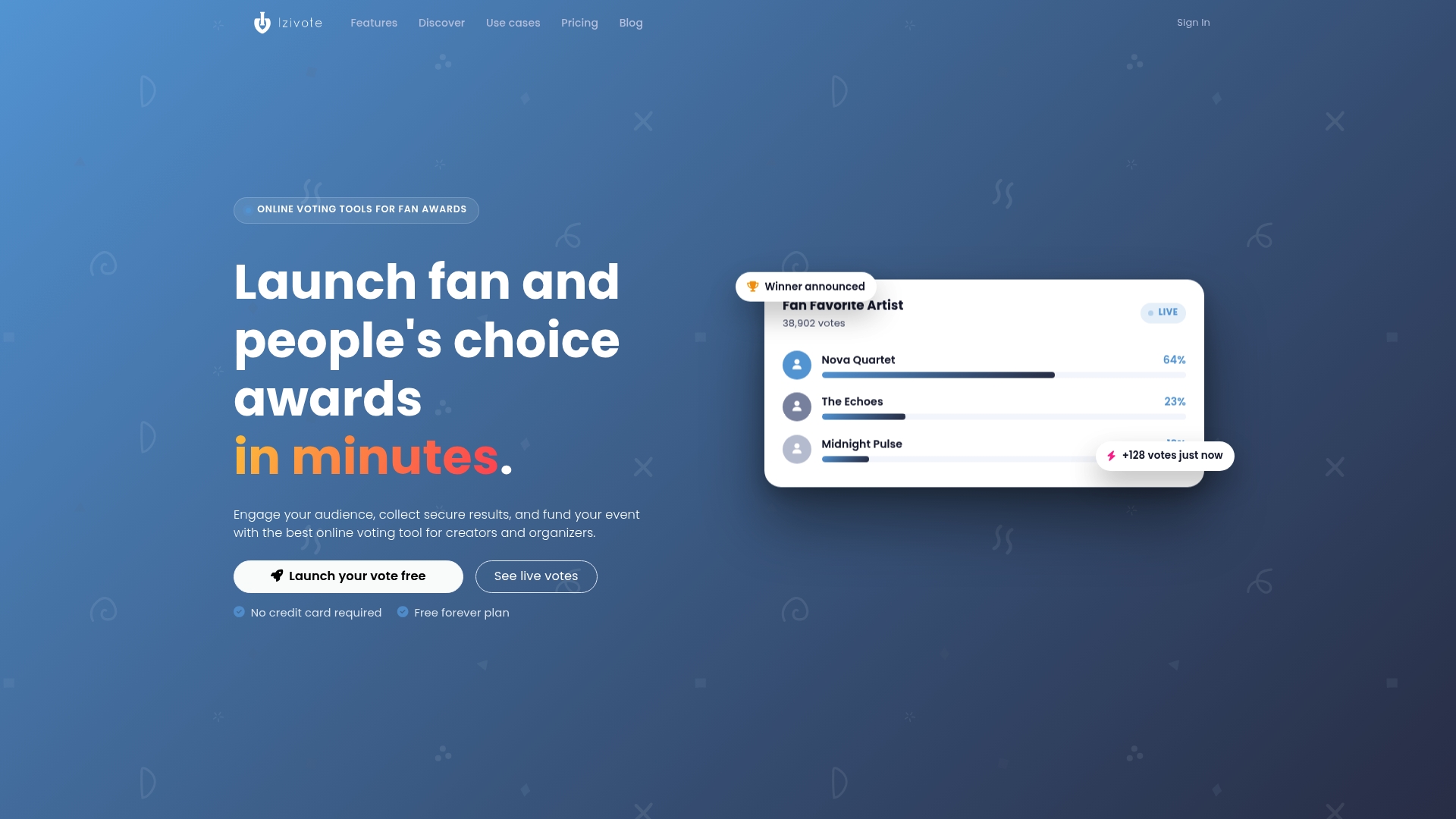
    We built a platform specifically for public and people’s choice awards, where nomination intake needs to flow directly into secure, branded voting. The platform supports:

    • Embeddable nominee profiles with photos, pulled straight from your approved shortlist.
    • Multiple voting modes, including open voting, login-based voting, and paid voting with payment handling built in.
    • Live result dashboards so organizers and audiences can watch standings update in real time.
    • Automatic vote closing and real-time analytics, so you are not manually tracking a deadline across spreadsheets.

    This setup fits fan awards, school and student election voting, and community or club awards where public engagement matters as much as the final result. Our pricing page lists our Free plan alongside Pro at $6 per month ($60 per year) and Premium at $14 per month ($140 per year), plus a 10% platform fee on paid votes. If your award is ready to move from nominations into a public vote, check our people’s choice awards use case to see how the setup works end to end.

    FAQ

    What should you write when nominating someone for an award?

    Focus on a specific, concise achievement statement that explains what the nominee did, who it affected, and when it happened, rather than a general description of their character. Reference the exact award category criteria so reviewers can match your statement to what they’re scoring, and keep it within any stated word limit.

    How do you get nominated for an award?

    Nominations typically come from colleagues, members, or community contacts who submit a form on your behalf, so visibility and a track record in your category matter more than directly requesting a nomination. Some programs also allow self-nomination, which is worth checking in the award’s stated eligibility rules.

    Is it okay to nominate yourself for an award?

    Self-nomination is allowed by many award programs and is explicitly permitted on some nomination forms, so check the specific program’s rules rather than assuming it’s off-limits. When self-nomination is allowed, the same evidence standards apply: a clear achievement statement and any required supporting documents.

    Can you share an example of how to write an award nomination?

    A strong nomination opens with a one-sentence summary of the achievement, follows with two or three specific examples or outcomes, and closes with why the contribution fits the award category. Template pages like Typeform’s awards nomination form include hint text and category prompts that model this structure directly on the form.

    What is the difference between a nomination form and a voting platform?

    A nomination form collects and organizes entries for review, while a voting platform takes an approved shortlist and runs public or member voting on top of it, often with live results and payment handling for paid votes. Programs that only need to collect and score nominations can use a form alone; programs adding a public vote typically need both.

    Sources

    Made with BabyLoveGrowth to get recommended by ChatGPT

  • Google Forms Voting: 6 Checks Before a Formal Election

    Google Forms Voting: 6 Checks Before a Formal Election

    Google Forms work fine for informal polls and casual team votes, but it falls short for formal elections where results need to hold up to scrutiny. The core problem is structural: Forms gives you no end-to-end verifiability and no cryptographic audit trail, so nobody can independently confirm that every vote was counted as cast. If your vote has real stakes, test thoroughly first or move to a system built for it.


    TL;DR:

    • Collecting verified Google Account emails helps flag duplicate submissions, but it removes anonymity and still cannot stop voters from using multiple accounts.
    • Before launch, test the public link on a phone and laptop, verify the connected Sheet’s file ID, and submit from separate accounts and an incognito window.
    • Keep Forms to informal, nonbinding polls; binding elections, board or union votes, and decisions with legal consequences need verifiable audit trails Forms cannot provide.
    • Large votes should account for a 50,000 response summary cap and Sheet sync issues above roughly 100,000 rows; voter emails also create manual privacy duties.

    Izivote
    Choose Voting Built for Awards
    Izivote offers fan and people’s choice awards clear, secure voting, with identity-based options and real-time analytics for organizers.

    Explore Izivote

    Table of Contents

    Why Google Forms lacks the security guarantees elections need

    End-to-end verifiability means a voter can confirm their own ballot was recorded correctly, and any observer can confirm the final tally matches every submitted ballot, without exposing who voted for what. It is the standard that separates a casual poll from a system you can defend if someone challenges the result.

    Google Forms was not built with this standard in mind. Academic research on election security consistently draws a line between general-purpose survey tools and dedicated voting systems: specialist platforms implement verifiability and audit mechanisms that general-purpose tools lack, and organizers should not assume Forms provides election-grade guarantees just because it collects structured responses. There is no confirmation code a voter can check, no published proof a third party can audit, and no independent tally verification.

    Toolkits built specifically for this purpose show what the gap looks like in practice. ElectionGuard and similar cryptographic toolkits generate confirmation codes and verifiable tallies that let voters confirm their ballot was cast as intended and let auditors confirm the count without seeing individual choices. Forms exposes none of this.

    There is also a hard trade-off built into how Forms handles identity:

    • Collect email addresses and you get authentication, but you lose anonymity because responses are tied to Google Accounts.
    • Skip email collection and you get anonymity, but you lose any way to verify who actually voted or whether someone voted twice.

    One structural gap drives most of the risk: Forms offers no cryptographic receipt or independent audit log, so a disputed result has no technical way to be resolved beyond trusting the raw spreadsheet.

    Common technical issues that break voting forms

    Most vote-day problems are mundane, not malicious. They still cost you results if you do not catch them early.

    1. A voter leaves a required field blank on mobile because the field was hidden below the fold, and the submission silently fails.
    2. A browser extension (ad blocker, privacy tool, or script blocker) interferes with the submission script and the vote never reaches Google’s servers.
    3. A weak or dropped connection cuts off submission mid-transfer, and the voter assumes it went through.
    4. The linked response Sheet does not match the live form because an admin edited a copy or linked the wrong file ID, so votes land somewhere nobody is watching.
    5. The account hosting the form hits a storage limit and stops accepting new responses without an obvious warning to voters.
    6. A burst of simultaneous submissions during a close vote creates response-limit edge cases that behave unpredictably.

    Practitioner support threads confirm this pattern: most failed submissions trace back to mobile UI issues, connectivity, or browser extensions rather than anything exotic. Separately, a frequent admin mistake is linking an edit view instead of the live form, which makes real responses appear to vanish.

    Pro Tip: Test the exact public link voters will use, not the edit link in your browser tab, on at least one phone and one laptop before you announce the vote.

    What Google Forms can be used for: safe, limited voting scenarios

    Forms earns its popularity honestly: it is free, familiar, and fast to set up. That makes it a reasonable fit for low-stakes situations where a disputed result would not carry real consequences.

    • Informal team polls, like choosing a meeting time or a lunch spot.
    • Small private club votes where the group already trusts each other and a tie just gets discussed.
    • Non-binding popularity votes that feed into a larger decision rather than deciding it outright.

    If you want to add a light layer of authentication without destroying anonymity entirely, one workable pattern is to require sign-in through Google Account email collection, then export the raw responses and manually strip identifying columns before anyone sees the tally. Google’s own documentation confirms Forms can require verified sign-in or allow anonymous responses, but not both at once without manual work on your part.

    What Forms should never carry: binding governance decisions, board elections, union votes, or any public election with legal consequences. These need verifiable audit trails that a spreadsheet export cannot produce.

    Pro Tip: Keep the voting window short (hours, not days) and spot-check a sample of responses manually. Shorter windows reduce the time available for coordinated manipulation.

    Pre-vote checklist: how to test a Google Form voting flow before launch

    Run this sequence before you send the link to a single voter:

    1. Confirm you are sharing the live published form URL, not an edit link.
    2. Open the linked response Sheet and confirm its file ID matches what you expect, not a duplicate or an old copy.
    3. Submit a test response from an incognito window, a phone, and a second Google Account to confirm the full path works end to end.
    4. Simulate a weak connection (airplane mode toggled mid-submission, or a throttled network) to see how the form fails.
    5. If you expect a surge of simultaneous votes, have several test accounts submit at nearly the same moment and check whether the Sheet records every one of them.
    6. Export the responses to CSV and confirm the format matches what you plan to use for counting or reporting.

    Before announcing results, document what you will keep and for how long:

    • A timestamped export of raw responses immediately after closing the form.
    • A written note of who had edit access during the voting window.
    • A backup copy of the response Sheet stored separately from the live file.

    Google’s documentation on managing responses confirms Forms can stop accepting submissions once you close it, but closing does not retroactively fix a sync mismatch you missed during testing.

    Impact of multiple or duplicate submissions and prevention strategies

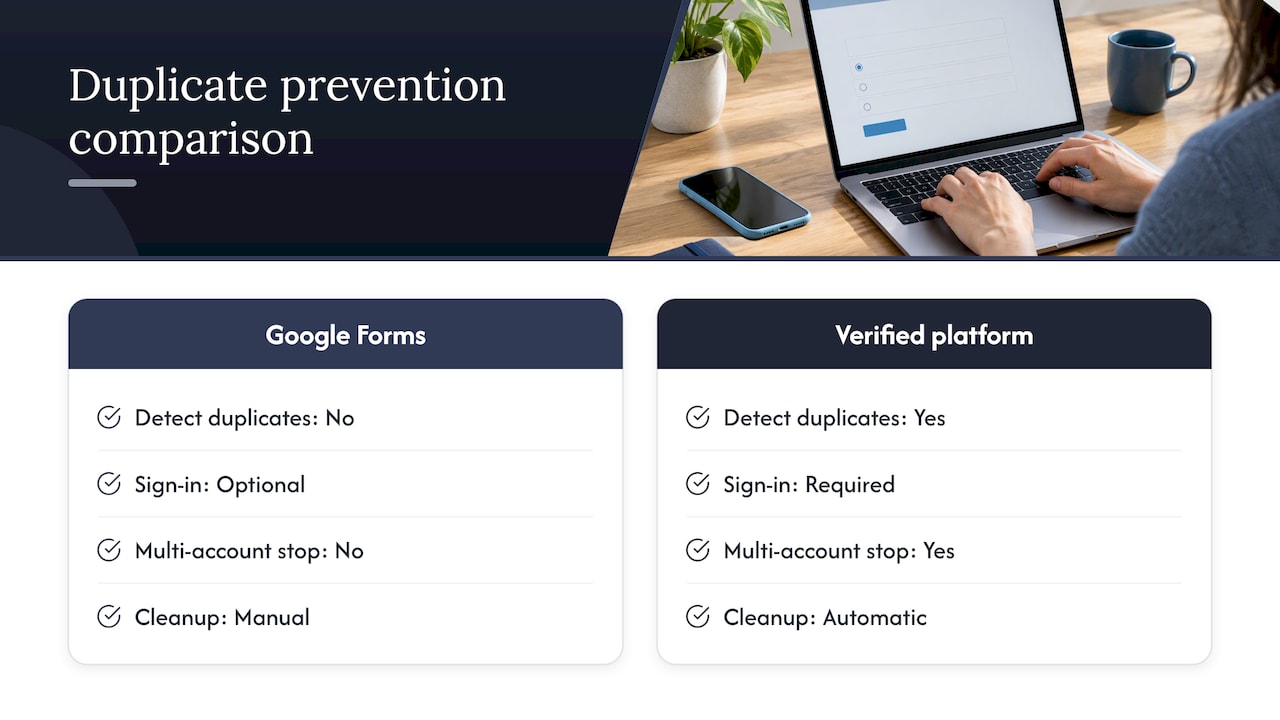
    Duplicate submissions are one of the most common ways a Google Forms vote gets challenged after the fact. Without an authenticated voter roster, Forms cannot natively tell whether the same person submitted twice from two devices, two browsers, or a shared link passed around a group chat.

    The practical impact scales with the size of the vote. In a ten-person team poll, a duplicate is a minor annoyance you can spot by eye. In a public awards vote with thousands of entries, duplicates can shift a close result and you have no reliable way to detect them after the fact, since anonymous responses carry no identifying marker to deduplicate against.

    The only partial fix within Forms itself is requiring sign-in to collect verified Google Account emails, which lets you flag and remove duplicate submissions tied to the same account during your post-vote review. This does not stop someone from using multiple accounts, and it reintroduces the authentication-versus-anonymity trade-off covered earlier. Response limits can cap total submissions, but a response limit stops the count, not the duplication within it.

    For votes where duplicate prevention actually matters, a platform with built-in identity verification at the point of voting, rather than a manual post-hoc cleanup, removes this failure mode by design rather than by spreadsheet triage.

    Impact of multiple or duplicate submissions and prevention strategies — overview diagram

    Addressing and managing ballot stuffing and vote manipulation risks

    Ballot stuffing is the more deliberate cousin of duplicate submissions: one person or a coordinated group submitting many votes to push a result. Google Forms has no native rate limiting per device or per network, so a determined voter can refresh and resubmit from the same browser repeatedly unless you require account sign-in.

    Even sign-in requirements have a ceiling. Someone can create multiple free Google Accounts in minutes, and nothing in Forms flags that pattern for you. Security community discussions on this exact question conclude that Forms cannot verify an eligible voter list or detect coordinated manipulation, which is precisely why practitioners warn against using it for anything resembling a real election.

    Research into coercion-resistant voting protocols goes further, showing that even verified sign-in does not address vote-buying or coercion, since someone can watch over a voter’s shoulder or demand proof of how they voted. Mitigating this in Forms requires manual vigilance: watching submission timestamps for suspicious clustering, cross-referencing IP-adjacent timing where visible, and manually disqualifying accounts created the same day as the vote. None of this scales past a small, low-stakes audience.

    Limitations in customizing voting options and question types relevant to awards

    Awards voting has specific needs that generic survey question types were not designed for: nominee photos next to each choice, grouped categories with a single winner per group, write-in options that do not break the tally, and a visual layout that makes browsing twenty nominees easy on a phone.

    Forms gives you multiple choice, checkboxes, and dropdowns, which cover the basics but flatten everything into plain text options. There is no native way to attach a nominee’s photo directly beside their name in a multiple choice question, so organizers resort to workarounds like numbered lists referencing a separate image gallery, which adds friction exactly where you want voting to feel effortless.

    Multi-category awards compound the problem. Each category needs its own question block, and voters scrolling through a long form for ten award categories are more likely to abandon partway through or miss a required field, which loops back into the submission failures covered earlier. There is also no built-in way to prevent a voter from selecting the same nominee across categories where that would be considered a conflict, since Forms has no cross-question validation logic for that use case.

    Integration challenges with third-party analytics and reporting tools

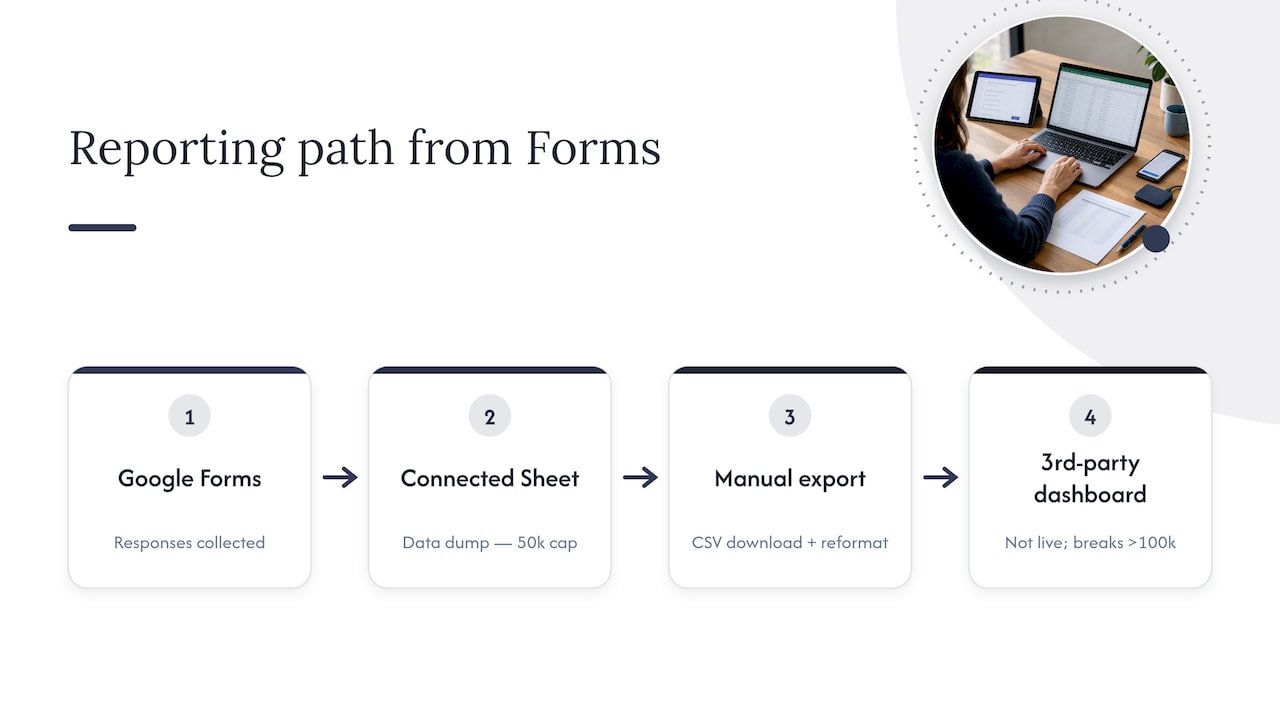
    Once a vote closes, many organizers want more than a raw count. They want engagement trends, vote distribution by category, or a public-facing results page that updates live. Google Forms routes everything into a connected Sheet, which works as a data dump but was not built as a reporting layer.

    Pulling that Sheet data into a dashboard or analytics tool means building your own export and import pipeline, usually a manual CSV download followed by a reformat before anything else can read it cleanly. There is no native live connection to common business intelligence tools, so “real-time” results generally mean refreshing a Sheet and re-running a chart, not an actual live feed.

    Google Forms reporting path and data limits

    At scale, this gets harder. Google’s own documentation notes that very large response sets hit summary and sync limits, including a 50,000 response summary cap and sync issues once a connected Sheet grows past roughly 100,000 rows. For an organizer trying to show a public live leaderboard during an active vote, that is a meaningful ceiling, and it means any third-party dashboard you build on top is only ever as current as your last manual export.

    User experience issues affecting voter turnout

    A voting form that is hard to use loses votes, full stop. Forms was designed as a generic survey tool, and that shows up in small frictions that matter more during a time-limited public vote than they would in an internal team survey.

    Long scrolling lists of nominees with no photos or grouping make it hard for a voter to quickly find their favorite in a crowded category, and that friction tends to show up as abandoned sessions rather than complaints. Mobile responsiveness is generally solid, but required-field errors are easy to miss on a small screen, which ties directly back to the submission failures covered earlier. There is also no progress indicator for multi-category awards forms, so a voter filling in category six of ten has no sense of how much is left, which can prompt them to give up.

    None of these are catastrophic individually, but together they shape turnout more than organizers expect. A form that takes ninety seconds to complete with clear visual cues keeps more voters through to submission than one that takes three minutes of scrolling through plain text options.

    Handling of voter data privacy under relevant regulations

    Collecting voter emails for authentication means you are collecting personal data, and that triggers privacy obligations depending on where your voters are located. Google’s infrastructure handles storage and account security on its end, but the responsibility for how you collect, use, and retain that data as an organizer sits with you, not with Google.

    Under regulations like the EU’s GDPR, collecting email addresses for voter verification generally requires a lawful basis for processing, a clear statement of what the data will be used for, and a defined retention period after which you delete it. Google Forms gives you no built-in consent management, no automatic data retention timer, and no built-in mechanism for honoring a deletion request beyond manually editing the Sheet yourself. If a voter later asks you to remove their data, that is a manual process you have to track and execute.

    For a ten-person office poll this is a minor administrative task. For a public vote collecting emails from voters across multiple countries, it becomes a real compliance obligation that a spreadsheet was never built to manage, and organizers should treat that gap as a planning requirement, not an afterthought.

    Organizer perspective: balancing convenience and trust

    Forms earns its place in a lot of toolkits because it is free and nobody needs onboarding to use it. The tipping point usually arrives the moment a vote has real stakes attached: money, reputation, or a result someone is willing to challenge. That is when organizers start asking for receipts, audit logs, and a tally nobody can quietly edit after the fact, and a general-purpose survey tool was never built to answer that ask.

    The question is never whether Forms works. It’s whether you can defend the result if someone asks you to prove it.

    — Joshua

    A purpose-built alternative to Google Forms voting issues

    When a vote needs to hold up to scrutiny, we built Izivote to close the exact gaps covered above. Identity-based voting ties each ballot to a verified participant without forcing you to manually strip and reconcile a spreadsheet afterward, and our paid voting mode handles payment collection directly.

    Izivote

    Our dashboard shows live results as they come in, without the manual export-and-reformat cycle a connected Sheet requires, and embeddable voting pages let you run the vote directly on your own event site instead of sending voters to a separate link.

    Upgrading makes sense once a vote crosses from informal into binding: elections with real consequences, large public audiences where duplicate detection matters, or fundraising votes where your supporters expect a receipt.

    • Identity-based and paid voting modes built to support authenticated, auditable results.
    • Live public results dashboard instead of a manual Sheet export.
    • Embeddable voting pages for your own site.
    • A free tier for small events, with Pro and Premium plans for larger ones.

    See current plans and pricing to find the right fit for your next vote.

    FAQ

    Can Google Forms be hacked or manipulated during a vote?

    Google Forms has no built-in protection against a single voter submitting multiple times unless you require sign-in, and even sign-in can be bypassed with multiple free accounts. Security community analysis confirms Forms cannot verify an eligible voter list or detect coordinated manipulation, which is why practitioners treat it as unsuitable for binding elections.

    How do I stop bots or duplicate votes in Google Forms?

    Requiring sign-in to collect verified Google Account emails is the main built-in option, letting you manually flag and remove duplicates tied to the same account. It does not stop someone using multiple accounts, so for votes where this risk matters, a platform with identity verification built into the voting step is a more reliable approach.

    Why isn’t my Google Form syncing responses to my spreadsheet?

    The most common cause is linking the wrong file, often an edit link or a duplicate copy instead of the live form’s actual response destination. Google’s troubleshooting documentation recommends verifying the file ID and ownership of the connected Sheet before assuming responses are missing.

    Is Google Forms GDPR compliant for collecting voter data?

    Google Forms gives you no built-in consent management or automatic data retention controls, so compliance with regulations like GDPR depends on how you, as the organizer, collect, store, and delete voter data manually. For public votes collecting personal information across multiple countries, this becomes a real administrative obligation rather than a minor detail.

    What is the response limit for Google Forms?

    Google’s documentation notes a 50,000 response summary limit, along with sync issues that can appear once a connected Sheet grows past roughly 100,000 rows. For smaller polls this rarely matters, but large public votes should test this behavior ahead of time.

    Sources

    Created with BabyLoveGrowth AI

  • Fan Engagement Through Voting: Why Predictions Belong in the Mix

    Fan Engagement Through Voting: Why Predictions Belong in the Mix

    Live voting reliably spikes real-time engagement when the outcome matters to fans, and prediction games keep that energy alive between those peaks. Combine both and you get a continuous participation loop instead of a one-time spike. Track unique voters, votes per user, share rate, and sponsor conversions as your core measures of success, and build your campaign calendar around them from day one.


    TL;DR:

    • Keep ballots focused: fan token polls averaged about seven options, and more choices were associated with lower participation; set one clear result announcement time.
    • Use predictions before major moments and between episodes, then switch to deadline driven voting when outcomes matter; halftime contests suit second half guesses.
    • An analysis of 3,576 fan token polls found roughly 4,000 participants per poll and 50% engagement among eligible holders; treat both as directional benchmarks.
    • Before announcing results, verify anomalies and publish totals for unique voters and votes cast; disclose resolved issues without exposing personal records.
    • Track sponsor click rate and attributable revenue, while setting a baseline across your first two or three events before judging turnout.

    Izivote
    Keep Fans Part of the Outcome
    Run fan voting with clear, secure, transparent processes using a platform built for awards and audience participation.

    Table of Contents

    Live voting versus prediction games: why you need both

    Fan voting asks people to choose an outcome they care about right now: a winner, a finalist, a most valuable player. Prediction games ask people to guess what will happen next, which activates a different motivation: being right, not just being heard. Both matter, and the strongest fan programs layer them across the event cycle instead of picking one.

    This layered engagement model uses prediction contests to build anticipation before a peak moment, then switches to live voting at the moment the outcome actually matters. It then returns to predictions or recaps to extend the conversation afterward. A few examples show the pattern:

    • An elimination round calls for live voting with a hard deadline and a public reveal.
    • A halftime or intermission slot works well for a quick prediction contest about the second half.
    • Between episodes of a series, a “who will win” prediction keeps fans checking back without needing a live event to anchor it.

    Designing a voting campaign: timing, formats, and incentives

    A voting campaign succeeds or fails on three decisions made before launch: what the outcome means, how simple the ballot is, and how it protects its own integrity.

    1. Pick an outcome fans actually care about, and commit to a single, clearly announced reveal time; ambiguity about when results drop kills urgency.
    2. Keep the ballot focused. Research on fan token polls found that polls averaged about seven answer options, and that a higher number of choices was associated with lower participation, while higher token or vote limits were associated with higher participation. Fewer, clearer choices tend to perform better.
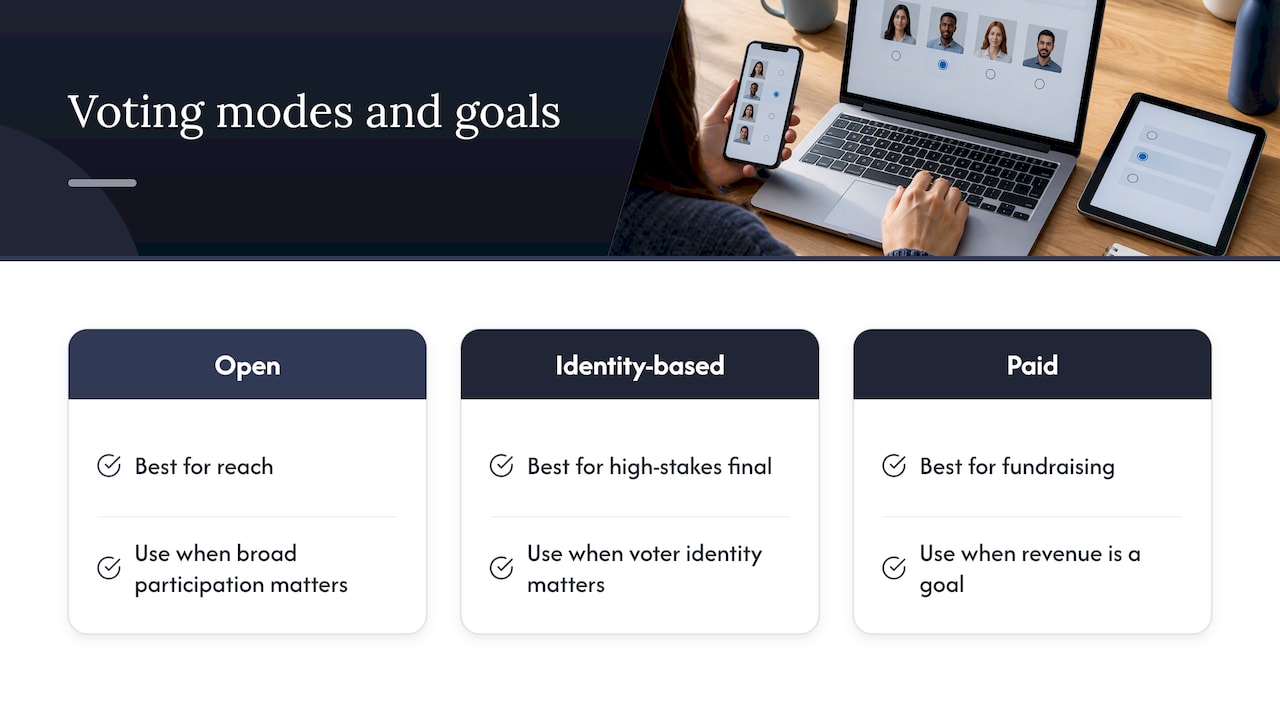
    3. Choose your voting mode deliberately: open voting maximizes reach, identity-based voting protects against manipulation, and paid voting adds a fundraising layer while still requiring clear limits per voter.
    4. Build nominee pages with real photos and short bios, test the entire flow on mobile before launch, and have a fallback plan ready if traffic spikes or a technical issue hits mid-vote.

    Pro Tip: Run your mobile voting flow on a throttled connection before launch. Most drop-off happens in the first ten seconds of a slow-loading ballot.

    Promotion and social sharing: boosting reach and participation

    Turning viewers into voters takes a deliberate push before, during, and after the moment that matters. Each phase has its own job.

    • Before the event: tease nominees, publish short profile reveals, and run a lightweight prediction contest to prime attention ahead of the real vote.
    • During the event: use second-screen prompts, QR codes on screen or in-venue, live result overlays, and push notifications timed to the vote window.
    • After the event: publish shareable result graphics, send personalized recaps to participants, and tie winners to merchandise drops or sponsor shoutouts to extend the moment’s value.

    Event-technology research backs this sequencing: personalization, gamification, and second-screen features such as predictions and recaps measurably increase dwell time and emotional investment, and a large share of fans say they want a single hub for live scores, voting, and exclusive content, pointing to a 67% preference for that kind of unified experience. Treat promotion as a three-act structure, not a single announcement post.

    Security, integrity, and transparency practices for credible results

    A voting campaign only works if people trust the result, and trust has to be built into the mechanics, not added after a controversy.

    • Layer your defenses: behavioral analytics and device fingerprinting catch bulk or automated voting, and passkeys or WebAuthn offer stronger protection than SMS codes alone for high-stakes votes.
    • Publish a post-vote audit summary: total unique voters, total votes cast, and any anomalies flagged and resolved, without exposing individual voter records.
    • Have a signed-off contingency plan before you launch, covering what happens if a technical failure or suspected manipulation requires delaying the announcement.

    Editorial guidance on public voting is direct about this: organizers should treat voting as something that must be robust and fair, with clear published terms and enough time built in to verify results before announcing them, according to audience interactivity guidance. A short, honest audit note does more for credibility than a flawless-looking but unexplained result.

    Measuring success: metrics that matter for organizers and sponsors

    Vanity metrics like total votes cast tell you less than a focused set of participation and conversion measures.

    • Core KPIs: unique voters, votes per user, share rate, dwell time on the voting page, and conversion to tickets or merchandise.
    • Sponsor KPIs: agreement-to-share rate, click-through rate on sponsored placements, and revenue you can directly attribute to the campaign.
    • Benchmarks: an analysis of 3,576 fan token polls found average participation of roughly 4,000 users per poll, with engagement around 50% among eligible token holders; treat these as directional targets rather than guarantees, since turnout varies by poll design and audience size.

    Set your own baseline from your first two or three events, then use these benchmarks to judge whether your format, timing, or promotion needs adjustment.

    How organizers apply these tactics with a purpose-built voting platform

    Putting this playbook into practice is easier with infrastructure built for it. A self-serve setup lets an organizer launch a multi-category vote in hours rather than negotiating a custom build, and a live public dashboard lets fans watch results shift in real time, which is itself a promotion tool.

    Multiple secure voting modes, including open, identity-based, and paid voting, let an organizer match the mechanic to the moment: open for reach, identity-based for a high-stakes final, paid when fundraising is part of the goal. Real-time analytics give organizers and sponsors the same dashboard view, so reporting on share rate or click-through doesn’t require a separate export. Votes have been cast across many events in multiple countries on a voting platform, which reflects how often these mechanics get reused once an organizer has them set up correctly.

    Three voting modes matched to event goals

    Author perspective: pragmatic rules of thumb from an event-voting practitioner

    Author perspective: pragmatic rules of thumb from an event-voting practitioner — overview diagram

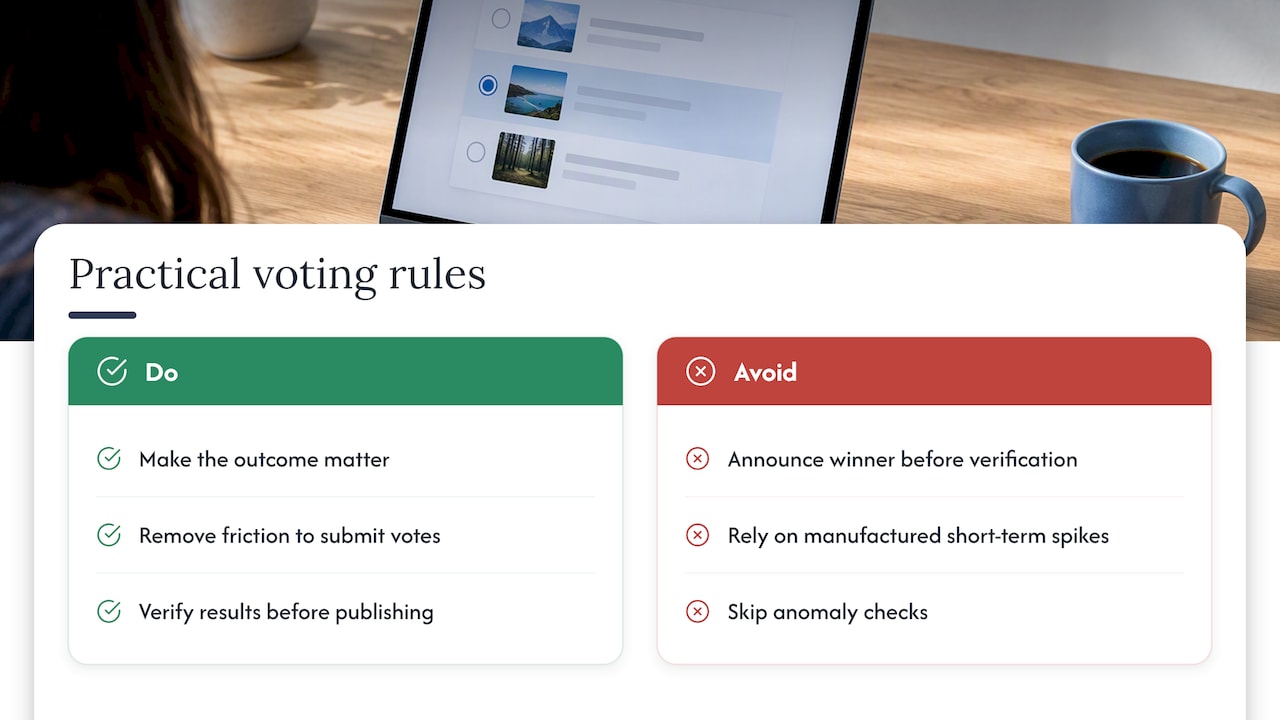
    Three rules hold up across every voting campaign I’ve watched succeed: make the outcome matter, remove every point of friction between intent and submitted vote, and verify your own results before you publish them.

    I’ve seen organizers lose a week of goodwill because they skipped the third rule, announcing a winner before anomalies were checked. The fix is rarely complicated: a short delay for verification costs far less than a retraction. Short-term engagement spikes are easy to manufacture; long-term fan loyalty only comes from campaigns people trust enough to return to.

    — Joshua

    How Izivote helps organizers launch secure, shareable fan-voting campaigns

    We built Izivote around the exact sequence this playbook describes: fast setup, live dashboards, and voting modes that match the moment. Launching an awards campaign takes minutes, not weeks, and your voting page embeds directly into your own site so fans never leave your brand experience.

    Izivote

    • Multiple secure voting modes, including paid voting with handled payments, so you can run a fundraiser alongside your award.
    • Real-time public dashboards that keep fans checking back and give sponsors a live view of their reach.
    • Nominee profile pages with photos built in, so your ballot looks finished on day one.

    If you’re planning a fan-choice or people’s choice award, our peoples choice voting tools are built for exactly that use case, and our pricing page covers the Free plan alongside Pro and Premium options for larger campaigns.

    FAQ

    What is the difference between fan voting and prediction games?

    Fan voting asks people to choose an outcome happening now, such as a winner or finalist, while prediction games ask them to guess a future outcome before it’s decided. Organizers who use both keep fans engaged across the full event cycle instead of only during a single peak moment.

    How do I stop paid or incentivized voting from skewing results?

    Pair any incentive with a clear vote limit per person and a voting mode, such as identity-based or login voting, that ties each vote to a verified participant. Publishing a post-vote audit summary of unique voters and flagged anomalies, as recommended in audience interactivity guidance, also deters and catches manipulation.

    What metrics should I track to prove ROI to sponsors?

    Track unique voters, share rate, click-through rate on sponsored content, and any revenue you can directly attribute to the campaign. Fan token poll research suggests roughly 4,000 participants per poll as a directional benchmark, though your own baseline from prior events is the more reliable target.

    How much does it cost to run a paid voting campaign?

    Izivote offers a Free plan alongside Pro plans at $6 per month or $60 per year, and Premium plans at $14 per month or $140 per year, with a 10% platform fee applied per paid vote processed. Organizers choose the plan based on event size and whether they need paid voting features.

    How many answer options should a voting ballot have?

    Keep the ballot focused. Analysis of fan token polls found that higher numbers of answer options were associated with lower participation, while polls averaged around seven options, so trimming your nominee list to the most meaningful choices tends to improve turnout.

    Sources

    Created with BabyLoveGrowth’s content tools

  • The Blueprint for Better Awards: 6 Features Your Voting Software Needs

    The Blueprint for Better Awards: 6 Features Your Voting Software Needs

    When you launch an online award or competition, you aren’t just collecting data. You are hosting a high-stakes digital event.

    General form builders and survey tools are engineered to quietly collect private feedback. Because they lack the mechanics of a competitive race, using them for public voting usually results in spam, frustrated voters, and an administrative nightmare for your team.

    If you are evaluating software for an upcoming awards show, contest, or election, you need a system built specifically for the dynamics of a race. Here is the blueprint for choosing a dedicated online voting platform that drives engagement and protects your credibility.

    The 6 Must-Haves for a True Voting Platform

    When evaluating a voting solution, grade the software against these six capabilities. If a tool cannot handle these natively, you will end up doing the heavy lifting manually.

    1. Voter Identity Verification: You need a frictionless way to prove every voter is a unique person. Without it, your “winner” is simply the nominee with the best voting bot.
    2. Granular Frequency Caps: Standard tools usually force a binary choice of unlimited voting or one vote per lifetime. A true platform lets you set precise rules, such as “one vote per category” or “one vote per day,” to match your campaign goals.
    3. Visual Nominee Profiles: Displaying a high-quality photo and context for every competitor honors the nominees. A race should feel like a visual showcase instead of a plain-text pop quiz.
    4. Customizable Result Visibility: A live, public tally builds massive excitement and trust. However, not every race should be public. Your software must include a toggle allowing you to display real-time leaderboards to voters or keep results strictly hidden until the official announcement.
    5. Automated Scheduling: The ballot must open and lock automatically at predetermined times. This hardcodes your deadline directly into the voting interface.
    6. Integrated Pay-Per-Vote: If you are monetizing your event, payments must instantly convert into credited votes. Manual spreadsheet reconciliation leads to lost votes and angry fans.

    Matching the Setup to Your Audience

    Identity verification and frequency caps are crucial, but your exact setup depends on who is voting:

    • Media Brands & Radio: You need your audience to return daily. Prioritize: Daily voting caps, seamless native website embeds to retain ad impressions, and live tallies for on-air reads.
    • Creators & Blog Communities: You are dealing with highly motivated fan bases and heavy traffic spikes. Prioritize: Frictionless social sign-ins, daily frequency limits, and visual nominee profiles.
    • Campus & Corporate Elections: Integrity is your only metric. Prioritize: Strict SSO (Single Sign-On) directory integration, rigid one-time voting, and hidden results.

    The Cost of the “Manual Workaround”

    When you force a generic form to act like a voting platform, you pay with your time. You have to manually monitor IP addresses, export data, merge text entries, and build charts in Excel.

    If you charge for votes, the headache worsens. Form builders leave you staring at a list of payment transactions. This forces you to manually match payments to nominees and calculate bulk bundles by hand.

    A dedicated platform automates the administration. For example, if you run paid voting on Izivote, you can set tiered bundles to offer discounted bulk votes, and the system instantly updates the tally the moment a payment clears. Organizers keep 90% of the revenue, which is deposited directly into their own connected processor account. There is no messy reconciliation and no hidden booking fees.

    When Standard Tools Are Actually the Right Choice

    Voting platforms aren’t a universal replacement for forms. Stick with a standard survey builder if:

    • You are gathering internal feedback or conducting market research.
    • Your form requires complex conditional logic or heavy file uploads.
    • You are running a program that relies entirely on a closed panel of expert judges reviewing private scorecards. This requires dedicated awards management software rather than public voting tools.

    Defending the Result

    The true test of your software happens the moment the polls close. In any competitive event, the runner-up’s supporters will demand to know the race was fair.

    If you use a form builder, your only defense is a private spreadsheet and a promise that you cleaned the data properly. A purpose-built voting platform removes human error entirely. When you can point to a system that automatically authenticated users, enforced limits, and managed the clock, the results are bulletproof. This leaves your audience to focus purely on the celebration.

  • Izivote Update: Frictionless Voting, Faster Setup, and Tighter Security

    Izivote Update: Frictionless Voting, Faster Setup, and Tighter Security

    Every extra click between a voter and a ballot costs you participation. When an audience has to jump through hoops to authenticate, conversion drops. That is why our latest platform update directly targets friction. We have rebuilt how people sign in, stay signed in, and cast their votes, while giving organizers sharper tools to manage campaigns behind the scenes.

    Here is how the latest Izivote updates make running your online voting campaigns smoother for everyone involved.

    The End of Login Fatigue

    We know voters hate starting from scratch. Now, when a voter authenticates on one Izivote campaign, they are instantly recognized across any other campaign that asks for the same sign-in method.

    Returning voters no longer have to hunt through their inboxes for a new verification code every single time they visit your page. They stay signed in for longer periods, and the voting page immediately knows exactly where they left off. If a session does naturally expire after an extended break, we have entirely removed cryptic error messages. Instead, the page clearly explains what happened and offers a single, prominent button to get them right back into the action.

    When someone is done and clicks sign out, it is now a complete global sign-out. This includes vote pages that are embedded natively into your own website, ensuring shared devices remain completely secure.

    Faster Checkouts and Clearer Boundaries

    For organizers running paid voting campaigns, speed is revenue. We updated the checkout process so a voter’s email address prefills automatically from their browser. Less typing means fewer abandoned carts and more completed votes for your cause.

    We also tightened our system messaging to keep the voting pool clean. If a user tries to bypass your rules using a temporary or forwarding email address, the platform no longer just fails silently. It gives the user a clear, plain-language explanation of exactly why that address cannot be used.

    Cleaner Setup and Instant Security for Organizers

    Behind the scenes, we streamlined the campaign creation process to give organizers more precise control. Choosing how your audience authenticates is now a dedicated step in itself. We replaced the old “Google” label with a broader “Login” configuration, allowing you to clearly select either standard email or Google sign-in.

    If you are running a restricted election or a private staff award, managing your audience is now much easier. Your controlled voter lists will now accept standard email addresses right alongside traditional voter IDs, making bulk uploads far more intuitive.

    Security enforcement moves much faster now, too. If you ever need to block a specific account, that restriction takes effect almost instantly. Unwanted activity is stopped dead in its tracks rather than lingering for days.

    Finally, to support all of these upgrades, the Izivote Help Centre has been completely rewritten. Every guide matches the current interface exactly, terminology has been updated to match the new Login flow, and all references to retired features are gone.

    All of these updates are live right now. Log in to your dashboard to experience the new setup flow and launch your next campaign.

  • How to Run Award Show Voting: The Complete Guide

    How to Run Award Show Voting: The Complete Guide

    Whether your final ceremony is a glittering in-person gala or a live-streamed event, the first time you run online awards voting, things tend to break in the exact same two places. Nominations devolve into a chaotic flood of DMs and emails, and on announcement night, someone inevitably claims the results were rigged.

    Neither of these is a software problem. Both are solved by structural decisions you make weeks before a single vote is cast. If you want to run a flawless award campaign, here is the proven framework to keep your nominations organized, your voting secure, and your final results bulletproof.

    Start With Your Purpose and Categories

    Before you name a single category, define what winning actually means. A career-boosting industry award requires strict integrity rules, while a local community volunteer award relies more on tone than audited vote counts. Defining your core purpose settles future debates.

    When it comes to building your ballot, resist the urge to add categories just so more people can win. A first-year show works best with six to ten specific, competitive categories. Nine highly competitive races will always generate better engagement than twenty thin ones.

    Mix your category types deliberately to balance credibility with engagement:

    • Peer categories: Judged by industry insiders to build professional credibility.
    • Popular categories: Decided by public online voting to drive mass traffic.
    • Committee awards: Selected by your organizing team to recognize overlooked contributions.

    Tame the Nomination Process

    Open nominations are where most organizers lose control. If you allow it, submissions will arrive across every social channel you own.

    Make one route the only route. Host a single nomination form directly on your vote page and keep it open for a strict 10 to 14 days. Limit entries to one nomination per category per person to prevent spam, and require basic assets upfront, like a high-quality photo and a one-line bio.

    Most importantly, never surprise your nominees. Once you assign an impartial moderator to verify eligibility, ask the nominees for permission before publishing the shortlist. Give voters a clean, focused list of three to six names per category.

    Set Bulletproof Voting Mechanics

    Your authentication method determines whether the public trusts your results. For standard public awards, requiring a social login (like Google) is the sensible default. It sharply cuts down on double-voting without forcing users through a tedious account creation process. If you are running a high-stakes corporate or student award, use a restricted pre-approved email list. (You can even run paid voting for charity fundraisers, though you should always check local competition laws first).

    Whatever rules you choose, such as limiting votes to one per day, publish them clearly on the page before voting starts.

    Crucially, let your software close the vote automatically. Publish your exact opening and closing times with time zones. An automated close is an indisputable fact. A manual close clicked by an organizer at 11:45 PM invites instant suspicion, especially if the leaderboard recently shifted.

    To build even more trust, make the vote look like it belongs to you. Sending your audience to a third-party website kills momentum. With platforms like Izivote, you can embed the vote page directly onto your own site with a single snippet of code, keeping the entire experience natively within your own branding.

    Promote the Vote and Announce the Winners

    Nominees will do the heavy lifting for your promotion if you make it easy. Give each nominee a direct link to their category and a custom graphic. If they have to explain how to navigate a complex website, they will post once and give up.

    Plan your promotional pushes around natural attention spikes: launch day, a midpoint update highlighting neck-and-neck races, and a massive 48-hour urgency push right before closing, which is historically the highest traffic day for online voting.

    When it is time to announce the winners, use hard data. Announcing a winner with zero data invites skepticism, but stating that a winner took 41% of 2,300 votes ends the argument before it begins. Publish the full percentage breakdown so runners-up can also proudly share their strong performance.

    The Award Show Action Plan

    Running a tight ship means following a clear checklist. Because platforms like Izivote make the technical setup instant, you do not need to drag your planning out over months. You can launch quickly and put your energy entirely into promotion and community building.

    Here is the step-by-step breakdown to guide your event:

    • Phase 1: Strategy and Setup. Define the show’s purpose, draft the categories, set your exact dates, and document all voting rules. Build a page for voting and publish the rules.
    • Phase 2: The Nomination Drive. Officially open public nominations. Let them run while you chase down entries for quiet categories and prepare your social media graphics.
    • Phase 3: Shortlisting. Let the system close nominations automatically. Verify eligibility, gather headshots, ask nominees for permission, and finalize your shortlist.
    • Phase 4: Voting Begins. Open the polls! Execute your launch day push, followed later by a midpoint update on close races to keep momentum high.
    • Phase 5: The Final Push and Reveal. Execute the final 48-hour push. Let voting close automatically, then announce your winners using hard percentages.

    The true quality of an award show is decided in the planning phase. Take an hour this week to lock down your categories, rules, and action plan. By the time the votes start rolling in, you will be free to focus on promoting the event and preparing for an incredible physical gala or live stream.

  • Stop Hacking Survey Tools: How to Run a Flawless Award Show Without the Panic

    Stop Hacking Survey Tools: How to Run a Flawless Award Show Without the Panic

    If you are behind a local award show, university gala, or talent competition, you know the physical room demands all of your attention. Yet, too many organizers spend their live events hiding in the back room, refreshing generic survey forms and manually tallying votes.

    When you hack together basic polling tools for a live event, you are signing up for unnecessary panic. Those tools require constant supervision, forcing you to act as a human calculator rather than an event producer. It is time to automate the voting process so you can actually run your show. By switching to a “set and forget” platform built specifically for live awards, you can put the tech on autopilot and step back out into the room.

    The Danger of the Manual Shutoff

    The most stressful moment of an award campaign is the exact minute voting is supposed to close. If you are using a repurposed corporate form, someone has to physically sit at a laptop, watch the clock, and manually pull the plug to prevent late votes from altering the results.

    A purpose-built event platform eliminates this entirely through automated scheduling. You simply set your closing time during your initial setup. When the clock strikes, the system automatically shuts off voting. Nobody has to be awake to monitor the poll, no late entries slip through, and the integrity of the deadline is perfectly maintained without a single click from your team.

    Real-Time Math, Zero Tallying

    Generic forms dump raw data into rows and columns, leaving you to calculate the winners while the audience waits. This creates a massive bottleneck right before the climax of your event.

    By upgrading to a dedicated award platform, the heavy lifting happens in the background. Live leaderboards and progress bars update instantly as votes arrive. When the poll auto-closes, the final results are immediately locked in and formatted for you. The system does the math in real time, completely eliminating the frantic back-room counting and ensuring you always know exactly who the winner is the second voting ends.

    Built-In Duplicate Control

    Another massive time-sink for organizers is auditing the vote to ensure fairness. When you use basic tools, you often have to manually comb through the data to spot fake accounts, bot activity, or duplicate entries.

    When you use a platform designed for audience competitions, duplicate control is enforced by design. Built-in safeguards—like one-click Google sign-in or verified invite lists—automatically prevent ballot stuffing before it happens. The system acts as the bouncer, ensuring every vote is legitimate so you do not have to play detective on event night.

    You spend months planning the perfect event. On the night of the show, your focus belongs on the stage, the guests, and the experience, not on managing the vote. By upgrading to a seamless, automated system like Izivote, you can step out of the back room, trust the technology to run itself, and actually enjoy the incredible event you built.

  • Secure & Monetize Your Competitions and Fan Awards with Izivote’s Redesigned Paid Voting

    Secure & Monetize Your Competitions and Fan Awards with Izivote’s Redesigned Paid Voting

    Organizing a fan award, talent competition, or public poll is a true labor of love. It takes immense time, energy, and resources to bring communities together and celebrate the talent that matters most.

    At Izivote, we provide the online voting platform you need to run secure, beautiful, and highly engaging campaigns so you can focus on what you do best: hosting a spectacular event. We also understand that sustaining these competitions requires capital. That is why we thoughtfully redesigned our paid voting system to help you protect the integrity of your poll while seamlessly funding your future events.

    Here is how our upgraded platform helps organizers run fair competitions and monetize online polls effortlessly:

    Protect Poll Integrity: A Powerful Shield Against Spam

    For many event organizers, the primary benefit of paid voting isn’t just fundraising. It is about guaranteeing a fair, transparent competition.

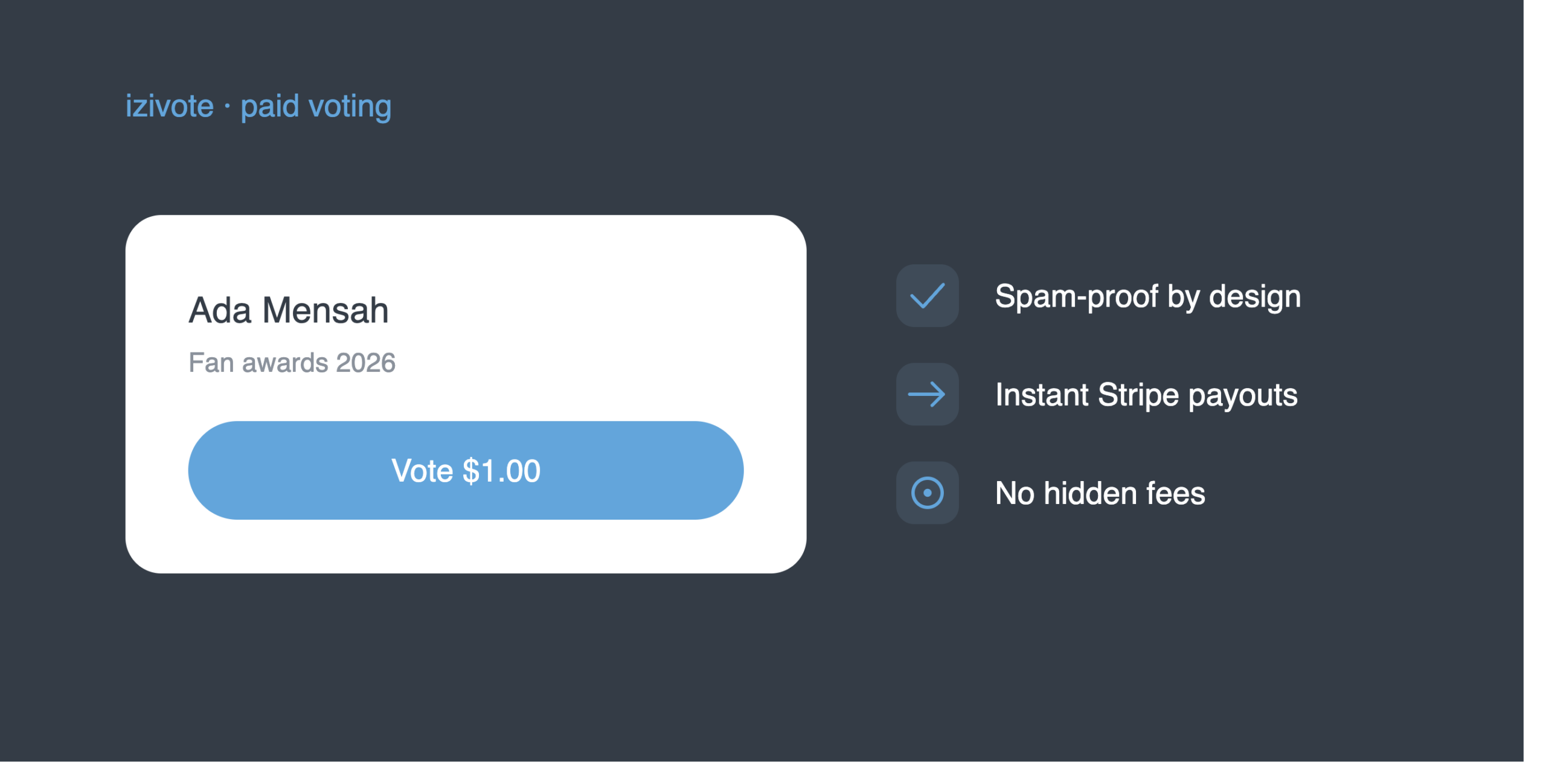
    Paid voting is one of the most effective anti-spam measures available for public polls. While bad actors can easily generate fake email addresses, faking a credit card transaction is incredibly difficult.

    By applying a micro-fee per vote, you introduce an ultimate security measure that ensures a level playing field for all participants. As a bonus, the revenue generated helps cover your event costs.

    Frictionless Operations: Direct Payouts with Stripe Integration

    You have enough on your plate without having to chase down your funds. In the past, we required manual payout requests and approval wait times. We have removed the middleman entirely.

    By connecting your Stripe account directly to Izivote, every single vote payment flows straight to you:

    • No manual requests: Payments move automatically.
    • No wait times: Stripe deposits earnings directly into your bank on your schedule.
    • Total control: Track transactions, payouts, and transparent fee breakdowns securely in your organizer dashboard.

    Note: Organizers in select regions without Stripe support may still access paid voting via manual payouts. Please review our list of supported regions.

    A Global Voting Platform: Accept Payments Anywhere

    Your audience shouldn’t be limited by geography. With Izivote, you can set a specific currency for each individual vote page directly from your dashboard.

    Supporters from anywhere in the world can vote for their favorites using their local credit card, and the payment is processed at the exact amount and currency you set. Furthermore, if a payment is ever refunded or disputed, our automated system instantly removes the tied votes to keep your leaderboard accurate without requiring any manual cleanup.

    A Seamless, Trustworthy Experience for Voters

    A successful campaign relies on happy supporters, so we optimized our checkout for a fast and confident voting experience. Voters can quickly back their favorites using Apple Pay, Google Pay, or localized credit cards. Because there are zero hidden fees, voters never experience surprise charges at checkout, keeping drop-off rates incredibly low.

    Once a payment clears, votes are registered instantly and the leaderboard updates in real time, giving your community immediate confirmation of their impact.

    Keep More Revenue: Transparent Pricing & Low Fees

    We fundamentally believe that the financial support generated by your community belongs to you. To maximize your event’s take-home revenue, we simplified our pricing structure to just 10% of each vote payment.

    Because you process payments through your own connected Stripe account, you simply pay Stripe’s standard processing fees directly. There are no hidden platform transaction costs. Your voters will always pay exactly the price you set, with zero surprise checkout fees to deter them from participating.

    Ready to Launch Your Next Fan Award or Public Poll?

    Funding and sustaining your online competition has never been easier or more secure.

    1. Connect to stripe: Create your free Izivote account and follow the steps on the payments page in your dashboard.
    2. Set your price: Build a vote page and set your custom price per vote.
    3. Launch your campaign: Publish voting, share it with your audience, and watch the support roll in.

    Visit the complete Paid Voting setup guide in our Help Center to launch your secure campaign today!

  • Introducing Discover: Every Live Vote on Izivote, One Click Away

    Introducing Discover: Every Live Vote on Izivote, One Click Away

    The best fan votes have always had one small catch: you could only find them if someone handed you the link. A creator dropped it in a story, an organizer pinned it to a group chat, a hashtag did the rounds, and if you missed it, you missed it. Great campaigns were happening all over Izivote, but there was no front door to walk through and see them.

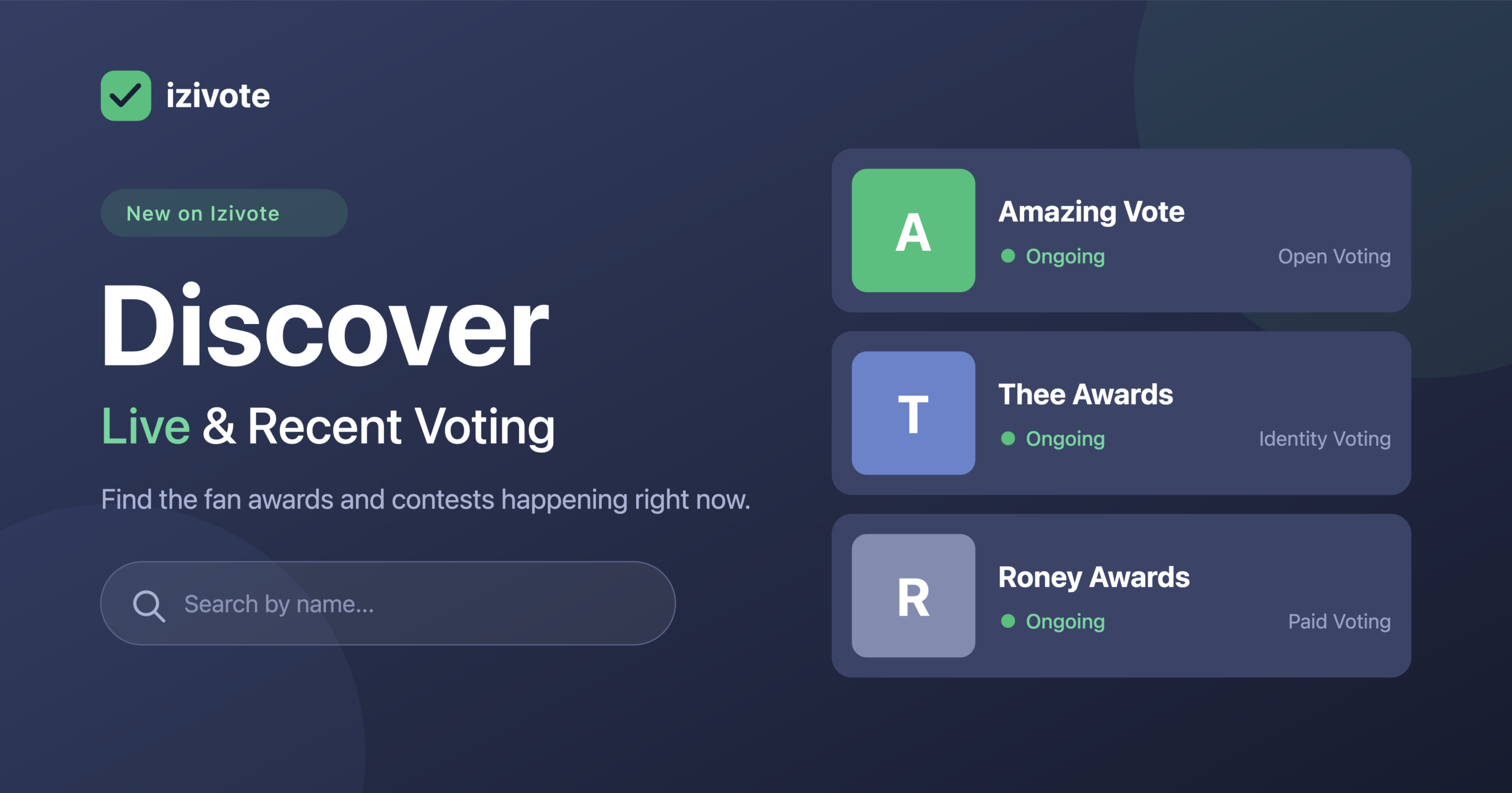
    Today that changes. Say hello to Discover, a single page where you can browse every fan award, contest, and poll happening on Izivote right now, and jump straight into the ones you care about.

    What is Discover?

    Discover is your live map of everything worth voting on. Head to the new Discover tab in the top menu and you’ll land on a page showing fan awards and contests as they happen: the ongoing races you can still swing, plus recent ones that have just wrapped.

    Each campaign gets its own card with everything you need to decide in a glance. You’ll see the name, a status indicator that tells you whether voting is Ongoing or Closed, and the vote type, so you know exactly how to take part before you even click in. Looking for something specific? The search bar up top finds any campaign by name in a second.

    No accounts to dig through, no links to hunt for. Just open Discover and see what’s live.

    For fans and voters

    If you love backing your favourite, Discover is built for you.

    Instead of waiting for a link to find you, you can go looking. Browse what’s open right now, spot a contest that catches your eye, and cast your vote in a couple of taps, with the same fast, mobile-first experience Izivote is known for. And because recent votes stick around for a moment after they close, you can circle back to see how a race you followed ended up.

    It turns Izivote from a place you visit for one specific vote into a place you visit to find your next one.

    For organizers

    Here’s the part that matters if you’re the one running the show: Discover is free exposure.

    Until now, your campaign rose or fell on the reach of your own link. Now, every eligible vote you run can also be found by people browsing Discover, an audience that’s already on Izivote and already in the mood to vote. That’s more eyes, more participation, and more of the momentum that makes a fan vote feel alive. If you’re running paid voting, more discovery can mean more support flowing to your event, too.

    You don’t have to do anything differently. Keep sharing your link and embedding your vote on your own site like always. Discover simply adds another way for the right people to find you.

    Where to find it

    Discover is live now. You’ll see it in the main navigation, or you can go straight to izivote.com/discover. Give it a look, find a contest that speaks to you, and join in.

    And if browsing the action gives you an itch to run your own? That’s rather the point. Create your first vote free; it takes under five minutes, no credit card required, and before long, your campaign could be the one everyone’s discovering.

    Happy voting. Because on Izivote, voting is izi.

  • Get More Visibility with the Enhanced Voter Identity Experience

    Take control of exactly who votes — and see how they engage.

    Identity-based voting has always been one of Izivote’s most powerful features. Whether you’re running an awards ceremony, a corporate election, an academic competition, or an exclusive members’ poll, it lets you decide precisely which individuals are eligible to cast a ballot. No open links. No duplicate votes. No uninvited participants.

    Today we’re releasing a significant upgrade to how you manage those voters — making the experience faster, clearer, and more insightful than ever before.

    What is identity-based voting?

    When you create a vote page on Izivote, you choose the voting mode that suits your event. Identity-based voting means you supply a list of unique identifiers — one per eligible voter. Each identifier is shared privately with the individual it belongs to, and only someone who holds a valid identifier can cast a vote on your page.

    This is ideal for award shows and galas where only registered attendees should vote, staff recognition programmes restricted to your organization, member associations where voting rights belong to dues-paying members, and academic institutions limiting participation to enrolled students or faculty.

    What’s new

    The updated Voter Identities panel brings an easier way to search and filter your voter list instantly as you type, add voters one at a time or by pasting an entire list in one action, and remove individuals or groups in bulk when your attendee list changes.

    More meaningfully, you now have a live view of engagement. At a glance, you can see who has voted, who hasn’t, and — for multi-category ballots — how far through the ballot each voter has progressed. If someone has only voted in three of six categories, you’ll know, and you can follow up before voting closes.

    One thing worth noting for your voters: participation data only tells you that someone has voted and how many categories they engaged with — never who they voted for. Their choices remain entirely private. This is by design, and it’s fundamental to how Izivote maintains the integrity of every vote.

    Participation insights are available with any subscription plan. Free plan users retain full access to voter list management — adding, removing, and organizing identities.

    How to use it

    Open your vote page from the dashboard and navigate to Voter Identities in the side menu. Add identities one at a time or paste your full attendee list. Share each identifier privately with the corresponding person — by email, printed badge, QR code, or however suits your event. Once voting opens, return to this panel at any time to monitor participation.

    Izivote handles the rest.

    What this means for event organizers

    Running a fair, verifiable vote has never required a technical background on Izivote — and this update reinforces that. The new voter identities panel gives you the oversight of an enterprise polling tool without the complexity. Whether your event has 20 voters or 2,000, you have full visibility and control in one place.

    If you’re on a Free plan and want access to voter participation insights, upgrade your account to one of our plans.