Live voting reliably spikes real-time engagement when the outcome matters to fans, and prediction games keep that energy alive between those peaks. Combine both and you get a continuous participation loop instead of a one-time spike. Track unique voters, votes per user, share rate, and sponsor conversions as your core measures of success, and build your campaign calendar around them from day one.
TL;DR:
- Keep ballots focused: fan token polls averaged about seven options, and more choices were associated with lower participation; set one clear result announcement time.
- Use predictions before major moments and between episodes, then switch to deadline driven voting when outcomes matter; halftime contests suit second half guesses.
- An analysis of 3,576 fan token polls found roughly 4,000 participants per poll and 50% engagement among eligible holders; treat both as directional benchmarks.
- Before announcing results, verify anomalies and publish totals for unique voters and votes cast; disclose resolved issues without exposing personal records.
- Track sponsor click rate and attributable revenue, while setting a baseline across your first two or three events before judging turnout.
Table of Contents
- Live voting versus prediction games: why you need both
- Designing a voting campaign: timing, formats, and incentives
- Promotion and social sharing: boosting reach and participation
- Security, integrity, and transparency practices for credible results
- Measuring success: metrics that matter for organizers and sponsors
- How organizers apply these tactics with a purpose-built voting platform
- Author perspective: pragmatic rules of thumb from an event-voting practitioner
- How Izivote helps organizers launch secure, shareable fan-voting campaigns
- FAQ
- Sources
Live voting versus prediction games: why you need both
Fan voting asks people to choose an outcome they care about right now: a winner, a finalist, a most valuable player. Prediction games ask people to guess what will happen next, which activates a different motivation: being right, not just being heard. Both matter, and the strongest fan programs layer them across the event cycle instead of picking one.
This layered engagement model uses prediction contests to build anticipation before a peak moment, then switches to live voting at the moment the outcome actually matters. It then returns to predictions or recaps to extend the conversation afterward. A few examples show the pattern:
- An elimination round calls for live voting with a hard deadline and a public reveal.
- A halftime or intermission slot works well for a quick prediction contest about the second half.
- Between episodes of a series, a “who will win” prediction keeps fans checking back without needing a live event to anchor it.
Designing a voting campaign: timing, formats, and incentives
A voting campaign succeeds or fails on three decisions made before launch: what the outcome means, how simple the ballot is, and how it protects its own integrity.
- Pick an outcome fans actually care about, and commit to a single, clearly announced reveal time; ambiguity about when results drop kills urgency.
- Keep the ballot focused. Research on fan token polls found that polls averaged about seven answer options, and that a higher number of choices was associated with lower participation, while higher token or vote limits were associated with higher participation. Fewer, clearer choices tend to perform better.
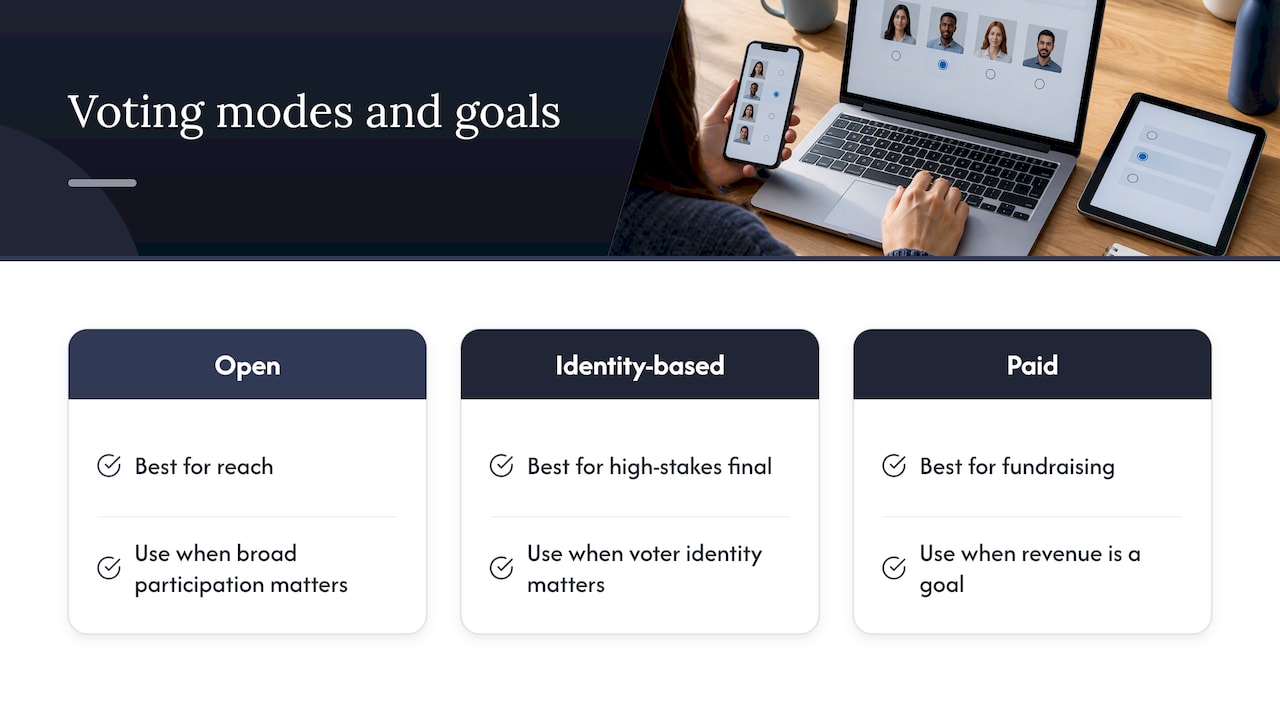
- Choose your voting mode deliberately: open voting maximizes reach, identity-based voting protects against manipulation, and paid voting adds a fundraising layer while still requiring clear limits per voter.
- Build nominee pages with real photos and short bios, test the entire flow on mobile before launch, and have a fallback plan ready if traffic spikes or a technical issue hits mid-vote.
Pro Tip: Run your mobile voting flow on a throttled connection before launch. Most drop-off happens in the first ten seconds of a slow-loading ballot.
Promotion and social sharing: boosting reach and participation
Turning viewers into voters takes a deliberate push before, during, and after the moment that matters. Each phase has its own job.
- Before the event: tease nominees, publish short profile reveals, and run a lightweight prediction contest to prime attention ahead of the real vote.
- During the event: use second-screen prompts, QR codes on screen or in-venue, live result overlays, and push notifications timed to the vote window.
- After the event: publish shareable result graphics, send personalized recaps to participants, and tie winners to merchandise drops or sponsor shoutouts to extend the moment’s value.
Event-technology research backs this sequencing: personalization, gamification, and second-screen features such as predictions and recaps measurably increase dwell time and emotional investment, and a large share of fans say they want a single hub for live scores, voting, and exclusive content, pointing to a 67% preference for that kind of unified experience. Treat promotion as a three-act structure, not a single announcement post.
Security, integrity, and transparency practices for credible results
A voting campaign only works if people trust the result, and trust has to be built into the mechanics, not added after a controversy.
- Layer your defenses: behavioral analytics and device fingerprinting catch bulk or automated voting, and passkeys or WebAuthn offer stronger protection than SMS codes alone for high-stakes votes.
- Publish a post-vote audit summary: total unique voters, total votes cast, and any anomalies flagged and resolved, without exposing individual voter records.
- Have a signed-off contingency plan before you launch, covering what happens if a technical failure or suspected manipulation requires delaying the announcement.
Editorial guidance on public voting is direct about this: organizers should treat voting as something that must be robust and fair, with clear published terms and enough time built in to verify results before announcing them, according to audience interactivity guidance. A short, honest audit note does more for credibility than a flawless-looking but unexplained result.
Measuring success: metrics that matter for organizers and sponsors
Vanity metrics like total votes cast tell you less than a focused set of participation and conversion measures.
- Core KPIs: unique voters, votes per user, share rate, dwell time on the voting page, and conversion to tickets or merchandise.
- Sponsor KPIs: agreement-to-share rate, click-through rate on sponsored placements, and revenue you can directly attribute to the campaign.
- Benchmarks: an analysis of 3,576 fan token polls found average participation of roughly 4,000 users per poll, with engagement around 50% among eligible token holders; treat these as directional targets rather than guarantees, since turnout varies by poll design and audience size.
Set your own baseline from your first two or three events, then use these benchmarks to judge whether your format, timing, or promotion needs adjustment.
How organizers apply these tactics with a purpose-built voting platform
Putting this playbook into practice is easier with infrastructure built for it. A self-serve setup lets an organizer launch a multi-category vote in hours rather than negotiating a custom build, and a live public dashboard lets fans watch results shift in real time, which is itself a promotion tool.
Multiple secure voting modes, including open, identity-based, and paid voting, let an organizer match the mechanic to the moment: open for reach, identity-based for a high-stakes final, paid when fundraising is part of the goal. Real-time analytics give organizers and sponsors the same dashboard view, so reporting on share rate or click-through doesn’t require a separate export. Votes have been cast across many events in multiple countries on a voting platform, which reflects how often these mechanics get reused once an organizer has them set up correctly.
Author perspective: pragmatic rules of thumb from an event-voting practitioner
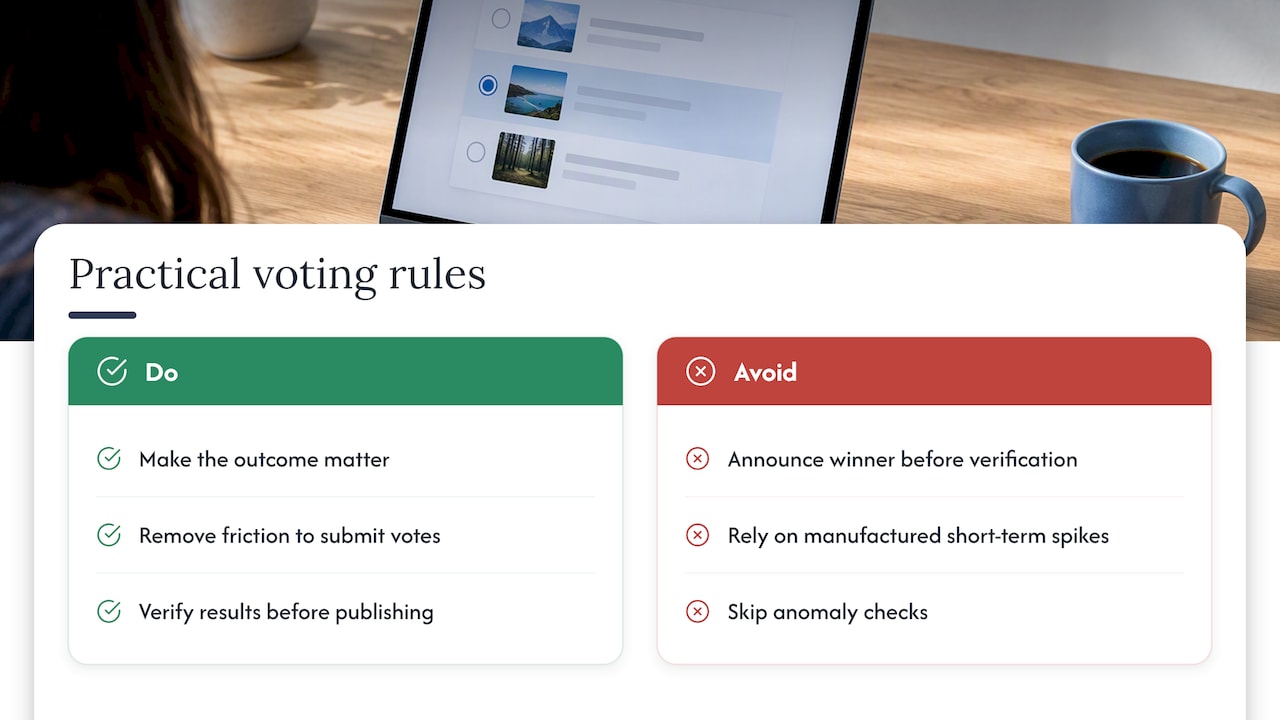
Three rules hold up across every voting campaign I’ve watched succeed: make the outcome matter, remove every point of friction between intent and submitted vote, and verify your own results before you publish them.
I’ve seen organizers lose a week of goodwill because they skipped the third rule, announcing a winner before anomalies were checked. The fix is rarely complicated: a short delay for verification costs far less than a retraction. Short-term engagement spikes are easy to manufacture; long-term fan loyalty only comes from campaigns people trust enough to return to.
— Joshua
How Izivote helps organizers launch secure, shareable fan-voting campaigns
We built Izivote around the exact sequence this playbook describes: fast setup, live dashboards, and voting modes that match the moment. Launching an awards campaign takes minutes, not weeks, and your voting page embeds directly into your own site so fans never leave your brand experience.
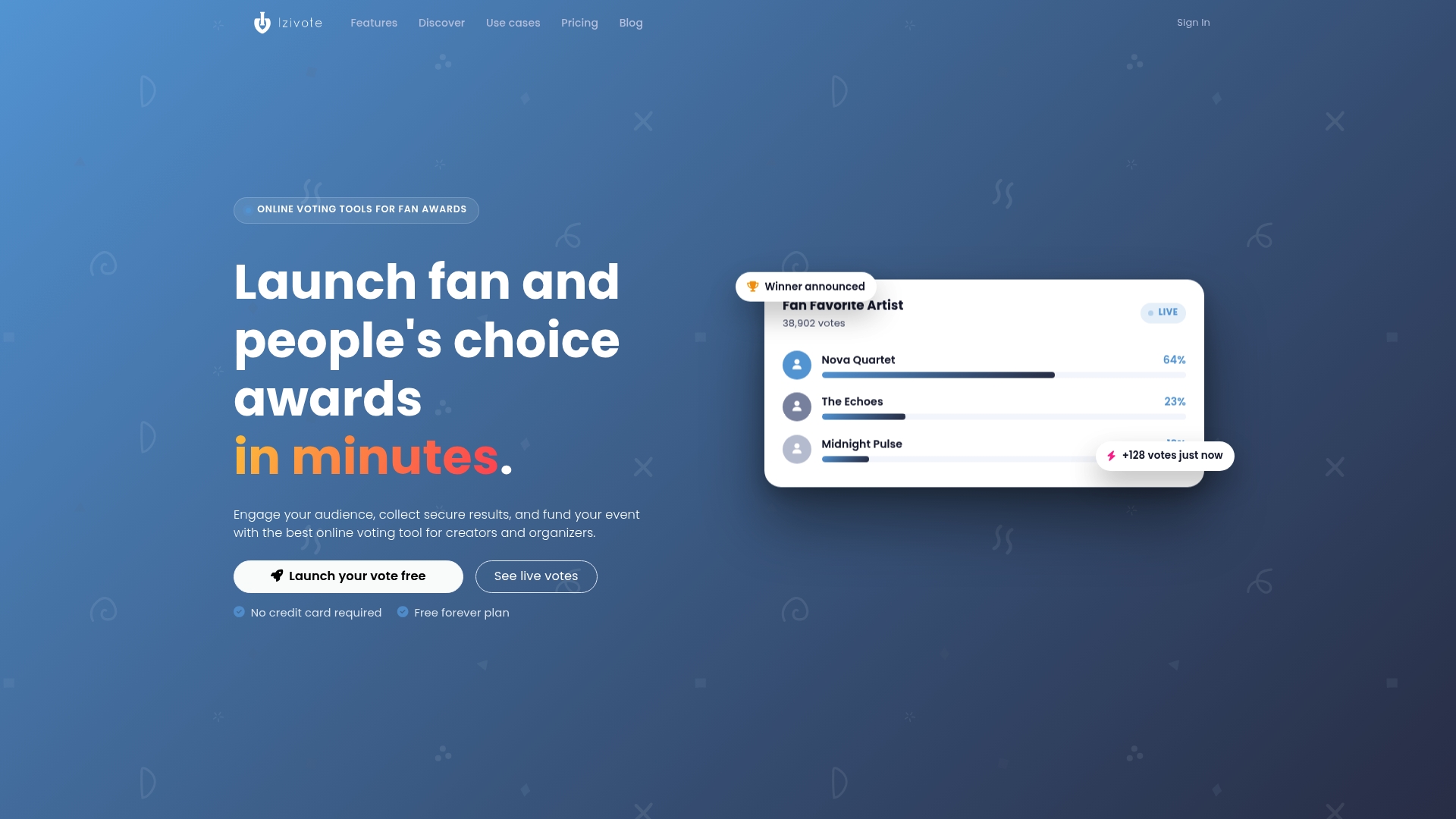
- Multiple secure voting modes, including paid voting with handled payments, so you can run a fundraiser alongside your award.
- Real-time public dashboards that keep fans checking back and give sponsors a live view of their reach.
- Nominee profile pages with photos built in, so your ballot looks finished on day one.
If you’re planning a fan-choice or people’s choice award, our peoples choice voting tools are built for exactly that use case, and our pricing page covers the Free plan alongside Pro and Premium options for larger campaigns.
FAQ
What is the difference between fan voting and prediction games?
Fan voting asks people to choose an outcome happening now, such as a winner or finalist, while prediction games ask them to guess a future outcome before it’s decided. Organizers who use both keep fans engaged across the full event cycle instead of only during a single peak moment.
How do I stop paid or incentivized voting from skewing results?
Pair any incentive with a clear vote limit per person and a voting mode, such as identity-based or login voting, that ties each vote to a verified participant. Publishing a post-vote audit summary of unique voters and flagged anomalies, as recommended in audience interactivity guidance, also deters and catches manipulation.
What metrics should I track to prove ROI to sponsors?
Track unique voters, share rate, click-through rate on sponsored content, and any revenue you can directly attribute to the campaign. Fan token poll research suggests roughly 4,000 participants per poll as a directional benchmark, though your own baseline from prior events is the more reliable target.
How much does it cost to run a paid voting campaign?
Izivote offers a Free plan alongside Pro plans at $6 per month or $60 per year, and Premium plans at $14 per month or $140 per year, with a 10% platform fee applied per paid vote processed. Organizers choose the plan based on event size and whether they need paid voting features.
How many answer options should a voting ballot have?
Keep the ballot focused. Analysis of fan token polls found that higher numbers of answer options were associated with lower participation, while polls averaged around seven options, so trimming your nominee list to the most meaningful choices tends to improve turnout.
Sources
- Voting participation and engagement in blockchain-based fan tokens (arXiv / Electronic Markets)
- Voting participation and engagement in blockchain-based fan tokens
- Guidance: Audience Interactivity – Part C: Detailed Guidance on Voting
- Tech in sports report (Sogeti)
Leave a Reply