
Yes, online voting is subject to GDPR, and organizers must treat voter lists and vote processing as controller responsibilities. That means choosing a lawful basis, minimizing the data you collect, signing an Article 28-compliant DPA with any platform you use, running a data protection impact assessment when the vote carries real risk, and planning for secure deletion once results are final. Document these decisions and collect your vendor’s DPA before you launch.
TL;DR:
- Choose the lawful basis before registration: member elections may rely on legitimate interest, statutory votes on legal obligation, and fan awards on consent.
- Large scale processing, systematic monitoring, or biometric data requires a DPIA, which the organizer must own rather than delegate to the platform.
- Keep identity records separate from ballots, use pseudonymous identifiers, and restrict access because an actor with access to both stores could reconnect voters with ballots.
- Before launch, obtain an Article 28 DPA that names subprocessors, breach notification deadlines, audit rights, security measures, and transfer safeguards for every processing location.
- Delete identifiable voter records after the dispute window closes, log the deletion, and retain anonymized result aggregates only as long as reporting requires.
Table of Contents
- What GDPR-compliant voting means across the election lifecycle
- Core GDPR principles applied to elections
- Personal data in online voting: what counts and what gets sensitive
- Lawful basis, consent, and what voters must be told
- Data minimization, pseudonymization and protecting ballot secrecy
- Working with vendors: processors, DPAs, and your checklist
- Storage, retention schedules and secure deletion after the election
- Cross-border transfers and hosting: what to check before you sign up
- Technical and organizational measures to require and verify
- When to run a DPIA and how to manage ongoing risk
- Applying GDPR practice to fan awards and public voting
- How Izivote supports GDPR-aware award voting
- FAQ
- Sources
What GDPR-compliant voting means across the election lifecycle
GDPR-compliant voting means every stage of your election, registration, authentication, vote casting, tally and audit, and deletion, has a defined lawful basis and a defined owner for the personal data involved. If you organize the vote, you are almost always the data controller even when a platform handles the technical delivery. The platform is your processor, and you keep primary accountability for how voter data gets used.
An anonymous or unlinkable ballot design simplifies this considerably, since a ballot that cannot be traced back to a voter removes most of the risk from the tally stage itself.
- Registration and authentication create identifiable records that need protection.
- Vote casting should be designed so the ballot itself carries no personal identifiers.
- Tally, audit, and deletion stages each need their own retention and access rules.
Core GDPR principles applied to elections
Five principles do most of the work in an election context: lawfulness, purpose limitation, data minimization, transparency, and security. Purpose limitation means a voter census collected for one award or ballot never gets reused for marketing or a different vote without a fresh lawful basis. Minimization means you collect only what authentication actually requires, not every field a sign-up form could ask for.
Privacy by design and by default, under Article 25, pushes you to build these choices into the system before launch rather than bolting them on afterward. In practice that might mean a voting form that defaults to collecting an email address only, with no optional fields pre-checked. The Council of Europe’s interpretative guidance applies this same logic directly to digital election technology, recommending pseudonymization or anonymization wherever feasible.
- Lawfulness: pick a basis before you collect anything, not after.
- Purpose limitation: define one use for the data and stick to it.
- Transparency: tell voters what happens to their data in plain language.
Pro Tip: When secrecy and transparency pull in different directions, write down the trade-off and your reasoning in your governance records rather than resolving it silently.
Personal data in online voting: what counts and what gets sensitive
Two categories of data live inside any online vote, and they need different handling. The voter census, name, email, member ID, is ordinary personal data. The ballot itself, who voted for what, should be designed to carry no personal identifier at all once it is cast.
Some voting designs introduce special-category data without organizers noticing, particularly when biometric authentication or anything revealing political opinion enters the picture. That data needs explicit consent or another specific legal ground, not the general basis you use for the rest of the election.
- Keep the voter census in a separate store from ballot records.
- Treat biometric or political-opinion data as special-category from the start.
- Avoid storing any identifier that lets a ballot be linked back to a voter.
Lawful basis, consent, and what voters must be told
Most elections run on legitimate interest, legal obligation, or consent, and the right choice depends on who you are and why the vote exists. A nonprofit running a member election often has a legitimate interest basis available; a public body running a statutory vote may be acting under a legal obligation; a brand running a fan award typically relies on consent collected at sign-up.
When a voting method proposes biometric identification or anything touching political opinion, the bar rises to explicit consent or a specific legal basis, and Council of Europe guidelines recommend supervisory consultation before deployment given the error-rate and discrimination risks involved.
Whatever basis you pick, your voter notice needs to cover a short list of items before anyone casts a ballot:
- Who the controller is and how to contact them.
- Why the data is being collected and for how long it will be kept.
- Which processors are involved and what rights voters have.
Data minimization, pseudonymization and protecting ballot secrecy
Pseudonymized voter IDs, encryption, and strict separation between the identity database and the ballot database are the core technical moves that reduce risk here. A pseudonymized ID lets your system confirm someone voted once without the ballot record itself revealing who they are.
Pseudonymization reduces risk but is not the same as full anonymization since a determined actor with access to both databases could, in theory, re-link the two. That is exactly why access to the identity store needs to be restricted separately from access to ballot data, and why logging systems should avoid capturing anything that could reconnect the two after the fact.
- Use pseudonymized identifiers rather than storing names alongside votes.
- Encrypt both databases and manage keys separately from the voting application.
- Limit who can query the identity store, and audit those queries.
For teams that want a deeper technical reference on de-identification methods, guidance on anonymizing personal data walks through the practical mechanics of pseudonymization in a compliance context.
Working with vendors: processors, DPAs, and your checklist
You remain the controller no matter how capable your voting platform is, which means you need an Article 28-compliant DPA in place before any voter data touches that platform. EDPB guidance on controller and processor roles recommends that these agreements spell out concrete security measures and audit rights rather than vague commitments.
- Confirm the DPA names processor obligations, sub-processor rules, and breach notification timelines.
- Ask for audit rights or independent evidence rather than taking a compliance claim at face value.
- Check whether the vendor can structurally separate identity data from ballot data.
- Review hosting location, certifications, and any history of prior incidents.
Storage, retention schedules and secure deletion after the election
Voter census data, audit trails, and anonymized results each warrant a different retention period, and conflating them is one of the more common mistakes organizers make. A census record tied to an individual should be deleted shortly after the dispute window closes, while an anonymized results aggregate can often be kept far longer for reporting purposes.
- Set a fixed deletion date for identifiable voter records tied to the election close.
- Automate deletion where your platform supports it, and log the deletion event itself.
- Record your retention periods in both your privacy notice and your DPIA.
A post-election destruction protocol that runs automatically and leaves an auditable log is worth more than a manual promise to “delete it later.”
Cross-border transfers and hosting: what to check before you sign up
Hosting inside the EU or EEA avoids the transfer question entirely, which is why many organizers prefer it by default. When a vendor processes data outside the EU or EEA, you need a valid transfer mechanism in place, standard contractual clauses or an adequacy decision, documented in the DPA itself.
- Ask where sub-processors are located, not just where the primary vendor is based.
- Check that the DPA’s transfer safeguards cover every location in the processing chain.
- Favor strong encryption and, where feasible, customer-managed keys.
Technical and organizational measures to require and verify
Encryption in transit and at rest, role-based access control, and immutable audit logs form the technical backbone of a secure voting system. EDPB correspondence on election-related processing notes that controllers remain accountable for configuring these safeguards correctly rather than assuming a platform handles it by default.
On the organizational side, least-privilege access, staff training, a documented incident response plan, and formal change controls matter as much as the technology itself. A system with strong encryption and sloppy access management is still exposed.
- Require TLS everywhere and encryption at rest for both identity and ballot stores.
- Ask for penetration test reports or independent security evidence, not just a claim of compliance.
- Confirm an incident response plan exists and includes defined breach notification timelines.
Pro Tip: Request a vendor’s most recent penetration test summary before you sign anything, not after an incident forces the question.
When to run a DPIA and how to manage ongoing risk
A DPIA becomes necessary when your vote involves large-scale processing, systematic monitoring, or any special-category data such as biometric authentication. EDPB guidance is clear that controllers cannot delegate this responsibility to a processor, even a highly capable one.
- Define the scope of the assessment: which systems, which data, which stage of the election.
- Assess necessity and proportionality against the purpose of the vote.
- Identify risks, document mitigations, and record the residual risk that remains.
- Consult your supervisory authority if the residual risk stays high after mitigation.
Risk management does not end when the DPIA is filed. Testing, audits, and a post-election review should feed back into an updated DPIA before the next cycle starts, especially if the voting method or vendor changes.
Applying GDPR practice to fan awards and public voting
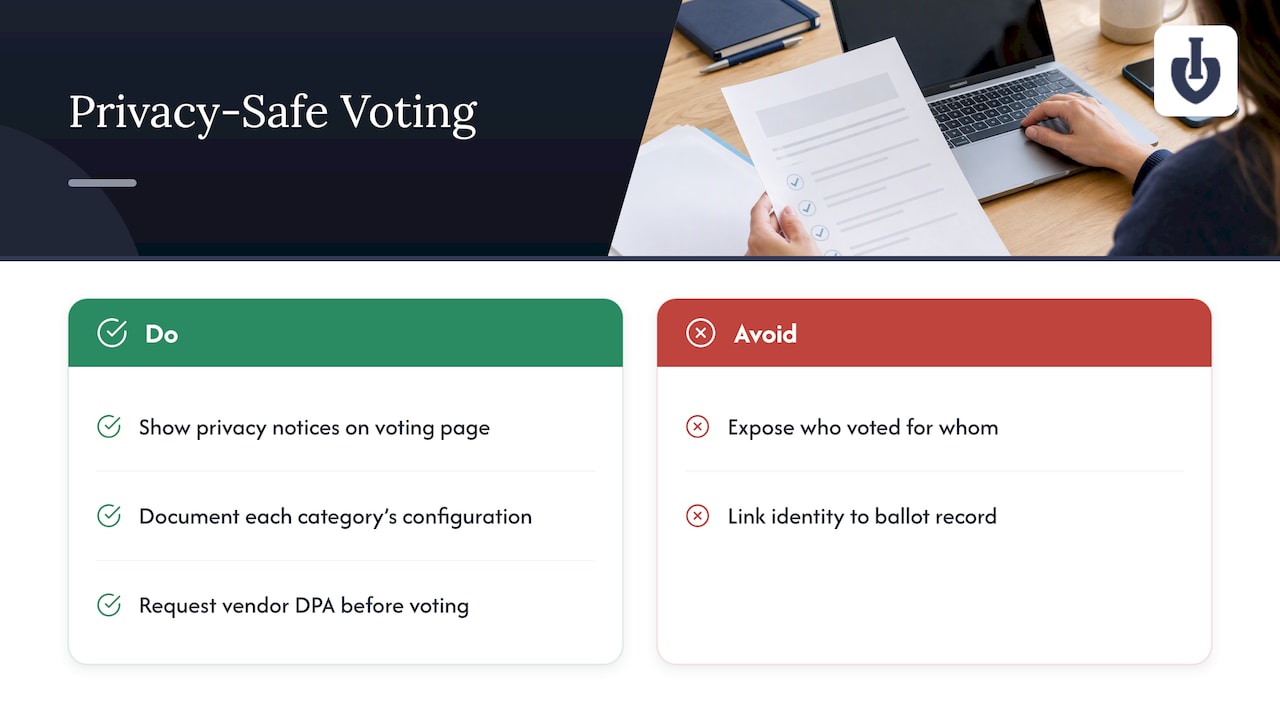
Award-style voting raises its own version of this problem: organizers want visible, engaging voting pages while keeping identity data away from the ballot record. Separating a voter’s identity record from their ballot, pairing a pseudonymized vote with a distinct identity check for eligibility, lets a public awards page stay transparent about results without exposing who voted for whom.
Keeping privacy notices visible on the voting page itself, documenting configuration choices as you set up each category, and requesting your vendor’s DPA before the first vote is cast all cost little and close most of the gap.
— Joshua
How Izivote supports GDPR-aware award voting
Our platform supports identity-based voting and paid voting handling that separate who is eligible to vote from what that vote actually says, aiming to keep ballot records cleaner from a privacy standpoint. The platform includes real-time dashboards to monitor turnout and results without exporting raw voter lists into spreadsheets.
Before launching, we recommend reviewing our Article 28 DPA and requesting our current security documentation so your own DPIA has what it needs. Our Free plan works for small award rounds, Pro runs $6 per month or $60 per year, and Premium runs $14 per month or $140 per year, with a 10% platform fee applied per paid vote processed. Check our pricing page or see how we support people’s choice awards directly.
FAQ
Is online voting legal under GDPR?
Online voting is legal under GDPR as long as the organizer identifies a lawful basis, minimizes the data collected, and secures a proper agreement with any processor involved. There is no blanket prohibition, but special-category data such as biometric authentication raises the compliance bar significantly, as Council of Europe guidelines make clear.
Who is the data controller in an online election?
The organizer running the election is almost always the data controller, even when a third-party platform delivers the voting technology. EDPB guidance confirms that this accountability cannot be delegated to the processor, so the organizer must still run DPIAs and configure the platform correctly.
Do I always need a DPIA for an online vote?
A DPIA is required when the vote involves large-scale processing, systematic monitoring, or special-category data like biometric authentication. Smaller, low-risk votes with minimal personal data may not require a full DPIA, but documenting that assessment is still good practice.
How long should I keep voter data after an election closes?
Identifiable voter census records should be deleted shortly after any dispute or audit window closes, while anonymized result aggregates can be retained longer for reporting. Your retention periods should be written into both your privacy notice and your DPIA before the election launches.
What should I check in a voting platform’s Data Processing Agreement?
A compliant DPA should spell out processor obligations, sub-processor rules, security measures, and breach notification timelines under Article 28. It should also grant you audit rights or point to independent security evidence rather than relying on an unverified compliance claim.
Sources
- Regulation (EU) 2016/679 (GDPR) – Article 28
- Council of Europe interpretative declaration on digital technologies and elections
- Guidelines on protection of personal data for voter registration and authentication (Council of Europe)
Leave a Reply