Category: How To

  • Email Verification Voting: How It Works and When to Use It

    Email Verification Voting: How It Works and When to Use It

    Email verification voting asks each voter to prove they can open a given inbox before their ballot counts. The voter enters an email address, receives a one-time code or confirmation link, confirms it, votes, and cannot vote again with that address. It is a practical duplicate-vote control for fan awards, people’s choice contests, school elections and community polls. It is not government-grade identity proof, and treating it as one is the most common mistake organizers make.

    This guide explains the mechanics, the real limits, the settings that matter, and a pre-launch checklist you can use whether you run a ten-nominee club poll or a public awards show.

    Izivote
    izivote.com
    Run More Trustworthy Fan Voting
    Izivote supports clear, secure voting for fan awards, with identity-based voting and real-time analytics in a user-friendly dashboard.

    Get started

    Key takeaways

    • Email verification proves access to an inbox, not that a voter is a unique person. It cuts casual repeat voting but does not stop someone who owns many addresses.
    • Match the control to the stakes: open email verification for public contests, a preloaded voter list with unique links for restricted elections.
    • Deliverability is the failure most organizers miss. Test Gmail, Outlook, school and corporate inboxes before launch and publish a recovery path.
    • Secure your sending domain with SPF, DKIM and DMARC so your verification emails are trusted and hard to imitate.
    • Decide in advance what you store, who can see it, and whether any voter can be linked to a choice.

    Table of Contents

    How email verification voting works

    The flow is simple, and the same on most systems:

    1. The voter opens your voting page.
    2. They enter an email address.
    3. The system sends a one-time code or a confirmation link to that address.
    4. The voter enters the code or clicks the link.
    5. The ballot is accepted and the verified address is marked as used.
    6. A second attempt with the same address is blocked, or limited to the number of votes your rules allow.

    Codes are usually short, expire after a few minutes and work once. A representative setup uses a 6-digit code that expires after 15 minutes, but expiry time, resend limits and how often a returning voter must re-verify are settings on each platform, not universal standards. Choose them deliberately.

    There is a stronger variant for restricted votes. Instead of letting anyone type any address, you upload the eligible voter list first and send each person a unique, single-use voting link. That checks two things at once: the person is on your roster, and they can read mail sent to the address you have on file. If you are running a board vote, a membership election or a class-president race, this is the version to use.
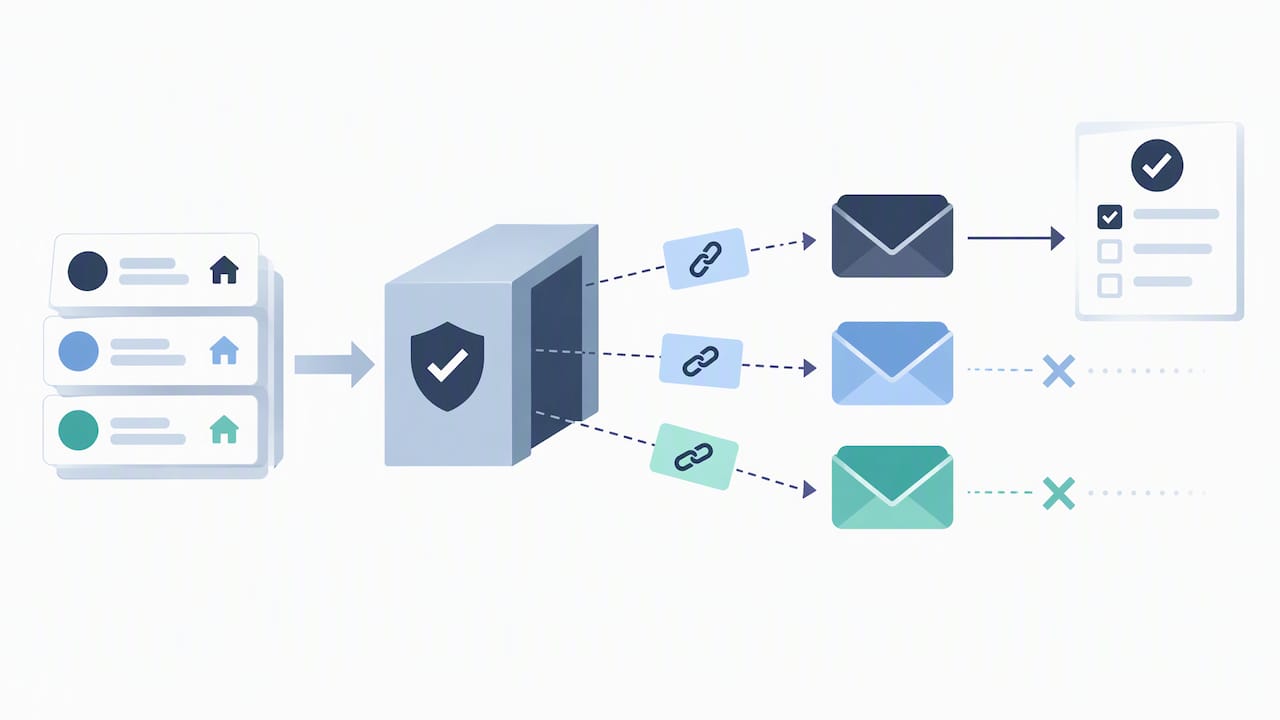
    Roster checked before unique voting links are issued

    What email verification does and does not prove

    Be precise about the claim you make to your audience. An email check proves that someone controlled an inbox at the moment of voting. That is all.

    The National Institute of Standards and Technology notes in its election security guidance on trustworthy email that email was not designed with security in mind and remains vulnerable to forgery, interception and manipulation. The U.S. Election Assistance Commission’s survey of internet voting similarly treats internet voting security as an ongoing technical and policy risk. Those documents concern public elections, which is a far higher bar than a fan award. Still, the lesson carries over: do not describe email verification as fraud-proof.

    In practice, here is what it does well and badly.

    ThreatDoes email verification help?
    Someone clicking vote repeatedly from one browserYes, strongly
    A fan voting twice with the same addressYes
    Typo or throwaway addressesPartly: the code must be received
    One person with dozens of free addressesNo, unless you add other controls
    Bots creating addresses at scaleOnly with rate limits and review
    Someone outside your eligible group votingNo, unless you use a roster or approved domains

    The fix for the weak rows is layering, not abandoning the method. For higher-integrity events, combine email verification with a roster, approved email domains, unique single-use links, audit logs, rate limits, anomaly review and, where proportionate, identity or phone verification.

    Choosing the right level of verification

    Start with two questions: who is allowed to vote, and what happens if the result is disputed?

    Public awards and fan contests

    When anyone may vote and the goal is one practical vote per reachable person, open email verification is a reasonable default. It is light for the voter, which matters because every extra step costs you participation. Fan awards, pageants, live shows and community contests fit here. If you also raise money through paid votes, a login or identity-based mode gives you a cleaner record of who bought what.

    Schools, clubs and member groups

    Here eligibility matters more than reach. Upload the roster, restrict by approved domain (for example a school’s student email domain), and send unique links. A student election is a good example: the question is not “did someone vote” but “was that someone a student.” Our student elections page shows how schools run these votes.

    Corporate and employee polls

    Company polls usually combine a work-domain restriction with one vote per address. Because corporate mail systems filter aggressively, deliverability testing is essential. See how this works on our corporate and employee polls page.

    High-stakes votes

    If the outcome carries legal or financial weight, such as bylaws, board seats or anything a regulator could ask about, email verification alone is not enough. Use a roster, unique links, audit trails and stronger identity checks, and check your organization’s governing documents and counsel about what method is permitted.

    Secure the sending domain before launch

    A verification system is only as trustworthy as the email that carries it. Attackers impersonate election-related organizations, and voters who receive a code from an unfamiliar or spoofed sender may either distrust it or fall for a fake one.

    The Cybersecurity and Infrastructure Security Agency recommends SPF, DKIM and DMARC for election-related organizations, with DMARC set to reject where possible or at minimum to a monitoring policy of p=none. NIST adds that organizers should use TLS, strong authentication and access control on email accounts, monitoring, malware scanning and official sender addresses.

    Translated for an event organizer:

    • SPF lists which servers may send mail for your domain.
    • DKIM signs messages so recipients can check they were not altered.
    • DMARC tells receiving servers what to do with mail that fails those checks.
    • An official sender address on your own domain looks more credible than a generic free-mail address.

    One limit to remember: these controls authenticate your mail domain. They reduce spoofing and phishing, but they do not prove a voter is a unique human or that the address belongs to an eligible voter. NIST’s guidance on UOCAVA-supporting systems separates authentication, authorization and transport security for exactly this reason: a secure channel and an eligibility model are two different jobs.

    If your organization also sends newsletters or donor appeals from the same domain, it is worth reviewing your wider setup. This overview of email marketing platforms for nonprofits is a useful starting point for pre-launch checks on sending practices.

    Deliverability: the problem most organizers miss

    The most common operational failure is not fraud. It is voters who never receive their code.

    Common causes:

    • The message lands in spam, junk, promotions or social folders.
    • A voter requests several codes and an earlier code is invalidated by a later one.
    • Corporate or school filters quarantine the message.
    • The voter mistyped their address and never knows.

    CISA’s guidance stresses that the verification email must look authentic and be deliverable before the experience can be trusted. Do these things:

    1. Send test codes to Gmail, Outlook, a school account, a corporate account and a mobile mail app.
    2. Tell voters on the voting page to check spam, junk and promotions folders.
    3. Say plainly that requesting a new code cancels the old one.
    4. Publish a support address or form for voters who are stuck.
    5. Watch for a spike in requests with no matching votes. It usually signals a delivery problem.

    A voter who gives up at the code screen is a lost vote, and in a paid contest it is lost revenue too.

    Privacy and ballot secrecy are separate decisions

    Many organizers assume that verifying an email means knowing who voted for whom. It does not have to. A system can keep an eligibility record showing that an address has voted while storing the ballot separately. NIST’s UOCAVA guidance treats these as distinct design choices.

    For a fan award, linking voters to choices is rarely needed, and voters care about how their address is used. Write down, and publish in plain language:

    • What you collect (the address, the timestamp, the choice).
    • Whether the address can be connected to the choice by anyone, including you.
    • How long you keep the data and who has access.
    • Whether you send any follow-up mail, and how a voter opts out.

    If you have voters in jurisdictions with privacy laws, such as the EU or California, check with a qualified privacy adviser about notice and retention requirements for your event.

    A pre-launch checklist

    Use this list before you open voting:

    1. Define eligibility. Who may vote, and may they vote more than once (once per category, once per day, or once overall)?
    2. Pick the method. Open email verification, or a preloaded roster with unique links.
    3. Configure the sender. Official address, SPF, DKIM and DMARC in place.
    4. Set the limits. Code expiry, resend limits and rate limits per address and per network.
    5. Test delivery. Consumer, school, corporate and mobile inboxes.
    6. Write the help text. Spam-folder advice, a support contact, and what to do if a code fails.
    7. Plan monitoring. Who watches for duplicate or abnormal activity, and how often?
    8. Preserve records. Keep an audit trail and a final results report.

    When comparing voting software, Capterra’s voting software guidance suggests also checking voter-capacity limits, automated reminders, candidate profiles, real-time dashboards and exportable reports. Those are sensible questions to put to any vendor, including us.

    Watching results: analytics that matter

    Verification only protects you if you look at the data while voting runs. Whatever tool you use, you want a live dashboard that shows:

    • Votes over time, so a sudden surge at 3 a.m. stands out.
    • Votes per nominee and per category.
    • Verified versus unverified attempts.
    • Repeated attempts from one address or network.
    • An export you can keep after voting closes.

    A sharp jump for one nominee is not proof of cheating, since a nominee may simply have shared the link with a big audience. It is a prompt to look closer, and to decide beforehand what you will do about it, for example reviewing suspicious votes before results are published. Writing that rule down before launch protects you from accusations of bias afterward.

    How Izivote fits

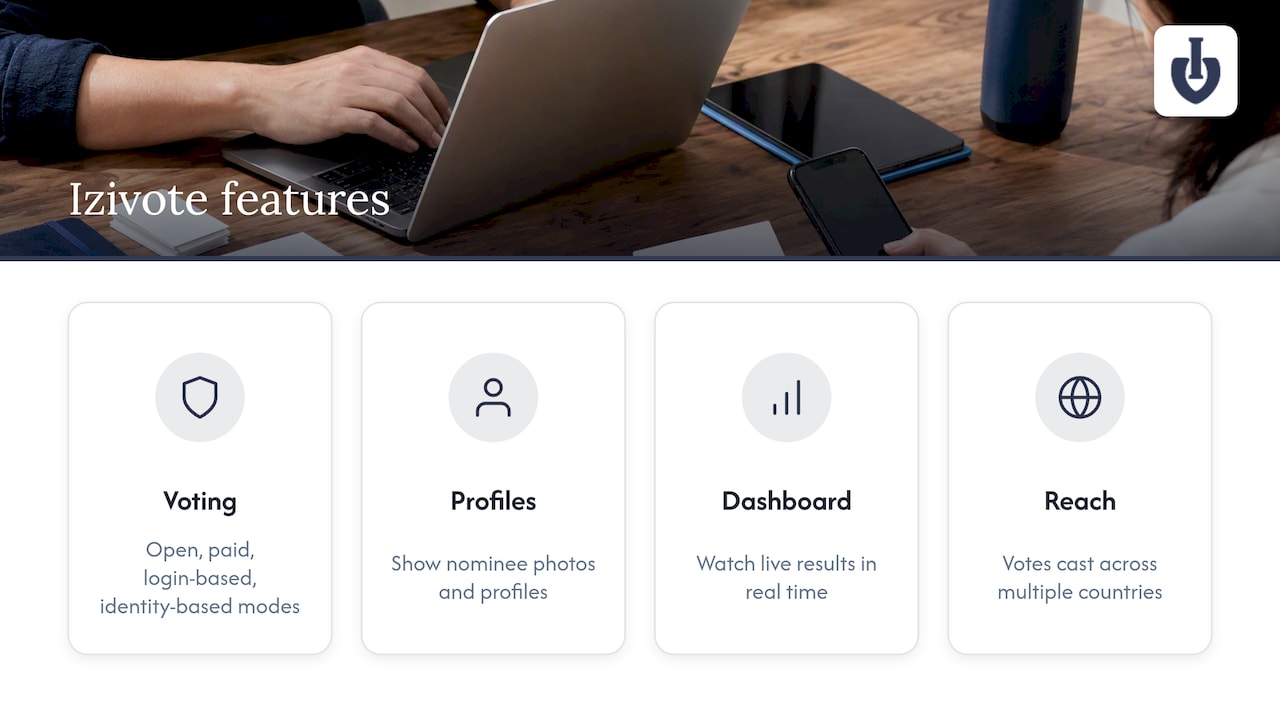
    Izivote is built for public audience awards and events. You can set up a voting page yourself on the web, run multi-category votes with photo nominee profiles, embed the voting page on your own site, allow self-nomination and close voting automatically. Voting modes include open, paid, login-based and identity-based, so you can match the control to the event, and the dashboard shows votes in real time so you can spot odd patterns while voting is still open. See the full list on our features page, or how organizers run people’s choice awards and fan awards.

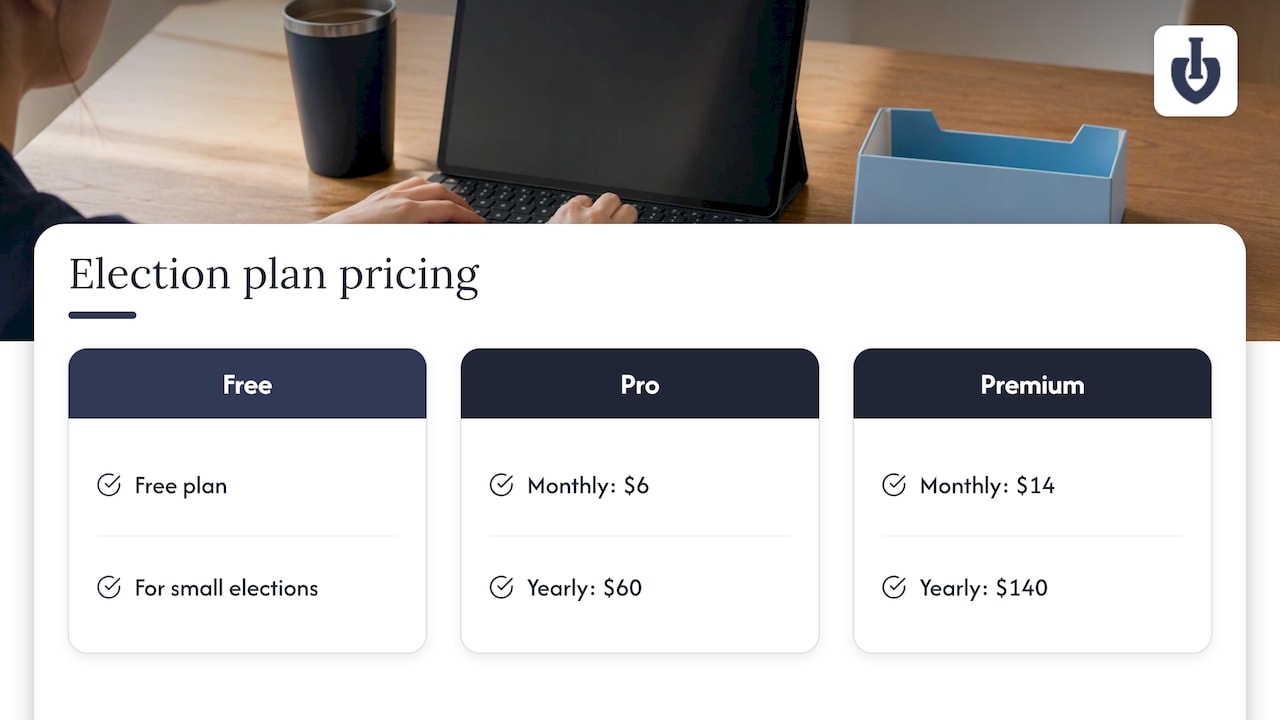
    Pricing is published on our pricing page: a Free plan for small events, Pro at $6 per month or $60 per year, and Premium at $14 per month or $140 per year. Paid voting carries a platform fee of 10% per vote. If you are not sure which voting mode suits your contest, start on the Free plan and test the voter experience yourself before you announce anything.

    Frequently asked questions

    Is email verification enough to stop fake votes?

    It stops casual repeat voting, but not a determined person with many inboxes. For public contests that trade-off is usually acceptable. Where it is not, add a voter roster, approved domains, rate limits and review of unusual activity, and consider identity or phone checks.

    Should voters need an account to vote?

    Not necessarily. An email code with no account keeps the process quick and gets higher participation. Use login or identity-based voting when you need a clearer record, for example in paid voting or restricted member votes.

    What should I do when voters say they never got the code?

    First ask them to check spam, junk and promotions folders, and to request only one code at a time, because a new code can invalidate the earlier one. Then check your sender authentication and test with the same mail provider. Keep a support contact visible on the voting page.

    Can I run an email-verified vote for a school or workplace?

    Yes. Restrict voting to an approved domain or upload a roster and send unique links, so only people on your list can vote. Test the messages against the school’s or company’s mail filters before opening the ballot.

    Sources

    Recommended

  • People’s Choice Voting Setup: A Step-by-Step Guide

    People’s Choice Voting Setup: A Step-by-Step Guide

    To set up people’s choice voting, you need six decisions made in order: what you are awarding, who may vote and how, what a vote costs (if anything), how you will stop cheating, when voting opens and closes, and how you will announce the result. Do those well and the software part takes an afternoon. This guide walks through each decision, with the settings we see organizers get wrong most often.

    Izivote
    Set Up Your People’s Choice Vote
    Izivote helps organizers run fan and people’s choice awards with clear voting, identity-based options, paid votes, and real-time analytics.
    1Choose a voting method
    2Set identity-based or paid voting
    3Monitor votes with real-time analytics

    Get started

    Key takeaways

    • Decide the voting rules before you touch any tool: categories, one vote or many, free or paid, and whether voters must identify themselves.
    • Match the voting mode to the risk. A office-snack poll can be open; a cash-prize award needs login, identity checks or paid votes.
    • Publish your anti-fraud rules on the voting page itself, and watch results live while voting runs.
    • Treat a public vote as a popularity contest, not a measure of quality, and say so.
    • A free plan covers small events. Paid voting carries a 10% platform fee per vote on Izivote, so price your votes with that in mind.

    Table of Contents

    Start with what the vote is for

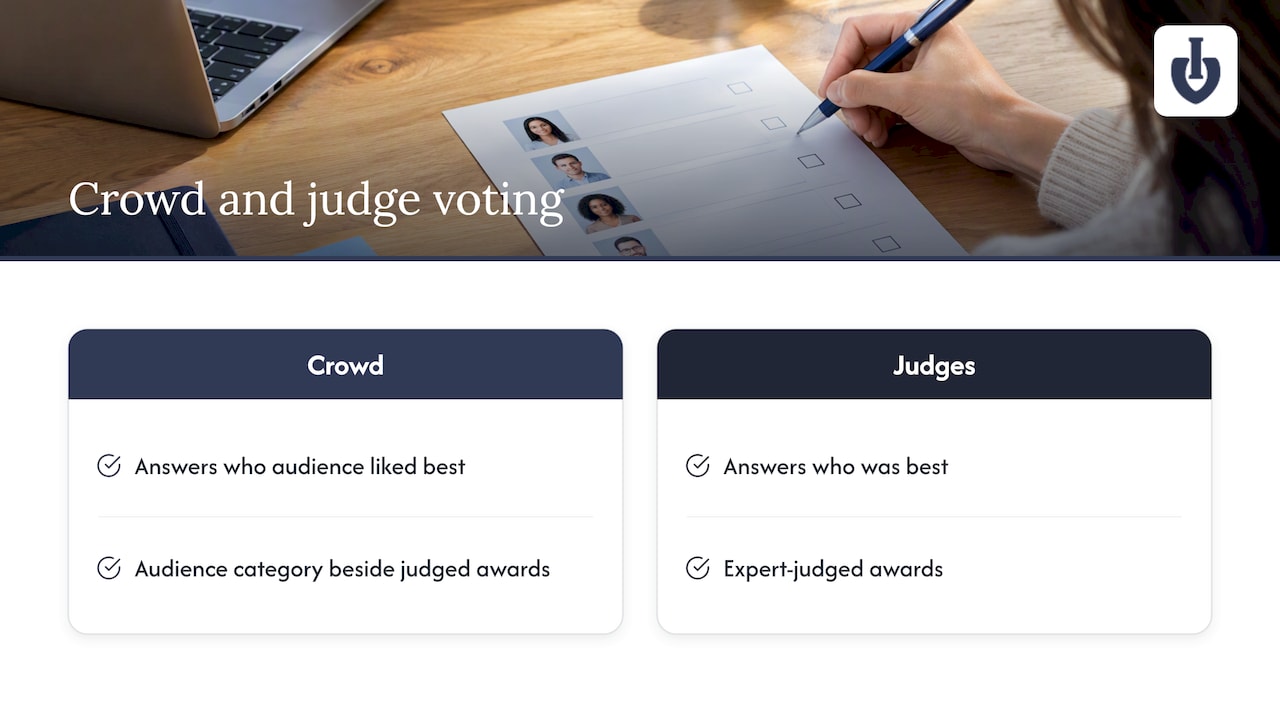
    A people’s choice award answers one question: who did our audience like best? That is a different question from “who was best?” Judges answer the second. The crowd answers the first.

    This matters for setup because it shapes every later choice. Public voting tends to work best as an audience category that sits alongside expert-judged awards, so the crowd gets a say without putting your main categories at risk, as Zealous notes in its practical guide to public voting. The same article lists the usual failure modes: bot fraud, repeat voting through VPNs and coordinated group voting.

    The BBC takes a similar view. Its editorial guidance on voting says the robustness of the voting mechanism should match the editorial significance of the vote. In plain terms: the more your result matters, the tighter your rules should be.

    Write one sentence before you go further, for example: “Fans choose their favorite food truck at the Riverside Festival, and the winner gets a feature on our website.” If you cannot write that sentence, you are not ready to build the ballot.

    Start with what the vote is for — overview diagram

    Design the ballot: categories and nominees

    Keep categories few and clear

    Every category is a separate decision for the voter and a separate thing for you to promote. Five to ten categories is a comfortable range for most community awards. Past that, voters skip categories and your promotion gets diluted.

    Name categories so a stranger understands them without a rulebook: “Best Local Coffee Shop” beats “Excellence in Hospitality (Beverage).” If a nominee could fit two categories, decide now whether it may appear in both.

    Decide how nominees get on the ballot

    You have three common routes:

    1. You pick them. Fastest, and the best for small, curated events such as a talent show or a pageant.
    2. The public nominates. Good for community awards where you do not know every candidate. Collect nominations first, then screen them, then open voting.
    3. Self-nomination. Entrants put themselves forward. This works well for contests and creator awards, but you should review entries before they go live.

    Whichever route you choose, collect the same things for each nominee: name, a clear photo, a one- or two-line description, and a link if relevant. Voters respond to faces and short stories. A ballot of bare names favors whoever is already famous.

    Set the voting rules for nominees too

    Tell nominees in writing what they may and may not do. Can they ask friends to vote? Can they offer prizes for votes? Can they run ads? Decide now, because you will be asked in week one.

    Choose a voting mode

    This is the decision with the biggest effect on integrity. The main options are:

    ModeHow it worksBest forMain risk
    OpenAnyone with the link can voteLow-stakes polls, classroom or office funEasy to repeat-vote
    LoginVoters sign in before votingCommunity awards, fan clubsFake accounts
    Identity-basedVotes are tied to a verified identityHigher-stakes awardsMore friction for voters
    PaidEach vote is boughtFundraisers, fan awardsPerceived pay-to-win

    Izivote supports all four modes, and its help page on voting types and voter identity explains how each one behaves. You can mix approaches across events, but keep one mode per category so the rules stay easy to explain.

    When paid voting makes sense

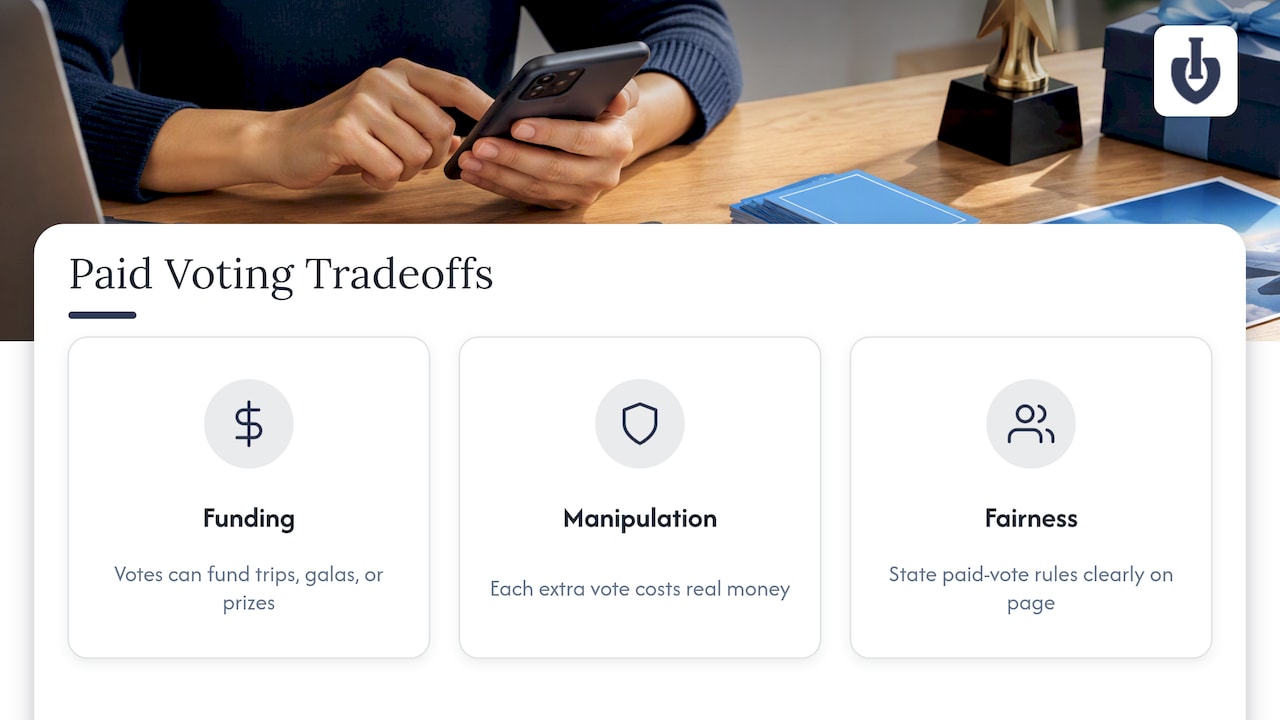
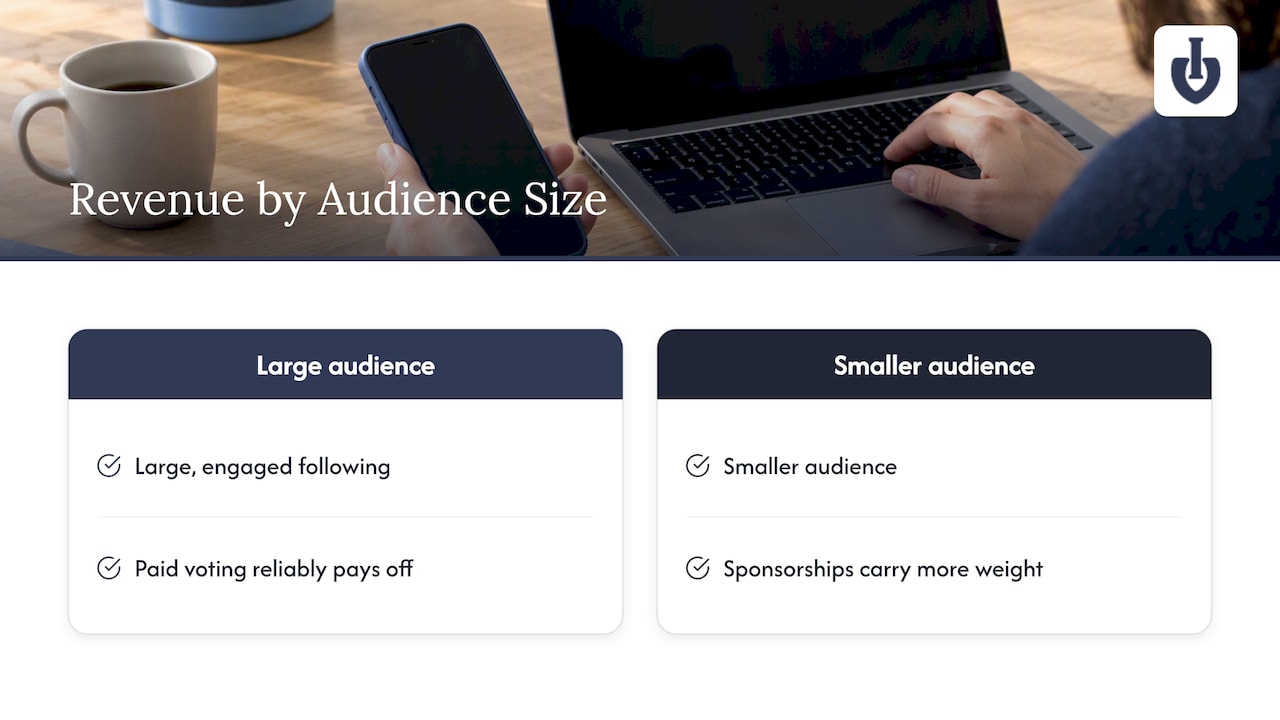
    Paid votes turn enthusiasm into funds. A school can raise money for a trip, a nonprofit can fund a gala, a fan community can cover prizes. They also make casual manipulation expensive, because every extra vote costs real money.

    The tradeoff is perception. If the highest spender always wins, the award loses meaning for people who cannot pay. Many organizers handle this by running a free vote and a paid vote side by side, or by making paid votes a bonus on top of one free vote per voter. If you go this route, state it clearly on the voting page. We go deeper on the money side in our piece on monetizing fan voting, sponsors and fairness.

    When paid voting makes sense — overview diagram

    Set up the vote in Izivote, step by step

    Here is the practical sequence on our platform. It takes most organizers well under an hour for a first event.

    1. Create the vote. Start from the create-a-vote page. Give it a plain title and a short description of who can vote and why.
    2. Add categories. One per award. Order them the way you want voters to see them.
    3. Add nominees. Upload a photo and a short profile for each. If you allow self-nomination, turn it on here.
    4. Pick the voting mode. Open, paid, login or identity-based, as above.
    5. Set the schedule. Choose the opening time and the automatic closing time so voting ends exactly when you said it would.
    6. Preview as a voter. Open the page on your phone, not just your laptop. Most votes come from phones.
    7. Publish and share the link, or embed the voting page on your own website so people never leave your brand.

    Once voting is live, the organizer dashboard shows votes in real time, so you can see which categories are moving and spot odd spikes. For more on this kind of event, see our page on people’s choice voting tools.

    Block fraud before it starts

    Fraud prevention is mostly design, not detective work. Four habits help.

    Say the rules out loud

    Award Force advises declaring a zero-tolerance policy and publishing it in bold on the voting page, with the penalties spelled out: fraudulent votes removed, or entrants disqualified. A visible rule deters casual cheating and gives you cover if you need to enforce it.

    A short version works. For example: “Votes obtained through bots, vote-buying outside the official process or multiple accounts will be removed. Entrants who benefit may be disqualified.”

    Match friction to stakes

    A vote for the best pumpkin at a church fair does not need identity checks. A vote that decides a sponsored prize does. Add friction only where the stakes justify it, because every extra step costs you voters.

    Watch the live numbers

    The same Award Force guide suggests tracking the vote in real time to catch unusual patterns, and auditing votes afterward if something looks wrong. Check the dashboard at least daily. Red flags include a nominee gaining thousands of votes overnight while others are flat, or a cluster of votes arriving within seconds.

    Keep the right to remove votes

    Put in your terms that you may void suspicious votes and that your decision is final. Then, if you act, act the same way for everyone.

    Decide on a timeline

    Voting windows are a balance. Too short and you miss people. Too long and attention fades.

    • Small community or school vote: one to two weeks.
    • Public award with promotion: two to four weeks, with a clear countdown.
    • Live event vote: a window that opens at the start of the show and closes at a set moment on stage.

    For reference, one large, established fan award runs a 21-day official window, according to its published voting FAQ, though we recommend sizing yours to your audience, not copying a national event. Whatever you pick, announce the close time with a time zone, and let automatic closing do the work so nobody has to be awake at midnight.

    For live events specifically, our guide to live event voting and audience polls covers how to run the vote on screens in the room.

    Promote the vote

    A vote nobody hears about produces a result nobody trusts. Plan promotion as part of setup:

    • Give nominees a shareable link and a ready-made message. They will do most of your marketing.
    • Embed the ballot on your site and send newsletters with the direct link.
    • Post progress updates, but think about what you show. Live public results build transparency and excitement, though they can also encourage ballot-stuffing toward the end. If your event is sensitive, consider showing standings only for the final day or hiding exact counts until the close.
    • Use reminders. A message two days before closing typically brings a second wave of votes.

    If you run sports or team awards, keep in mind that fans and experts often disagree about who was best. This explainer on why match awards and live stats diverge is a useful reminder of why a fan vote deserves its own category, separate from any judged award.

    Be honest about what the result means

    An online public vote is a self-selecting sample. People who vote are the ones who care, or the ones whose friends asked them to. The BBC’s guidance says producers should treat such votes this way and report the limitation, rather than presenting the result as representative of the public.

    You do not need to hedge every announcement. A simple line is enough: “The winner was chosen by votes cast by our community between these dates.” That is accurate, and it protects your credibility.

    What it costs

    Izivote’s pricing is published on the pricing page. As of today, the plans are:

    PlanMonthlyYearly
    FreeNo published priceNo published price
    Pro$6 per month$60 per year
    Premium$14 per month$140 per year

    Paid voting adds a 10% platform fee per vote. Do the math before you set a vote price. If you charge $1 per vote, the platform fee is $0.10 on each, so you keep the rest of the amount before any other processing costs. Decide whether that is acceptable, or whether your vote price should be higher. A small event can start on the free plan and move up only if it needs more.

    Start your people’s choice vote

    If you want a ballot with nominee photos, several voting modes, live results and automatic closing, you can create your vote on Izivote without paying anything up front. Fan awards, pageants, school contests and community polls are all common uses; the fan awards page shows how they look in practice, and the awards and competitions page covers programs that mix public and judged elements.

    Announce the result

    Close on time, check the final counts, and review any flagged votes before announcing. Then publish:

    • the winner and the final standings, if you showed them during voting;
    • the voting period and the method;
    • a thank-you to every nominee, not just the winner.

    Keep the results page live. Winners will share it, and it becomes the best advertisement for next year’s edition.

    FAQ

    How long does it take to set up a people’s choice vote?

    For a small event with a handful of categories, you can have a working ballot in under an hour if you already have nominee names and photos. The slow part is almost always gathering those photos and writing short profiles. Start there.

    Should voters be allowed to vote more than once?

    It depends on your goal. One vote per person is the cleanest for fairness. Multiple votes, especially paid ones, suit fundraisers. Whichever you choose, state the rule on the voting page and set the voting mode to enforce it.

    Is paid voting fair?

    It can be, if you are open about it. Many organizers pair a free vote with optional paid votes so that everyone has a voice, and then explain where the money goes. Hiding the rule is what damages trust, not the payment itself.

    Can I run a people’s choice vote alongside judges?

    Yes, and that is a common format. Keep the two results separate, with different award names, so nobody confuses a popularity result with a judged one.

    Sources

    Recommended

  • School Election Voting Setup: A Step-by-Step Guide

    School Election Voting Setup: A Step-by-Step Guide

    A good school election setup comes down to six decisions: who can vote, who can run, how long the campaign lasts, how students cast a ballot, how votes are counted, and how you show the result was fair. Make those choices before you build anything, then pick the tool (paper box, online ballot or both) that fits them. This guide walks through each decision in order, with a checklist you can adapt for a class, student council, homecoming court or prom vote.

    Izivote
    Run a More Transparent Student Election
    Izivote helps organizers run online voting with clear, secure processes, identity-based voting, and real-time analytics for results monitoring.

    Get started

    Key takeaways

    • Plan for two to four weeks, though a school election can run in as little as one week, according to the Australian Electoral Commission’s school election guidance.
    • Decide the rules (voters, candidates, timeline, tie-breaks) in writing before nominations open, and publish them.
    • Keep voting private and randomize the order of candidates on the ballot.
    • Online voting is fine for low-stakes school contests, but keep a record of results and a way to audit them for several weeks afterward.
    • Show the count. Transparency is what makes students accept a result they did not vote for.

    Table of Contents

    Start with the rules, not the tool

    Most problems in school elections are not technical. They come from rules that were vague or invented halfway through: a candidate who was not eligible, a tie with no tie-break, a recount nobody knew how to run.

    Write a one-page election charter and share it with students, families and candidates before nominations open. It should answer:

    1. Who votes? Everyone in a grade, the whole school, or one homeroom per ballot.
    2. Who can run? Official guidance on school governance, such as this UK government document on school governing bodies, suggests that clear, public expectations work better than restrictive eligibility criteria. The goal is to inform voters so they can choose for themselves. If your school requires a GPA or a number of petition signatures, state it up front.
    3. How many votes does each student get? One vote per office is standard. Say so, and say what happens to a ballot with extra marks.
    4. What breaks a tie? A runoff, a coin toss witnessed by an adviser, or a vote by the council. Choose before you need it.
    5. Who is in charge? Name a teacher adviser and a small student election committee. Students who help run the process tend to trust it more.

    Build a realistic timeline

    The Australian Electoral Commission lists one week as the minimum and two to four weeks as the recommended span for a school election. That is a useful benchmark even in the US, where student council calendars vary. A four-week plan looks like this:

    WeekWhat happens
    1Publish the rules, open nominations, recruit the election committee
    2Close nominations, verify candidates, collect photos and short bios
    3Campaign period: posters, speeches, Q&A or debate
    4Voting window, count, announcement

    If you only have a week, compress the campaign, not the verification step. Checking that every name is spelled correctly and every candidate is eligible takes little time and prevents the most embarrassing mistakes.

    Choose how students will vote

    You have three realistic options. None is wrong. The right one depends on school size, device access and how much is at stake.

    MethodBest forWatch out for
    Paper ballots and a ballot boxSmall schools, younger grades, civics lessonsStaffing, counting time, spoiled ballots
    Online votingLarger schools, remote or hybrid students, quick resultsDevice access, duplicate voting, privacy on shared screens
    HybridSchools that want both access and a paper trailMore coordination

    If you vote on paper

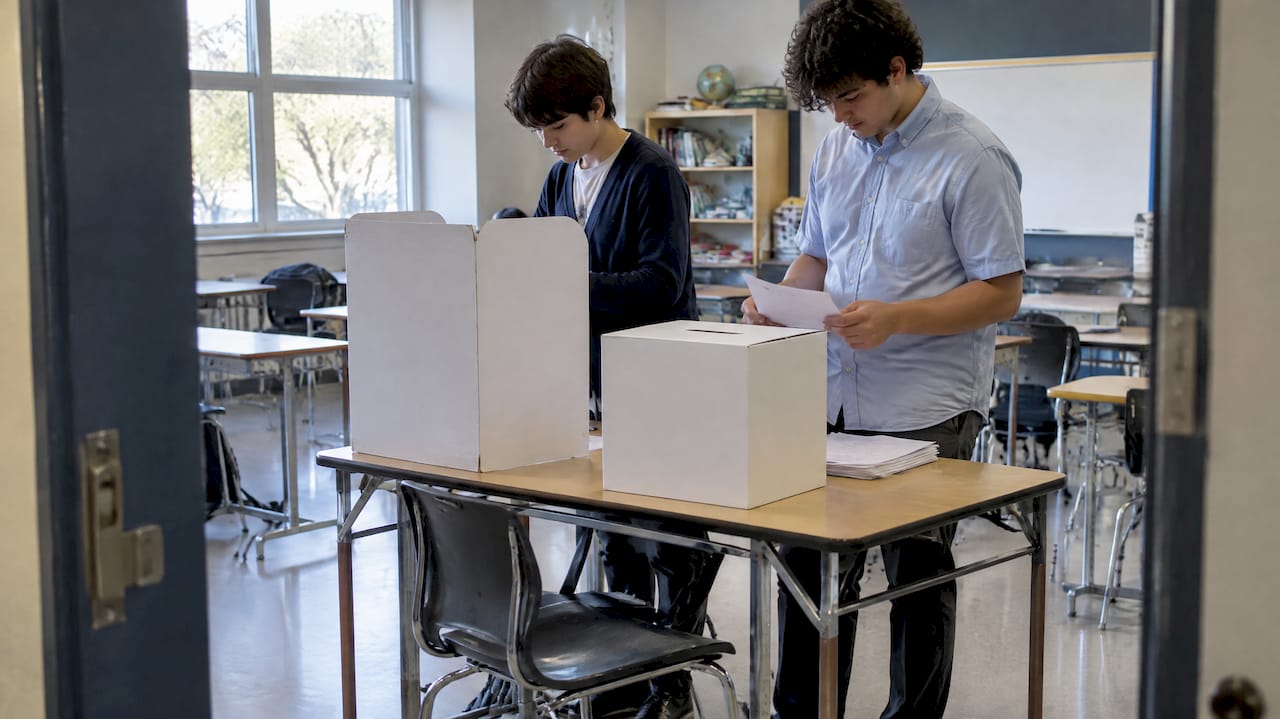
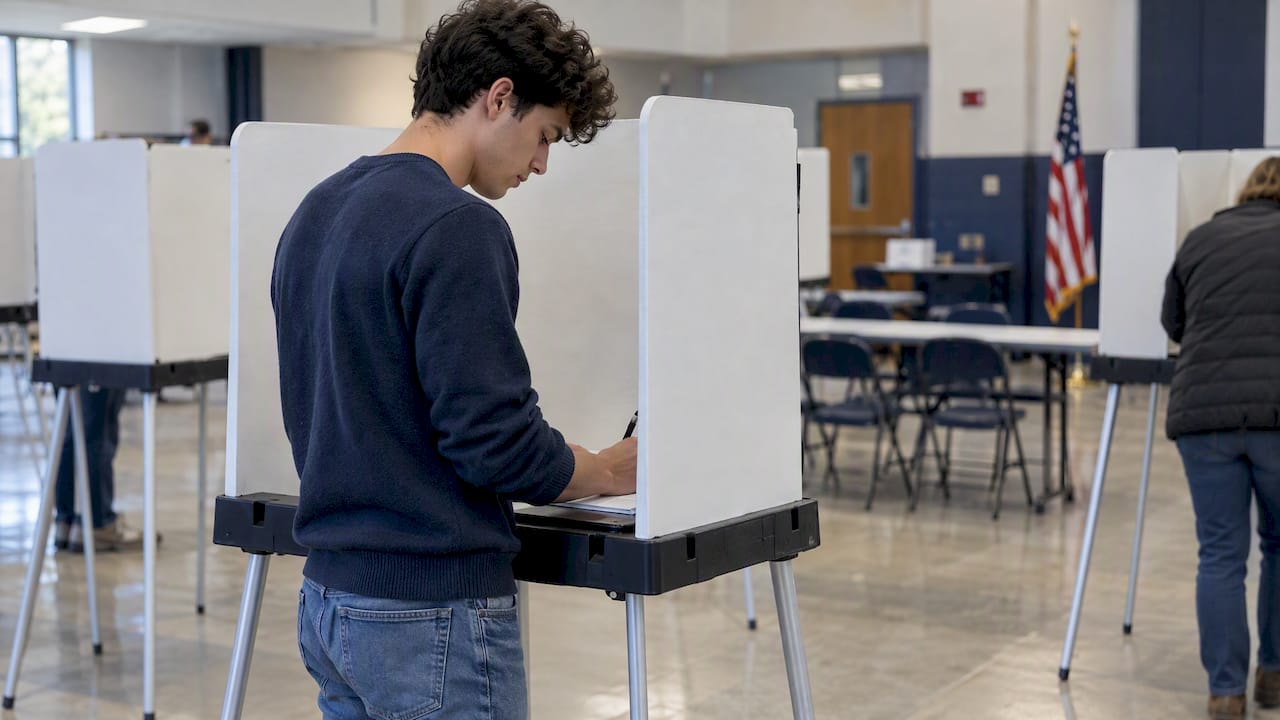
    Election guides for classroom simulations, like the Elections BC activity booklet, recommend about one polling station per 20 to 30 students. Each station has a voting screen facing away from the crowd, a ballot box, a voters list to cross-reference, and two officials: one to issue ballots and one to check names. Schools often set up in a common area such as the library, cafeteria or auditorium.

    The Get Voting program also shows how far a physical kit can go, with sealed ballot boxes and posters, which makes the vote feel real to students.

    If you vote online

    Online ballots remove most of the logistics. Students vote on a phone, tablet or school laptop during a set window, and the count is automatic. That speed is why many schools move online. A study of the student council election at the University of Namibia looked at what an online election system does to turnout and participation, a reminder that convenience can change who takes part.

    Two cautions belong here. First, security experts are blunt about high-stakes public elections: the Council on Foreign Relations summarizes that the National Academies, NIST and the FBI regard fully secure internet voting as not yet achievable, and they favor voter-marked paper ballots with audit trails. A student council vote is not a governmental election, but the lesson applies: use verification and keep records. Second, convenience is not the only goal. A user study from TU Darmstadt found that voters will give up some ease of use for a system they know is more secure, so do not assume students want the lowest-friction option at any cost.

    A generic form builder is the shortcut many schools try first. It is quick, but it usually lacks voter verification and a clean way to stop repeat votes, and students are good at finding that out. If you go online, choose a tool built for voting.

    Hybrid: a good middle path

    A hybrid approach lets students vote online during homeroom while a paper option stays available for anyone without a device or who prefers it. It also gives you a fallback if the wifi fails on election day. Researchers who studied an early student union election in Sweden, where internet voting was one of three ways to vote, documented how providing several channels works in practice. Offer more than one and your election covers more students.

    Set up the ballot itself

    Whether the ballot is paper or digital, three details matter most.

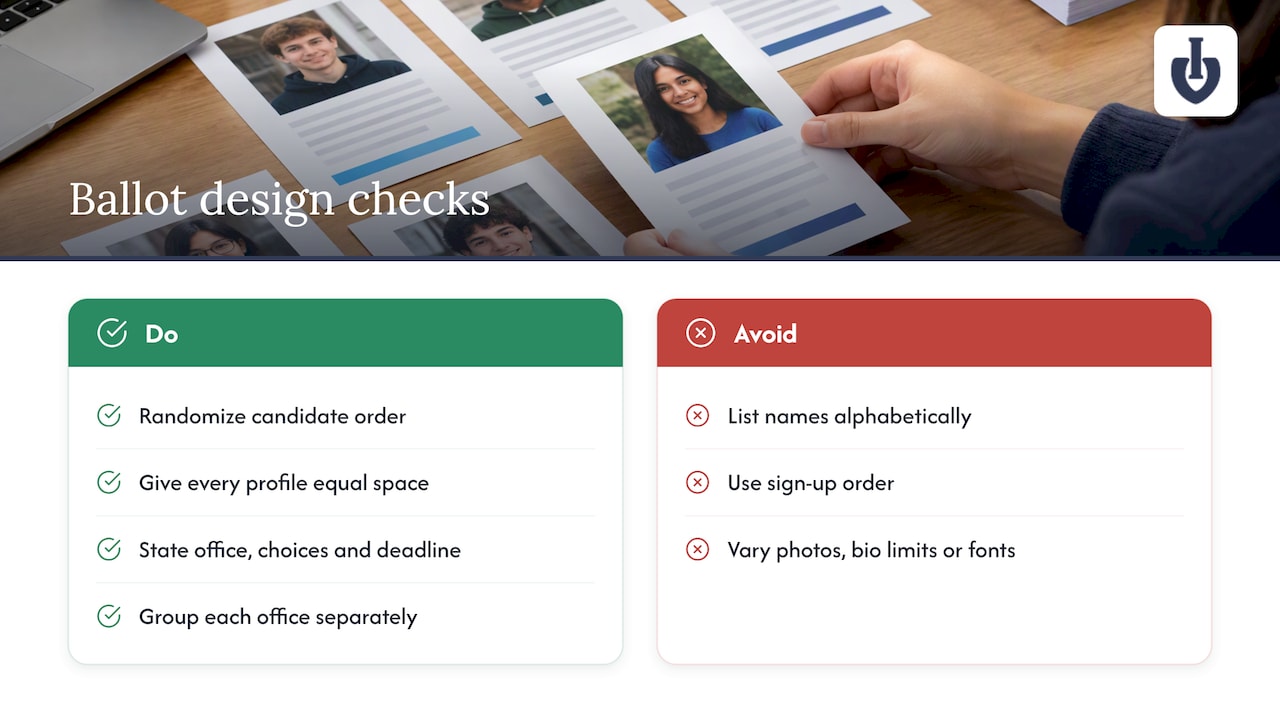
    Randomize the order of names. It is tempting to list candidates alphabetically or by sign-up time. The AEC’s Get Voting FAQ treats random ordering as a vital practice, because it prevents “donkey voting,” where voters just pick the first name. On paper, draw names from a hat to set the order. Online, use a tool that shuffles automatically.

    Give every candidate the same space. Same photo size, same word limit for the bio, same font. Visual profiles help students put a face to a name, but only if every profile looks alike.

    Keep the ballot short and clear. List the office, the number of choices allowed and the deadline. If you are voting on several offices (president, vice president, treasurer), group each office as its own category so nobody votes for the wrong one by accident.

    Three checks for a fair school ballot

    Protect privacy and prevent double voting

    Privacy is the part schools underestimate. Research on classroom voting from the International Society of the Learning Sciences repository found that students who vote publicly are less likely to change their views and more likely to follow the class majority. In a popularity-driven election, that pressure is real. Even a casual vote should happen behind a screen, or on a device nobody else can see.

    Practical steps:

    • On paper, use a voting screen or a corner of the room facing the wall.
    • Online, tell students to vote on their own device, not on a friend’s screen.
    • Never display who voted for whom, even to the adviser, unless the rules say so.

    To prevent repeat voting, tie each vote to something checkable. On paper, that is a voters list that officials mark off. Online, it is a login, a unique code, or an identity-based voting mode. Izivote’s voting types guide explains the open, login and identity-based options, so you can match the strictness to the stakes. An open link might be fine for choosing the school mascot. A class president race deserves a verified method.

    If your school already runs online registrations for clubs and extracurriculars, the same thinking applies: collect only what you need and check each participant once. This practical guide to digitizing after-school activity sign-ups (in Spanish) shows how one school-focused tool handles participant control and family communication, and the habits carry over to voter lists.

    Run the campaign period fairly

    A fair vote needs informed voters. The same guidance that discourages tight eligibility rules says the point of the process is to inform the electorate. Build that in:

    • A short speech day or recorded video for each candidate, with the same time limit.
    • A Q&A or debate moderated by an adviser.
    • A simple campaign rulebook: where posters can go, what can be spent, and a ban on negative claims about other students.
    • Candidate profiles on the voting page, so students see the same information when they vote.

    Count and announce the result

    The Western Australian Electoral Commission’s guide to student elections emphasizes transparency as the foundation of legitimacy. Their recommended habits include formal counting procedures, independent observers and a recap of the results that builds students’ trust. Here is a version that fits any school:

    1. Close the voting at the announced time. Automatic closing in an online tool removes the temptation to extend it for a friend.
    2. Count in front of witnesses. For paper, invite two students and one adult who is not the adviser. For online, have the committee review the results dashboard together.
    3. Check totals against the voters list. The number of ballots should not exceed the number of eligible voters who signed in.
    4. Announce winners with vote counts, or at least percentages, at a school assembly or on the morning announcements.
    5. Explain the process in a short recap, especially if the margin was narrow.

    Keep your records

    Experienced organizers recommend keeping paper ballots or logs for several weeks after the vote. The Umeå student union case study notes that improvised fixes to technical problems can increase dependence on the provider and add risk. Export the final results from your online tool, save them with your election charter, and keep any paper ballots sealed until the challenge window has closed.

    Where Izivote fits

    If you want to run the online part without building it yourself, our student elections page shows how schools set up a vote. You create categories for each office, add candidates with photos and profiles, choose a voting mode (open, login or identity-based), and watch live results on a dashboard. Voting can close automatically at the time you set, and you can embed the voting page on your school’s own website.

    There is a free plan for small elections. Paid plans are Pro at $6 per month or $60 per year, and Premium at $14 per month or $140 per year, and the full details are on our pricing page. The 10% platform fee only applies to paid voting, which most school elections never use. When you are ready, you can create your vote in a few minutes and run a test ballot with your election committee first.

    Where Izivote fits — overview diagram

    A one-page setup checklist

    Four weeks out

    • Write and publish the election charter
    • Name the adviser and the student committee
    • Open nominations

    Two weeks out

    • Verify candidates and collect photos and bios
    • Build the ballot, randomize the order, and test it
    • Decide the voting method and book the room or devices

    Voting week

    • Confirm the voters list or login method
    • Set up private voting spaces
    • Brief poll officials or the committee

    After the vote

    • Count with witnesses and compare totals to the voters list
    • Announce the results and the process
    • Archive results and keep any paper ballots for several weeks

    FAQ

    How long does it take to set up a school election?

    Plan for two to four weeks if you can. The AEC’s school guidance lists one week as the minimum. The ballot itself takes under an hour to build in an online tool, but nominations, verification and campaigning are what need the time.

    Is online voting secure enough for student council?

    For a school contest, yes, if you use verified voting and keep a record of results. Security authorities say fully secure internet voting is not yet achievable for high-stakes government elections, so do not treat a school tool as a substitute for those. Match the verification level to the stakes and archive your results.

    Can I run a school election with a free tool?

    Yes. A free plan can cover a small election, such as a single class or club. Check the plan limits before the vote, and test the ballot with your committee. Larger elections with several offices may need a paid plan.

    Should candidates be listed alphabetically?

    It is better to randomize. Official guidance warns that fixed order gives an advantage to the first names listed. Draw names from a hat for paper ballots, or use a tool that shuffles the order for each voter.

    Sources

    Recommended

  • Donation-Based Voting: How to Run It Fairly and Legally

    Donation-Based Voting: How to Run It Fairly and Legally

    Donation-based voting is a contest format where supporters cast votes by giving money, and the money goes to a cause. The nominee with the most votes wins recognition, and the cause receives the funds. It works well for people’s choice awards, school contests, pageants and charity galas. It also carries obligations: you must tell donors exactly where their money goes, keep the vote honest, and stay clear of anything that looks like paying for votes in an election.

    This guide covers how the model works, the rules a US organizer should know, how to protect the integrity of results, and how to set one up on Izivote.

    Izivote
    Run Fan Voting With Confidence
    Izivote supports paid votes and identity-based voting, with real-time analytics to help organizers monitor results and engage their audience.

    Explore Izivote

    Key takeaways

    • Donation-based voting links each vote to a gift, so you raise money and engagement in the same campaign.
    • Be explicit about who receives the money, what fees are deducted, and whether gifts are tax-deductible. The FTC treats unclear claims here as deceptive.
    • Keep fan and charity contests clearly separate from political elections, where paying for votes is a crime.
    • Verify every beneficiary charity yourself with IRS records before you promote it.
    • Protect results with identity checks, separate voter records from ballots, and publish your rules before voting opens.

    Table of Contents

    What donation-based voting actually is

    The format has a few common variations:

    • Donate to vote for a nominee. Each nominee represents a person, team or class. Supporters buy votes, and the funds go to one shared cause. The nominee with the most votes wins a title, a trophy or bragging rights.
    • Donate to vote for a cause. The nominees are charities. Each vote directs money to the charity the voter picks, and the top vote-getters receive a bonus or a larger share.
    • Paid votes with a fundraising share. The organizer sells votes at set prices and commits a stated portion of the proceeds to a named beneficiary.

    In all three, the vote is a way of showing support, and the payment is voluntary. That is what separates the format from a ballot in a government election, and it is why wording matters so much.

    It is also worth knowing why organizers like it. Free voting rewards whoever has the biggest reach for the least effort. Paid voting makes each vote cost something, so fans who care show it, and the organizer gets a revenue line. When that revenue is pledged to a cause, the contest becomes a fundraiser with a built-in audience.

    Where donation-based voting fits

    This format suits events where the audience is already invested in the outcome:

    • Fan and people’s choice awards. Audiences rally behind favorites. See how online voting for people’s choice awards is typically set up.
    • School and student contests. A spirit week, a talent show or a teacher-of-the-year vote can fund a class trip or a school program. For formal student government races, a free, identity-checked ballot is usually the better choice, and our page on student elections and schools explains why.
    • Community groups and clubs. Best garden, best food truck, best local business: neighborhood contests where votes support a local cause. Our community groups and clubs page covers this.
    • Pageants and live shows. Audience votes during or after a performance can fund the event or a partner charity.
    • Influencer and creator campaigns. A creator lets followers vote for the next project or charity partner, with votes funding the pick.

    It is a poor fit for anything with real governance consequences: board seats, union officer elections, public office. Those votes need their own rules, and in some cases the law dictates the method. The US Department of Labor, for example, notes in its guidance on electronic voting for union officer elections that labor organizations may choose their own systems only within the requirements of the law.

    The legal line: paid votes versus paying for votes

    The first question organizers ask is whether it is legal to charge for votes. For a fan award or a charity contest, selling votes is a widespread practice. The risk comes from blurring the line with political voting.

    Federal law makes it a crime to make or accept an expenditure in exchange for voting, or for voting for or against a candidate, in the context of an election. The text of 18 U.S. Code § 597 is short and worth reading once. A people’s choice award, a school spirit contest or a charity gala vote is not a political election, but the safest practice is to keep the distinction obvious to everyone involved:

    1. Never use donation-based voting for elections of public office, party positions, ballot measures or anything that resembles them. Do not run a contest on a political question and attach a price to votes.
    2. Call a paid vote a paid vote, and a donation a donation. If supporters are buying votes in a fan contest, say so. If they are giving to a charity and the vote is a thank-you, say that. Do not mix the two in the same sentence.
    3. Do not pay people to vote a particular way. Offering a prize for choosing nominee A is vote buying, even in a small contest, and it ruins credibility.
    4. State your rules publicly. Price per vote, caps, deadline, how ties are decided, where the money goes.

    Prize drawings tied to voting, such as entering everyone who votes into a raffle, can trigger state lottery and sweepstakes rules. If you plan one, check with a lawyer who knows your state’s law before you launch. That is a question for counsel, not for a platform guide.

    Donor protection: what the FTC expects

    When money is raised in the name of a cause, you are making claims to the public, and those claims must be true. The FTC’s consumer guidance on crowdfunding and fundraising platforms is aimed at donors, but organizers should read it as a checklist of what donors will look for. In practice it points to disclosing:

    • Who receives the money. Name the charity or program, not just “a local cause.”
    • What is deducted before it arrives. Platform fees, payment processing costs and your own expenses, if any.
    • Whether a gift is tax-deductible. Many contest payments are not, and implying that they are can be a deceptive claim.
    • How long funds take to reach the beneficiary, and what happens if money cannot be delivered.

    A good rule is to put this information on the voting page itself, above the pay button, in plain sentences. For example: “Each vote costs $1. After payment processing and the platform fee, 100% of the remaining amount goes to Riverside Food Pantry within 30 days of the contest closing. Votes are not tax-deductible donations.” Adapt the wording to your actual arrangement, and if you promise any share, deliver exactly that share.

    Tax deductibility is not automatic

    The deductibility of a payment depends on facts: whether the recipient is a qualifying organization, whether the payer receives something of value in return, and how the money is routed. A vote that comes with entertainment, a prize chance or a ranking benefit may not be a pure gift. Do not tell voters their purchase is deductible unless your accountant or the charity has confirmed it. If in doubt, say it is not, or say nothing about taxes and let the charity issue its own acknowledgments for direct gifts.

    Vet every charity before you promote it

    The FTC warns professional fundraisers in its business guidance on due diligence and truthfulness that you are responsible for the truth of what you tell donors, and that checking the charity’s real records beats relying on promotional material. An awards organizer who names a beneficiary effectively vouches for it.

    A quick vetting routine takes under an hour per charity:

    1. Confirm tax-exempt status. The IRS Tax Exempt Organization Search lets you check whether an organization is eligible to receive tax-deductible contributions and view its Form 990 filings.
    2. Read the latest Form 990. Look at program spending versus administrative and fundraising costs, and at whether the mission matches what the charity says publicly.
    3. Match names exactly. Scam organizations often use names that sound like well-known charities. Compare the legal name and employer identification number on your page to the IRS record.
    4. Get written agreement. Ask the charity to confirm in writing that it will accept the funds and that you may use its name and logo.
    5. Record the arrangement. Keep a one-page memo of who gets what, when, and how the transfer is made.

    If you are managing several beneficiaries, a donor and relationship tool helps keep records straight. One reference worth a look is this comparison of nonprofit CRM tools (in Italian), which also touches on how technology supports checks of charities’ financial records and tax filings.

    Keep the vote honest

    A contest that raises money can also attract gaming. Money and prizes raise the stakes, and a result that looks manipulated can sink both the award and the fundraiser.

    Verify who is voting

    Security guidance for voting systems consistently stresses authentication. NIST’s implementation guidance for the VVSG 2.0 covers multi-factor authentication in voting systems. A fan award is not a government election, so you do not need that level of rigor, but the principle carries over: confirm eligibility before the vote, and do not leave a voting page open to anyone with the link, especially when money or prizes are involved.

    On Izivote, you choose among voting types: open, paid, login-based and identity-based. Our help page on voting types and voter identity explains each. For paid voting, voters enter an email, choose one of your vote prices and a quantity, then pay by card, with payments powered by Stripe.

    Separate identity from the choice

    The Unitarian Universalist Association’s technical guidance on online voting recommends collecting unique identifiers such as email or member ID separately from the ballot, so duplicates and unauthorized entries can be caught before results are final. The same logic works for contests: you want to know that a voter is legitimate without displaying who voted for whom.

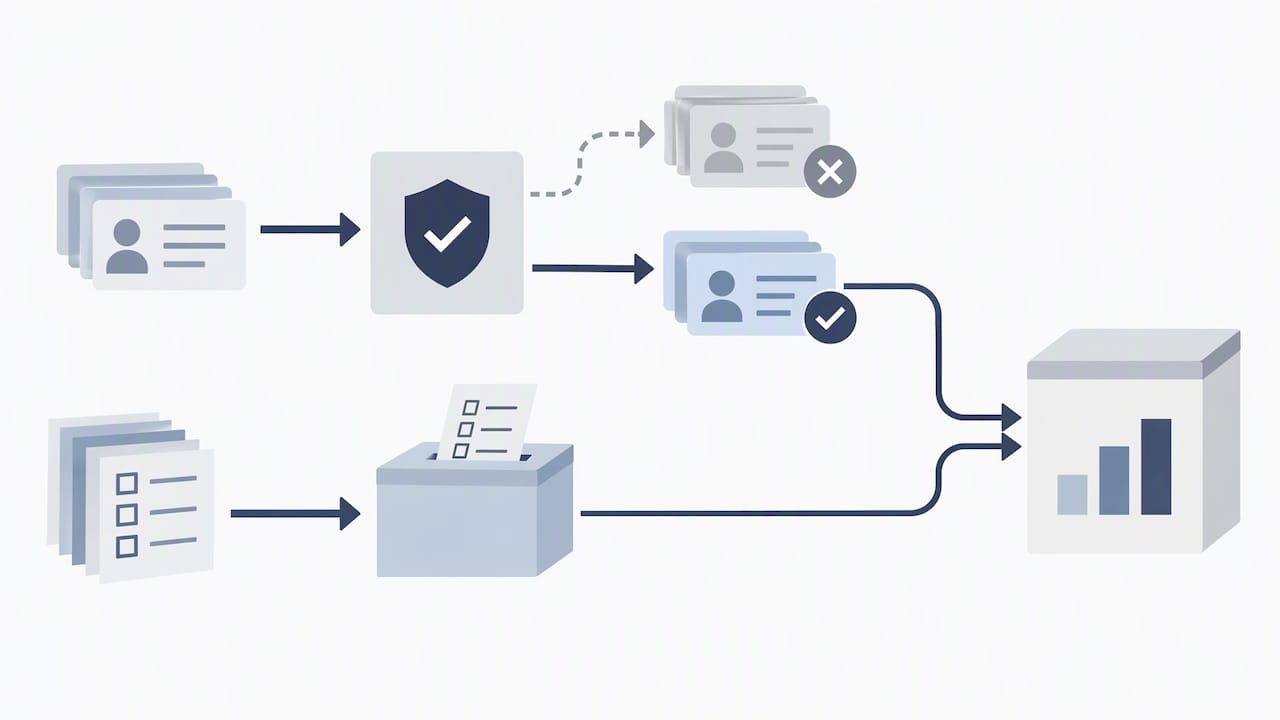
    Voter identity checked apart from the ballot

    Be transparent about the money

    Researchers studying incentives in voting find that the effect of payment on behavior depends on how openly it is handled. A working paper on vote-buying in controlled settings suggests that when participants feel a vote was bought, they may hold organizers less accountable. The practical lesson for a contest is to make every rule visible. Show live results, publish the vote price and publish the beneficiary split.

    Watch the moral hazard

    The BBC reported on US cities experimenting with cash prizes to lure people to the polls, and quoted experts who worry that incentives can crowd out the value of voting itself. In a fan award, that concern translates into a design question: are voters choosing the nominee they admire, or the one with the richest friends? Consider a few safeguards:

    • Cap the number of votes one person can buy per day or in total.
    • Run a free voting round alongside the paid round, so reach alone does not decide everything.
    • Let a judging panel score a share of the result, and say so up front.
    • Announce the winner’s margin and total raised, not just the name.

    A worked example

    Imagine a community theater running a “Best Local Hero” award for a spring fundraiser. It nominates twelve people, such as a crossing guard, a pharmacist and a youth coach. Votes cost $1 each, and the theater commits to give the proceeds, after fees, to a youth literacy nonprofit it has vetted in the IRS database.

    • Weeks 1 to 2: nominations open, including self-nomination, and photos and short profiles are added.
    • Weeks 3 to 5: voting is open. Each voter confirms an email address. The page shows live totals and a notice describing where the money goes.
    • Final day: voting closes automatically. The theater announces the winner at its gala and shares the total raised.
    • Within 30 days: the theater transfers the funds and posts a short confirmation with the amount.

    The numbers are illustrative only, but the pattern holds: a clear disclosure, a vetted beneficiary, a defined window, and a public wrap-up.

    Setting it up on Izivote

    Izivote is built for public audience awards and events, and the pieces a donation-based contest needs are already there:

    • Paid voting with payment handling. You set prices, and voters pay by card. Our paid voting page shows how charging per vote works.
    • Voting modes. Open, paid, login and identity-based voting, so you can match the level of verification to the stakes.
    • Nominee profiles with photos, multi-category voting and self-nomination.
    • Embeddable voting pages you can place on your own website.
    • Live results and analytics in an organizer dashboard, plus automatic vote closing.

    Our site lists several plans. The Free plan has no published price, which suits a small event. Pro costs $6 per month or $60 per year, and Premium costs $14 per month or $140 per year. Paid voting carries a platform fee of 10% per vote, which you should include when you calculate what the beneficiary will receive and what you disclose to voters. Check the pricing page for the current terms, and use our features overview to see what each plan includes.

    If you are launching a fan contest, the fan awards page and the awards and competitions page show typical setups. When you are ready, create your account and build your first voting page.

    A launch checklist

    1. Decide the model: vote for a nominee, vote for a cause, or paid votes with a stated share.
    2. Pick and vet the beneficiary using IRS records.
    3. Do the math, including payment processing, platform fees and any costs you will cover, and write the beneficiary share as a clear statement.
    4. Write public rules: price, caps, dates, tie-breaks, prizes, refund policy.
    5. Choose the voter verification level that matches the stakes.
    6. Add the disclosure text above the pay button.
    7. Test the full flow with a small purchase before opening to the public.
    8. Monitor the dashboard for unusual spikes, and respond to them according to your published rules.
    9. Close voting automatically, announce results, and pay the beneficiary on schedule.
    10. Publish a short wrap-up with the total raised and the amount sent.

    FAQ

    Is donation-based voting legal in the United States?

    For fan awards, school contests and charity events, charging for votes is a common practice. It is not acceptable in political elections, where federal law prohibits payments connected to voting, as set out in 18 U.S. Code § 597. If you plan prizes or raffles linked to voting, ask a lawyer about your state’s rules first.

    Are votes tax-deductible?

    Not automatically, and you should not suggest they are unless a tax professional or the charity has confirmed it. The FTC treats misleading claims about deductibility as a problem, so state clearly whether a payment is deductible. When in doubt, say that votes are not tax-deductible.

    How much of the money should go to the cause?

    That is your decision, but it must be stated clearly and honored. Include payment processing and platform fees in your calculation. On Izivote, paid voting has a 10% platform fee per vote, so build that into the figure you show voters.

    How do I stop one person from buying the whole contest?

    Set per-person caps, require identity verification, add a free voting round or blend in judges’ scores. Then publish those rules before voting starts. Transparent rules matter more than any single control.

    Sources

    Recommended

  • College Student Voting: Six Weeks to Avoid Ballot Mistakes

    College Student Voting: Six Weeks to Avoid Ballot Mistakes

    You can vote at your home address or your college address, but only in one place, and the rules differ by state. Do two things now: check your registration status online, and decide whether you need an absentee ballot or a plan for early or in-person voting. Tufts’ student voting research and the EAC voter guide show why early action matters, and we support school voting use cases at Izivote.

    Izivote
    Make Student Elections Easier to Run
    Izivote helps organizers run student elections with online voting, identity-based voting options, and a dashboard for monitoring votes.

    Explore Izivote

    Key Takeaways

    Register and vote early by understanding your options, deadlines, and technology to ensure your vote counts in student elections and beyond.

    PointDetails
    Choose your voting addressDecide whether to register at your home or college, as you can only vote in one location.
    Verify registration earlyCheck your registration status with your state’s official lookup and update it if necessary before voting.
    Use secure voting methodsUse in-person, early, absentee, or online voting systems that match your situation and follow security guidelines.
    Follow deadlines and rulesBe aware of registration, ID, and ballot return deadlines specific to your state to prevent disqualification.
    Promote digital voting participationIncrease voter engagement through reminders, candidate information, and easy-to-access online platforms.

    Table of Contents

    How do you register to vote as a student?

    You have two cross-state options. Many states let you register online, and the National Mail Voter Registration Form is another option. Both lead to the same place: a spot on the rolls for the address you choose.

    The choice of address matters. Vote that you may only vote in one jurisdiction, and registering in two states is a federal crime. Your pick also shapes which local races and ballot measures you see. The guidance for college students adds that you can usually register at home or where you attend school, depending on state residency rules.

    Have these ready:

    • Your full legal name and date of birth
    • A street address, not a campus mailbox, for your residence
    • Your driver’s license or state ID number, or the last four digits of your Social Security number where required
    • A mailing address if your mail goes somewhere different

    After you submit, look for a confirmation message or a card in the mail. If nothing arrives, call your local election office and ask them to verify.

    Which voting method fits your situation?

    Voting options include Election Day voting at an assigned polling place or vote center during set hours. Many states also offer early in-person voting, often with extended hours at central locations. The EAC voter guide covers hours, polling place services and absentee procedures.

    Absentee or mail voting works when you will be away. Eligibility rules vary by state, so confirm yours, then request your ballot through your state or local election office.

    Mail ballots are easy to get wrong. NSLVE’s national data notes that ballots can be rejected for these reasons:

    • A missing signature
    • Missing ID details where a state requires them
    • Incorrect postage
    • Missing witness or notary information in states that require it

    Mail ballots can be rejected over a missing signature, bad postage or missing witness details. Read every line of the instructions before you seal the envelope.

    A provisional ballot is a fallback. Poll workers offer one when your name is not on the rolls or your eligibility is in question. Election officials later check your registration, and your ballot counts if they verify it. Ask how to track its status.

    What deadlines and residency rules apply to you?

    There is no national registration deadline. NCSL’s deadline tracker shows that some states allow same-day registration through Election Day, while others close registration up to 30 days before the election. That gap can catch students, especially those who move between a campus and a hometown.

    Use this rule of thumb for residency:

    • If you will be physically on campus when voting happens, registering at your college address usually makes sense.
    • If you will be home, or you want your hometown ballot, register there and vote in person or by mail.
    • If you are unsure, look up your college state’s residency rules before you switch. Some states set time requirements.
    • Never register in two places.

    Where do you find the exact rules? Start with your state election office. The EAC state summaries link to each office and list tools for registration lookup, absentee and early voting information, and polling place search. Check these pages early, because options after a missed cutoff vary by state.

    How do you check your registration and prepare your ID?

    Verify your status before you rely on it. Use your state’s official lookup, which the EAC state pages link to. Check the lookup for your registration status and any details it provides, such as your address or polling place. A missing or outdated record is something you can still fix if you act early.

    1. Open your state lookup and enter your name and date of birth.
    2. Confirm your address matches where you want to vote.
    3. Note your polling place and early voting sites.
    4. Check your state’s ID rules in the EAC voter guide.
    5. Set aside an accepted ID.

    Acceptable ID differs by state, and some states do not accept a student ID. If your name or address does not match the rolls, update your registration, ask for a provisional ballot at the polls, and follow up with the local election office.

    Pro Tip: Take a photo of your registration confirmation and your ID so you can fix mismatches quickly.

    What should you do if you’re away from home?

    You have three main options, as Vote.gov’s student guidance describes them:

    • Register in your college state if you qualify.
    • Vote absentee from your home state.
    • Travel home to vote in person.

    Check your college state’s rules before switching registration, since some states set residency time requirements. The EAC voter guide is a good reference for absentee procedures.

    If you choose absentee, treat the mail as the weak link. Request your ballot early and confirm when it should arrive. Use a mailing address that reliably receives your mail, return it with time to spare and track it if your state offers that feature. Study abroad students face the same steps, with longer mail times, so they should start earliest.

    Where can you find campus help?

    Look to your student government, your civic engagement office and campus toolkits. The All In Campus Democracy Challenge reports that campuses with formal, nonpartisan voting plans and coalitions see turnout at least 5 percentage points higher than campuses without them. Institutionalized programs work because they remove barriers instead of relying on individual effort.

    Simple actions help:

    • Pledge to vote and ask friends to do the same.
    • Find a ride to the polls or organize a group trip.
    • Volunteer as a poll worker.
    • Use your campus voter toolkit for deadlines and reminders.

    Why does student turnout matter?

    Students already show up in meaningful numbers, yet a gap remains. In 2024, 76% of eligible college students were registered and 53% voted, a 70% yield among registered students. That means some registered students still did not vote, often because of logistics like ID, transportation or ballot submission.

    Campus structure matters, as All In’s impact data suggests. The habit starts earlier too. Research on internal campus elections reports that turnout is often under 20% and sometimes under 10% for student government contests. Voting in the races closest to you builds the routine that carries into national elections.

    What is the six-week checklist before an election?

    Work backward from Election Day. The sooner you verify, the more options you keep.

    1. Verify your registration and address well before Election Day, using your state lookup.
    2. Decide where you will vote, home or college, and register or update if needed.
    3. Request an absentee ballot now if you will be away.
    4. Confirm your ID matches your state’s rules.
    5. Locate your polling place and early voting hours, then arrange transportation.
    6. Return a mail ballot early, or vote in person, and track your ballot where possible.

    Pro Tip: Put each step in your phone calendar with a reminder, working backward from your state’s deadline.

    How do electronic and online voting systems work?

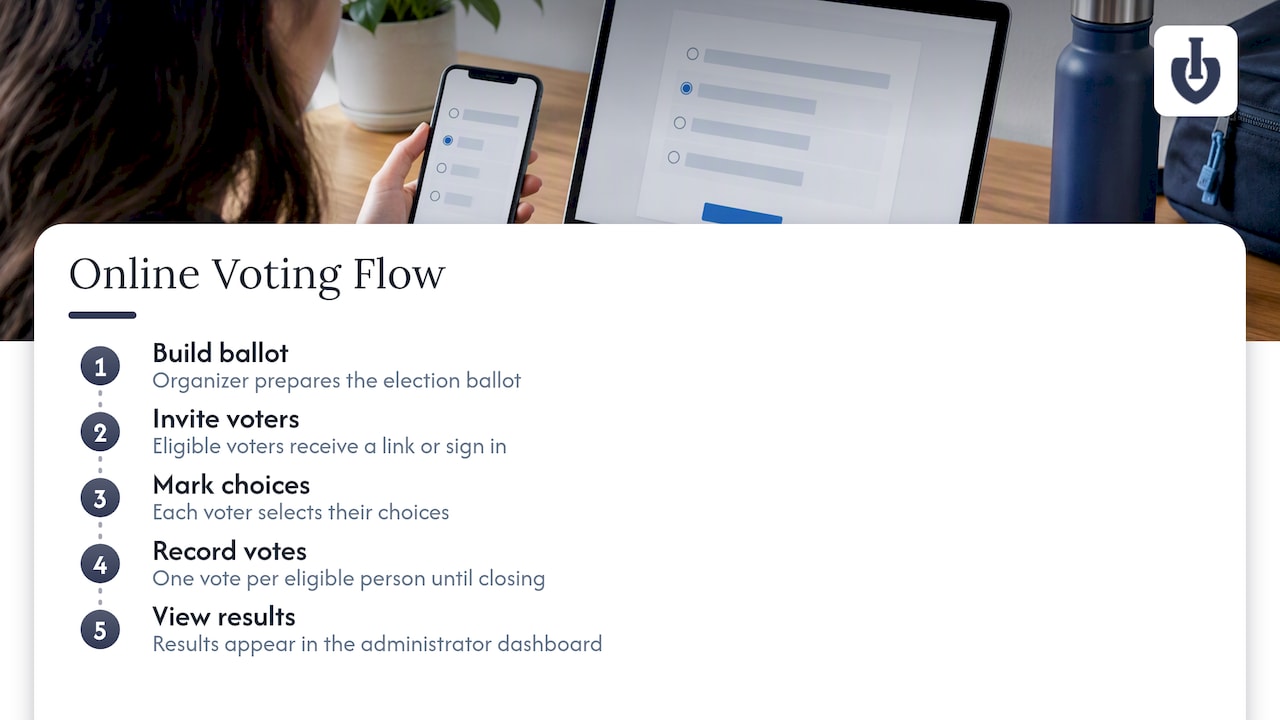
    Online voting for campus elections follows a simple flow. An organizer builds a ballot, eligible voters receive a link or sign in, each voter marks choices, and the system records one vote per eligible person before closing at a set time. Results then appear in an administrator’s dashboard.

    Five stages of an online campus election

    Security rests on several layers. Encrypted connections protect data in transit, so choices cannot be read between your device and the server. Authentication controls who gets in, which might be a school login, a unique code or a verified identity. Limits on repeat submissions guard against duplicate votes, and activity logs help administrators spot unusual patterns.

    Different elections need different safeguards. A high-stakes student government race should require sign-in tied to enrollment. A casual poll, like picking a mascot, can use lighter checks. We offer several voting modes at Izivote, including open, login-based and identity-based voting, so organizers can match the control level to the stakes. See our feature list for what each mode supports.

    Ask a few questions before choosing any system. Who can see raw responses? How is eligibility checked? What happens if a voter loses connection mid-ballot? Clear answers to these three questions tell you most of what you need.

    How do you protect voter privacy and ballot secrecy?

    Ballot secrecy means nobody can link your name to your choices. In student elections, that promise is easy to break by accident, for instance when a shared spreadsheet pairs email addresses with responses. A trustworthy setup separates the identity check from the ballot itself.

    Practical protections include:

    • Collecting only the data needed to confirm eligibility
    • Showing candidates and administrators aggregate results, never individual ballots
    • Limiting who can open the administrator dashboard
    • Setting a retention period and deleting voter data after certification
    • Telling voters in plain words what is recorded

    Candidates and their friends should never see how any individual voted. Leaders who run the election should avoid pressuring peers to vote in front of them, since public pressure undermines the secret ballot as much as any technical flaw.

    Transparency and secrecy can coexist. Publishing totals, vote counts per category and the election’s rules lets everyone trust the outcome without exposing anyone’s choices. If a platform offers an audit trail, confirm that it logs events like ballot submissions and closing times, not the content of each voter’s selections.

    When you evaluate a tool, read its privacy statement before launching. A short, specific statement beats a long, vague one every time.

    What role do mobile and online platforms play in student elections?

    Students live on their phones, so a ballot that works well on a small screen removes a major barrier. A mobile-friendly platform lets someone vote between classes, from a dorm or on a commute, rather than hunting for a polling table. That convenience can matter for commuter students, night students and those on remote placements, who may not regularly cross the quad.

    Purpose-built platforms also save organizers effort. Instead of printing ballots and counting by hand, leaders set up categories, add candidate photos and profiles, and share a link. Live dashboards show participation as it grows, so a club president can see whether a reminder is needed before voting closes.

    We built Izivote for this kind of work. Organizers can launch a vote quickly, embed the voting page on a school site, use multiple categories and rely on automatic closing at a set time. Our student elections page shows how schools and student government use it, and you can try it by creating a vote on our free create page.

    Platforms do not replace outreach. A clear ballot only helps if students know the vote exists, so pair the tool with announcements, posters and reminders.

    What challenges come up in online student voting, and how do you solve them?

    Three problems show up most often: proving who is voting, stopping repeat votes and keeping everyone informed.

    Authentication is the first. If anyone with a link can vote, results are easy to distort. The fix is to match the check to the stakes. Use school sign-in or identity-based voting for official elections, and keep open voting for informal polls.

    Multiple voting comes next. One person can submit many ballots from different devices or accounts. Solutions include one-ballot-per-account rules, limits per device or connection, and review of unusual spikes in activity. Always decide your rules before voting opens and publish them, so nobody argues about fairness afterward.

    Access is the third. Students without reliable internet, or with disabilities, may struggle with a digital ballot. Offer a campus computer lab or an in-person alternative, and test your ballot on small screens.

    Other pitfalls are easy to avoid:

    • Confusing ballot wording that splits votes between similar options
    • Unclear deadlines that cause last-minute complaints
    • No plan for disputes or recounts

    Write a one-page election plan that covers eligibility, authentication, timing and what happens if something goes wrong. Having that plan ready is often the difference between a smooth election and a messy one.

    How can student organizations boost digital voting participation?

    Participation grows when voting feels easy, visible and social. Start with timing: announce the election well ahead, repeat the date, and send a reminder on the day. Short messages with a direct link can be easier to act on than long explanations.

    Make the candidates easy to know. Post short profiles with photos and a sentence on what each person will do. Hold a quick Q&A or livestream so students can ask questions. People vote for someone they recognize.

    Use the channels students already read. Class group chats, club newsletters, campus social accounts and a spot on the student portal each reach a different audience. Ask professors to mention the vote in class, which may reach people who do not see a poster.

    Build momentum with a few simple tactics:

    • Set a participation goal and share progress
    • Run friendly competition between residence halls or clubs
    • Consider a fair incentive, such as a campus event raffle, if school rules allow
    • Thank voters afterward and share the results

    Links to our blog on online voting guides offer more ideas for running engaging votes. Above all, report the outcome and what leaders will do with it. Students vote again when they see that their ballots led to something.

    What legal considerations apply to digital student voting platforms?

    Student elections are not governed by the same laws as public elections, but they still carry rules. Your school’s student government constitution and election code usually set who may vote, who may run and how disputes get resolved. Start there, and follow it precisely, since a technical breach can invalidate a result.

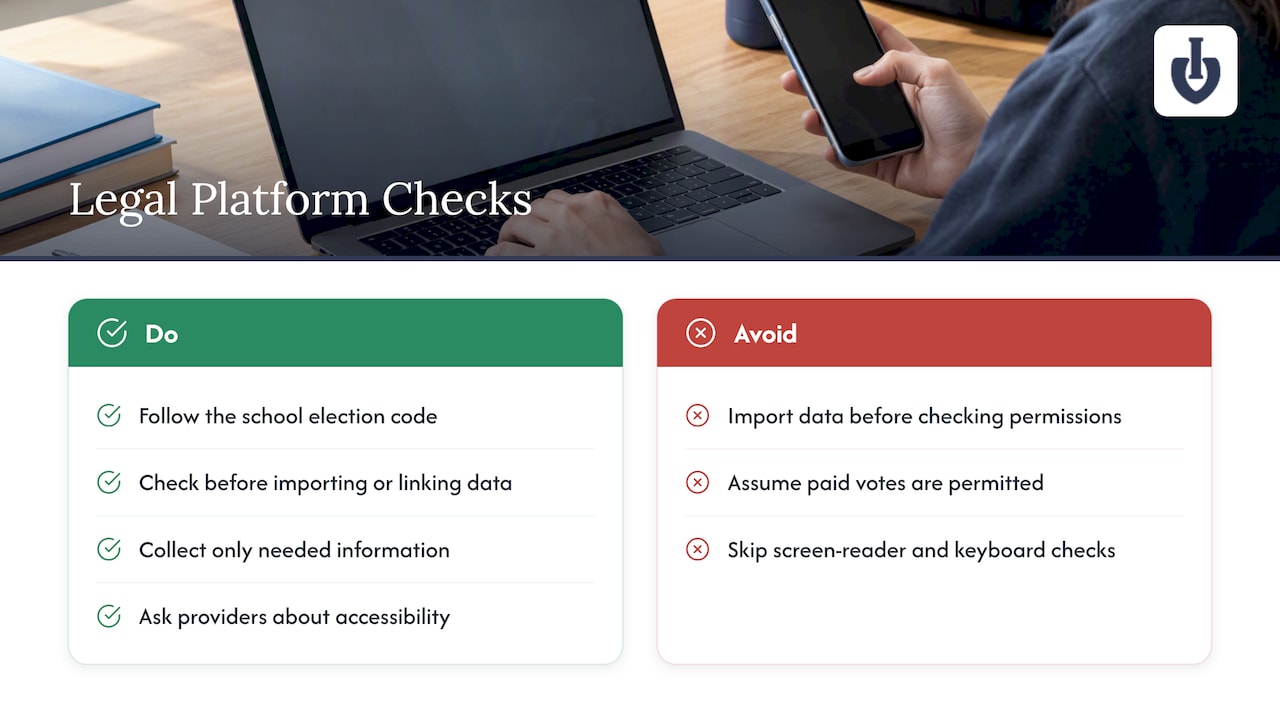
    Data protection is the other major area. Student information can be sensitive, and many schools restrict how it is shared. Before importing a roster or linking a student login, check with your administration about what is allowed. Collect only what you need and be clear about how it will be used.

    If a vote involves payments, such as a fundraiser with paid votes, extra rules may apply. Our paid voting adds a 10% platform fee per vote, as listed on our pricing page. Confirm with your school whether paid voting is permitted for official elections, since many institutions treat official student government races differently from charity contests.

    Accessibility matters too. A ballot should work with screen readers and keyboard navigation so every eligible student can take part. Ask any provider about accessibility before you commit.

    None of this replaces advice from your school. Speak to your student affairs office or an advisor if you are unsure, and keep written records of your election rules and decisions.

    What legal considerations apply to digital student voting platforms? — overview diagram

    FAQ

    What is the deadline to register to vote as a student?

    There is no national deadline. Some states allow same-day registration, while others require registration up to 30 days before the election. Check your state election office early.

    Can I vote at my college address or my home address?

    You can usually choose either, depending on state residency rules, but you may vote in only one place. Registering in two states is a federal crime. Pick the location where you will be present, or vote absentee from the other.

    How do I vote if I’m away at school?

    Register in your college state if you qualify, request an absentee ballot from your home state, or travel home to vote in person. Request mail ballots early. Read the instructions closely, since missing signatures or witness details can lead to rejection.

    Does my student ID count as voter ID?

    It depends on the state. Some states accept a student ID and some do not, so check your state’s rules in the EAC voter guide. Bring a second accepted ID if you are unsure.

    What if my name is not on the voter list at the polls?

    Ask for a provisional ballot. Election officials check your registration afterward and count the ballot if they verify it. Follow up with your local election office.

    Sources

    Recommended

  • People’s Choice Awards Setup for Organizers: Match Checks to Stakes

    People’s Choice Awards Setup for Organizers: Match Checks to Stakes

    To run people’s choice awards setup quickly and safely, use a purpose-built, self-serve online voting platform such as Izivote, then work through the checklist below. Build your process around the usability and transparency principles in NIST’s VVSG guidance, and plan to publish a short verification summary after the vote closes. That one habit does a lot for your legitimacy.

    Izivote
    Run a More Transparent Awards Vote
    Izivote helps organizers run people’s choice awards with clear, secure voting, real-time analytics, and a user-friendly dashboard.

    Get started

    Key Takeaways

    Using a purpose-built online voting platform like Izivote ensures transparency, security, and ease in managing people’s choice awards effectively.

    PointDetails
    Define rules earlyEstablish nomination categories, eligibility, and voting rules before collecting nominees to avoid confusion later.
    Match voting method to stakesChoose a voting process that aligns with your event’s importance, balancing ease of use and security.
    Design clear ballotsCreate simple, mobile-friendly ballots with consistent nominee presentation and limits on choices to boost participation.
    Layer anti-fraud controlsImplement multiple defenses such as rate limits, device fingerprinting, and verification to prevent gaming the vote.
    Use Izivote for streamline managementIzivote offers customizable voting options, live result tracking, and proven reliability for events worldwide.

    Table of Contents

    What should you finish before building the vote?

    Scan this list before you touch any software:

    • Define categories, eligibility and nomination rules before you collect a single nominee.
    • Pick a voting method that fits your stakes: open, login-gated, identity-verified or paid.
    • Gather nominee photos and short bios, and decide between single-choice and ranked ballots.
    • Set anti-fraud guardrails and write down who decides when to pause voting.
    • Schedule a load test and a dry run, and plan to publish audit logs after close.

    Each item gets its own section below.

    How do you plan categories, rules and a timeline?

    Start with the structure, because every later decision depends on it. Choose between open nominations, where anyone can suggest a nominee, and a curated shortlist your team assembles. Whichever you pick, write the process down and publish it.

    Then work through these steps in order:

    1. Write eligibility rules that say who can nominate and who can vote.
    2. Set a tie-break policy now, such as a runoff round or a shared win, so you never improvise under pressure.
    3. Build the timeline: nomination window, verification window, voting window, then an audit and appeal period.
    4. Add lead time for assets. Photos and bios arrive late more often than not.
    5. If you plan paid voting, budget for fees. On Izivote, paid voting carries a 10% platform fee per vote, so factor that into any fundraising target.

    A realistic timeline gives you room to promote the vote and still leave a few days to check results before the ceremony.

    Which voting method fits your event?

    Match the method to what is at stake. A local fan favorite poll and a nationally watched industry award need very different protection, and the Financial Conduct Authority’s speech on calibrating controls makes the same point: simple browser-based duplicate prevention may be enough for low-stakes polls, while high-stakes awards call for stronger checks such as single sign-on or phone-based authentication.

    • Open voting: lowest friction and the highest turnout, but the easiest to game.
    • Login gating: email and password add a speed bump for repeat voters without much effort for real ones.
    • SSO or phone verification: the strongest one-person-one-vote protection, at the cost of more steps.
    • Paid votes: good for raising money, but you take on payment handling and platform fees.

    Keep the voter’s effort in mind. Research on voting design cautions that over-complicating the flow suppresses participation, for example by forcing email confirmation on every vote.

    Pro Tip: Use device fingerprinting or single sign-on to enforce one vote per person while keeping the ballot to one or two taps.

    Our features page lists the verification modes we support.

    How should you design ballots and nominee pages?

    A ballot should be obvious at a glance. Voters on a phone, in a hurry, will abandon anything confusing.

    • Use one clear call to action and a consistent nominee order within each category.
    • Set sensible limits on how many choices a voter can make.
    • Specify nominee assets up front: one image size and aspect ratio for everyone, plus a bio of a couple of sentences.
    • Design mobile first, with readable labels and full keyboard navigation.
    • Offer audio or other alternatives where you can. VVSG 2.0 describes accessibility modes including visual, audio, touch and limited dexterity.
    • For multi-category ballots, group categories on one scrolling page or one step per category, and use ranked layouts only when the format truly needs them.

    Before launch, run your ballot past a few people who have never seen it. The NIST usability handbook recommends prototype testing early and complete voting-session testing before deployment.

    Which anti-fraud controls and tests do you need?

    Layer your defenses, adding more as the stakes rise.

    • Rate limits and IP throttling to slow bulk voting.
    • Device fingerprinting to catch repeat voters.
    • SMS or phone verification for sensitive categories.
    • SSO where your audience already has accounts.

    Watch for vote spikes, odd geographic patterns and repeated identical behavior. Decide your escalation steps in advance: pause the window, investigate, then communicate. Prepare a short message for nominees whose votes are disqualified, stating what happened and how to appeal.

    Venue Wi-Fi often cannot handle high concurrency, so test simultaneous connections before your event. If you plan to show live voting on site, simulate the crowd or batch requests rather than trusting the room’s network.

    Run a full rehearsal at least a few days before launch, with test votes, a simulated spike and a practice pause.

    What does a live voting runbook look like?

    Write your runbook so anyone on the team can follow it:

    1. Confirm start and stop controls and the countdown timer.
    2. Open voting and check the first votes arrive correctly.
    3. Monitor your dashboard at a fixed cadence.
    4. Close voting at the announced time and freeze results.
    5. Finalize and verify winners before announcing them.

    If you show live results at the ceremony, decide the refresh rate, which screen displays them and whether nominees see counts before the reveal. Our results and presenting guide covers the display options. Prepare fallbacks: freeze results, announce winners manually, or name provisional winners if something looks wrong. Tell voters and nominees plainly how progress will be shared.

    How do you audit results and report transparently?

    After close, check the results before you celebrate them.

    • Review timestamped logs and anonymized records for unusual patterns.
    • Publish a short summary of your verification steps, any disqualified votes and your methodology. Deloitte’s research on transparency notes that explaining how results were verified reduces skepticism and raises perceived legitimacy.
    • Encrypt personal data, delete what you no longer need and state your retention policy. The Cratos principles recommend encryption, deletion of personal data and auditability of processes.
    • For high-stakes awards, invite an independent party to verify the count.

    Why do we recommend Izivote for people’s choice awards?

    Izivote

    We built Izivote for exactly this job. You can set up a vote yourself, choose from open, paid, login-based or identity-based voting, show nominee photos and profiles, and watch live results on a real-time dashboard. Votes have been cast across events in multiple countries, and our customer stories show how organizers use it.

    Start with a free vote, run your rehearsal, then compare plans on our pricing page. For more detail on awards workflows, see our people’s choice use case. When you are ready, create your free vote and send the link to your team for a dry run today.

    Why do we recommend Izivote for people's choice awards? — overview diagram

    FAQ

    How long should a people’s choice vote stay open?

    Long enough to promote and short enough to keep energy high. Many organizers run a nomination window, a verification window and then a voting window, with an audit period at the end. Set the dates before you announce anything.

    Do I need voter verification for a people’s choice award?

    It depends on the stakes. For a casual fan poll, simple duplicate prevention may be enough, but high-stakes awards need stronger checks such as single sign-on or phone verification.

    Can I show live results at the ceremony?

    Yes, if you plan for it. Test your connection first, because venue Wi-Fi often struggles with many devices at once. Keep a fallback ready, such as freezing results and announcing winners manually.

    How do I prove the results are legitimate?

    Publish a short verification summary that describes your checks, any disqualified votes and your method. Keeping timestamped logs makes that summary easy to write.

    Sources

    Recommended

  • Monetize Fan Voting: The 10% Fee, Sponsors, and Fairness

    Monetize Fan Voting: The 10% Fee, Sponsors, and Fairness

    Charge-per-vote pricing and bundled micropayments run on a purpose-built voting platform are the fastest practical way to turn fan engagement into reliable revenue. We built Izivote around this model, pairing paid voting with real-time dashboards so organizers can launch a campaign and start collecting funds within days. The roadmap below covers pricing, formats, setup, and fairness safeguards that keep campaigns both profitable and credible.


    TL;DR:

    • Izivote charges a 10% fee on each paid vote, while payouts follow the processor’s schedule rather than the campaign’s closing date.
    • Ranked voting or point distribution can feel fairer than ballots with one option; add a judges’ save for close calls and publish rules before launch.
    • Per vote sales work best with an engaged audience; smaller events should weigh sponsorships more heavily, and forecast revenue from conversion, votes, and price.
    • Reserve bundle discounts for the final 48 hours, and use daily leaderboard resets or vote limits to sustain participation and curb runaway spending.

    Izivote
    Turn Fan Votes Into Event Revenue
    Izivote supports paid voting, identity-based methods, and real-time analytics for organizers running fan and people’s choice awards.

    Get started with Izivote

    Table of Contents

    How paid voting works: mechanics, payment flows, and hosting

    Paid voting is straightforward in concept: a fan selects a nominee, pays for one vote or a bundle, and the payment confirmation triggers an immediate tally update. Getting the mechanics right is what separates a campaign that feels trustworthy from one that invites complaints.

    Organizers need to configure a few things before launch:

    • Payment flow: connect a processor that confirms the charge and records the vote in the same transaction, so counts update live rather than after a batch delay.
    • Authentication: decide whether voters log in, verify by email or phone, or vote anonymously, since identity checks reduce duplicate or bot-driven votes.
    • Hosting choice: use a hosted vote page for speed or embed the voting widget directly on an existing event site for brand continuity.
    • Dashboard visibility: give staff and sponsors a live view of totals so results, and revenue, are transparent as the campaign runs.

    A platform fee typically applies per transaction rather than as a flat subscription cost, and settlement usually follows the payment processor’s standard payout schedule rather than the vote closing date. Clarifying these details before launch avoids disputes once voting opens.

    Pricing and revenue models: sample options and simple forecasting math

    Most fan voting campaigns combine a few pricing structures rather than relying on one:

    1. Price-per-vote: a flat charge for a single vote, simplest to explain to fans.
    2. Bundles: discounted packs (five votes, ten votes) that raise average spend per voter.
    3. Donation tiers: a vote tied to a charitable minimum, common in fundraiser formats.
    4. Subscriptions or passes: a flat fee for unlimited voting during a window, useful for long campaigns.

    A simple forecasting model multiplies expected attendance by conversion rate, by average votes per converted voter, by price-per-vote. For example, a campaign with thousands of engaged fans, a low single-digit conversion rate, a few votes per converter, and a $1 price-per-vote can generate several hundred dollars in gross vote revenue before the platform fee.

    Izivote applies a 10% platform fee per paid vote processed through the platform, so organizers can build that cost directly into their forecasts rather than discovering it after settlement. Bundles and short-term surge pricing during finals tend to raise average revenue per voter, and branded category sponsorships (a sponsor underwriting “Best Newcomer,” for example) add a second revenue stream layered on top of direct vote sales.

    Formats and use cases that monetize best

    Fans respond differently depending on how a vote asks them to express a preference. Simple approval voting (one click, one choice) is fast but shallow. Ranking or point-distribution formats let fans signal intensity, and behavioral research on digital voting design finds these expressive formats correlate with higher perceived fairness and stronger ongoing engagement than single-choice approval votes.

    Formats and events that tend to monetize well include:

    • Fan choice awards with multiple nominee categories and photo profiles.
    • Talent shows and creator contests with elimination rounds that reward repeat voting.
    • Pageants where ranked voting adds perceived legitimacy to results.
    • Fundraisers where a vote doubles as a small donation.

    Leaderboards that reset daily, or that apply decaying point values, keep competitions from going stale when one nominee builds an early lead. Pairing votes with exclusive content, backstage passes, or merchandise discounts gives fans a reason to buy more than one vote.

    Pro Tip: Offer a bundle discount only during the final 48 hours of voting, it creates urgency without undercutting early-campaign revenue.

    Implementation checklist: step-by-step setup and launch tasks

    Launching a paid voting campaign is mostly a sequencing problem. A practical order looks like this:

    1. Pick the format and pricing tiers: decide on ranking versus approval voting and set per-vote or bundle prices.
    2. Build nominee pages: add photos, short bios, and category assignments, then choose hosted or embedded voting.
    3. Connect payments and confirm fees: test transactions end to end before opening voting to the public.
    4. Turn on fraud controls: enable identity or login verification where duplicate voting is a risk.
    5. Activate analytics: confirm the real-time dashboard is tracking votes and revenue accurately.
    6. Prepare marketing assets: share-ready graphics, sponsor messaging, and published voting terms should be ready before launch day.

    Running a short pre-launch test with a handful of real transactions catches payment or display issues before they affect paying voters.

    Best practices to protect fairness, sustain engagement, and reduce churn

    Revenue depends on fans trusting the result. A hybrid model, mixing fan votes with a judges’ panel that holds a save or override on close calls, preserves credibility without eliminating the fan-driven appeal. Research on explainable voting audits found that a dual-safeguard system combining rank-based aggregation with a judges’ save substantially reduced unfair eliminations compared to simple percentage-based tallying, while keeping audience engagement intact.

    A few safeguards consistently hold up:

    • Favor ranking or point-distribution inputs over single-choice approval, since expressive formats are tied to higher perceived fairness.
    • Apply daily leaderboard resets or decaying point values to prevent one early leader from discouraging later voters.
    • Cap votes per account or session to limit runaway spending by a single voter.
    • Publish voting rules, windows, and result timelines before the campaign opens, not after.

    Hybrid systems that combine rank-based aggregation with expert intervention substantially reduce historical unfair eliminations while preserving engagement.

    That kind of transparency matters more when money is involved, since fans scrutinize paid results far more closely than free ones.

    Author perspective: quick trade-offs and operational tips

    Paid voting reliably pays off when a nominee pool already has an engaged following, think fan awards or talent contests. When the audience is smaller, sponsorships usually carry more weight than per-vote revenue.

    Audience size compared with paid votes and sponsorship

    Watch for leaderboard fatigue: once a result looks locked in, voting drops off fast. Unclear terms about refunds or vote limits are the other common complaint.

    My practical advice: price for volume, not margin, and spend more effort on fairness perception than on squeezing extra cents per vote.

    — Joshua

    Izivote: implement paid voting, analytics, and embeds

    We built a voting platform specifically for fan and people’s choice awards, which means organizers skip the setup work a generic form tool would require. Paid voting, identity-based voting, and open voting all run on the same dashboard, so switching formats between categories or events takes minutes rather than a rebuild.

    Izivote

    What organizers get with us:

    • Self-serve setup that launches a voting page without a developer.
    • Embeddable voting widgets that keep the experience on an organizer’s own site.
    • Real-time dashboards showing vote counts and revenue as they happen.
    • Multiple voting modes, including paid, login-based, and identity-verified voting, selectable per category.

    Our plans start with a free tier for small events and scale to paid plans for larger campaigns with more categories and features. Check Izivote pricing to compare plans and see the paid voting fee structure before you launch.

    FAQ

    What does paid voting mean for a fan awards campaign?

    Paid voting means fans pay a small fee, either per vote or in a discounted bundle, instead of voting for free. Organizers keep the revenue minus the platform fee, which on Izivote is a flat 10% per vote processed.

    How much can a fan voting campaign realistically earn?

    Earnings depend on audience size, conversion rate, and price-per-vote, so there’s no single figure that applies everywhere. A rough estimate comes from multiplying expected voters by conversion rate, average votes per voter, and price, which gives organizers a conservative revenue band before launch.

    How long does a paid voting campaign typically run?

    Most fan voting campaigns run anywhere from a few days for a single event to several weeks for a multi-round talent contest or awards season. Shorter campaigns tend to use daily leaderboard resets, while longer ones often add bundle discounts near the close to sustain late-stage voting.

    What keeps a paid voting result from feeling unfair to fans?

    Publishing clear rules, voting windows, and result timelines before the campaign opens is the single biggest factor in perceived fairness. Using ranking or point-based voting instead of simple approval, and adding a judges’ save for close calls, also helps preserve credibility.

    What legal or compliance steps matter when monetizing votes?

    Payment processing needs to meet standard card-processing compliance, and voter data should be handled under applicable privacy rules for the regions where fans are voting. Organizers running fundraising-tied votes should also confirm local rules on charitable solicitation before launch.

    Recommended

  • Award Nomination Forms Online: 6 Fields, When to Add Voting

    Award Nomination Forms Online: 6 Fields, When to Add Voting

    Use a ready-to-use no-code nomination form template, or a downloadable Word or PDF template, to collect consistent, judge-ready nominations. These options cover most internal, school, and community awards without extra setup. Upgrade to a full platform only when you need reviewer scoring workflows, public voting, or paid-vote fundraising built into the same process.


    TL;DR:

    • Word and PDF forms suit low volume awards collected by email or in person, while builder templates add uploads, conditional questions, and automatic closing.
    • Require nominee and nominator details, a fixed award category, achievement statement, timeframe, and optional evidence; set upload limits and obtain publication consent.
    • Define eligibility rules, scoring criteria, and a retention period before launch, then restrict reviewer exports to evaluation fields and track disqualifications separately.
    • Verify nominator emails, add a bot check, and flag duplicates with a unique nominee identifier; publish only approved nominees for any public vote.
    • Send a reminder about a week before the deadline, since nominations often arrive in the final 48 hours; include examples of strong achievement statements.

    Izivote
    izivote.com
    Move from Nominations to Voting
    When your award is ready for public voting, Izivote helps organizers run secure, transparent votes and monitor results with real-time analytics.

    Explore the voting platform

    Table of Contents

    Where to find ready-to-use nomination form templates

    Three types of templates cover almost every award program, and each one fits a different scale of event.

    Downloadable Word and PDF templates work best for low-volume or internal awards where you collect nominations by email or in person. They print well, require no software setup, and are easy to adapt for a staff recognition program or a small club award.

    No-code form-builder templates handle higher volume and more complex requirements. Pages like Typeform’s awards nomination form template, Jotform’s awards nomination form, and Formpl support file uploads, conditional logic, and automatic form closing at a set deadline. You can publish one of these in under an hour and share it by link, embed, or QR code.

    Template libraries and AI-assisted generators sit between the two. They let you start from a near-finished layout and adjust fields, wording, and branding quickly, which suits organizers running an annual award who want a fresh look without rebuilding the form from scratch.

    • Internal or small-scale awards: a Word or PDF template distributed by email is usually enough.
    • Community, school, or industry awards with many nominators: a no-code builder template handles volume and file uploads better.
    • Public or fan-voted awards: a template still works for intake, but you will need a separate voting step once nominations close.

    The right starting point depends less on how “official” the award feels and more on how many nominations you expect and whether reviewers need to score or compare them side by side.

    What fields belong on a judge-ready nomination form

    A nomination form only works if every submission gives reviewers the same information in the same format. Based on the field sets used across major template providers, a solid form includes:

    1. Nominee details: full name, title or role, organization or department.
    2. Nominator contact information: name, email, and relationship to the nominee.
    3. Award category, selected from a dropdown rather than typed in freely.
    4. A concise achievement statement describing why the nominee qualifies.
    5. The relevant timeframe (the period the achievement or contribution covers).
    6. Optional supporting evidence: a letter of endorsement, a short CV, or images.

    Typeform’s template guidance confirms these fields as standard across employee, student, member, and community award forms. For supporting documents, set clear file-type and size limits upfront. The Zayed Award for Human Fraternity nomination form caps its letter of endorsement at 1,000 words and specifies accepted upload formats, which is a useful benchmark for your own limits.

    Word limits and short hint text under each field push nominators toward focused, comparable answers instead of long, unstructured essays. Add a plain-language checkbox asking for permission to publish the nomination and use any submitted photos if the nominee wins.

    Pro Tip: Cap the achievement statement at a moderate length to ensure succinct and focused entries. Reviewers read faster, and nominators write tighter, more specific entries.

    Customizing and sharing your nomination form

    Once your fields are set, a few configuration choices determine whether the form feels easy or clunky to fill out.

    • Use conditional logic so category-specific questions only appear after the nominator selects a category, keeping the form short for everyone.
    • Match the form’s branding, colors, and header image to your event or organization to build trust and reduce drop-off.
    • Set a visible deadline with a stated time zone, an automatic close date, and a confirmation email sent to each nominator.
    • Share the form through whichever channel reaches your audience fastest: a direct link, an embedded widget on your event page, a QR code on printed materials, or a line in an email newsletter.

    Formpl.us and Cognito Forms both note that templates publish quickly, but larger programs still need reviewer access controls, scheduled notifications, and export options once nominations start arriving. Build those settings in before you share the link, not after submissions begin.

    From nomination to final decision: the typical workflow

    Most award programs, regardless of size, move through the same sequence of stages. The HRSA condition nomination process is a useful public example of how a staged review structure works in practice: intake, eligibility screening, committee evaluation, and a final recommendation.

    For a public or member-voted award, the stages typically look like this:

    • Nomination intake: the form collects entries until the deadline closes.
    • Eligibility and administrative review: staff check for completeness and basic qualification.
    • Committee scoring: reviewers rate nominees against a shared rubric.
    • Shortlist publication: qualifying nominees move forward with public profiles.
    • Voting or ranking: the audience or a judging panel ranks the shortlist.
    • Final approval: results are confirmed and winners are notified.

    A staged review and voting process like this gives large or high-stakes award programs a documented, auditable path from first submission to final decision.

    A template handles the first stage well on its own. You need a platform once reviewer scoring, public voting, paid voting, audit logs, or real-time dashboards become part of the requirement, because stitching those features onto a basic form usually means manual spreadsheet work and lost data.

    A quick pre-launch checklist worth running every time

    Before publishing any nomination form, I run three checks: are categories and evaluation criteria clearly defined, are file and word limits set so submissions stay comparable, and is the close date locked to a stated time zone with a notification flow in place for nominators and reviewers.

    A platform with built-in reviewer controls and live dashboards removes most of the manual tracking that makes nomination season stressful for organizers.

    — Joshua

    Verifying eligibility and catching duplicate nominations

    Eligibility problems and duplicate entries cause most of the late-stage headaches in award programs, so it pays to design the form to catch them early.

    Ask nominators to confirm eligibility criteria directly on the form, such as tenure, membership status, or geographic region, rather than assuming they have checked the rules elsewhere. A required checkbox or short eligibility question filters out a share of ineligible entries before they ever reach a reviewer.

    For duplicates, require a unique identifier for each nominee, such as an employee ID, member number, or email address, so your form or spreadsheet can flag repeat entries automatically. Many no-code builders support a duplicate-detection rule based on a specific field; set this up before the form goes live rather than cleaning duplicates manually afterward.

    Keep a running list of nominees as submissions arrive, and cross-check new entries against that list weekly rather than waiting until the deadline. This catches both duplicate nominations for the same person and nominations submitted under slightly different name spellings. For larger programs, assign one reviewer to eligibility screening specifically, separate from the committee members scoring the content of each nomination, so eligibility checks don’t bottleneck the scoring process.

    Keeping your nomination form secure from fraudulent entries

    A nomination form that collects names, contact details, and sometimes photos needs basic safeguards against spam and manipulated submissions.

    Add a CAPTCHA or similar bot-check to block automated spam submissions, which is standard on most no-code form builders without extra cost. Limit one submission per nominator per nominee where your form tool supports it, which cuts down on repeat or coordinated entries meant to inflate a single nominee’s visibility.

    Require a verifiable nominator email address rather than allowing anonymous submissions. This single step discourages most fraudulent entries, since nominators know their submission is traceable. For public or fan-facing awards, keep nomination intake and any public voting completely separate: verify and shortlist nominees first, then publish only the approved shortlist for voting. Cognito Forms’ guidance on award nomination workflows recommends this separation specifically to prevent unverified or low-quality entries from appearing in a public ballot.

    Finally, request explicit consent for data use and publication at the point of submission. The National Privacy Commission’s nomination form guidance notes that a clear privacy statement, stated retention period, and contact point for data correction all belong on the form itself, not in a separate policy document nominators have to go looking for.

    Keeping your nomination form secure from fraudulent entries — overview diagram

    Moving from nomination intake to the voting phase

    Once your shortlist is finalized, the transition to voting works best as a distinct second step rather than an extension of the same form. Export your approved nominee list, including names, categories, and any photos or profile text you plan to display publicly.

    A spreadsheet export from your nomination form typically includes everything you need to build voting profiles: nominee name, category, submitted bio or achievement statement, and any uploaded image. Match this data against your voting tool’s import format before the shortlist goes live, since reformatting after voting opens creates delays.

    If your award includes a public or fan vote, this is the point where a dedicated voting setup, rather than a second form, becomes worth considering. A platform built for online voting for awards and competitions can take an approved shortlist directly into a branded voting page with photos, categories, and live results, without requiring a second round of manual data entry. Confirm your voting window, time zone, and any vote-limit rules before publishing the shortlist publicly, since changing these mid-vote undermines trust in the result.

    Award nominations moving into public voting

    Promoting your nomination form to get enough entries

    A well-built form still needs visibility, and most award programs underestimate how much reminder communication nominations actually require.

    Share the form link across every channel your audience already uses: email newsletters, social posts, and any event or organization website where you can embed the form directly rather than linking out. A QR code on printed flyers or at in-person events works well for awards tied to a physical venue or conference.

    Send at least one reminder email roughly a week before the deadline, since a meaningful share of nominations typically arrive in the final 48 hours of any open call. Give nominators a short list of example achievement statements or past winners (where privacy allows) so they understand what a strong nomination looks like before they start writing. Clear, specific hint text on the form itself does some of this work automatically, as Typeform’s design guidance notes: shorter prompts and category-specific questions tend to increase both completion rates and the usability of what gets submitted.

    If your award program runs annually, keep a short list of past promotion channels that worked and skip the ones that didn’t, so each cycle gets faster to launch than the last.

    Managing nomination data after submissions close

    Once the deadline passes, how you handle the incoming data determines how smoothly the review stage goes.

    Export all submissions into a single spreadsheet or dashboard view as soon as the form closes, rather than letting entries sit scattered across email and form-tool exports. Most no-code builders support a direct CSV or Excel export, which should include every field plus a timestamp and submission ID for tracking.

    Build a simple reviewer-facing version of this export with only the fields judges need to see: nominee name, category, achievement statement, and any supporting files. Strip out nominator contact details from the reviewer copy unless your process specifically calls for reviewers to know who submitted each entry.

    Keep a separate record of eligibility decisions and duplicate flags, so you can explain any disqualification later if a nominator asks. Set a clear data retention period for nomination records, consistent with the privacy statement on your form, and delete or archive entries once that period ends. This keeps your records manageable for next year’s cycle and avoids holding onto personal data longer than your stated policy allows.

    What most nomination-form advice gets wrong

    Most guidance on award nominations spends its energy on form design: field order, button colors, how many questions is too many. That matters, but it is not where programs actually run into trouble. The real failure point is the gap between intake and decision: nominations arrive, pile up in a spreadsheet, and nobody has a clear rule for scoring, eligibility, or what happens to the data afterward.

    A good template solves the first problem. It does nothing for the second. If you only remember one thing from this guide, make it this: decide your scoring rubric and your data retention rule before you publish the form, not after nominations start arriving. Everything else, branding, word limits, file formats, is secondary to having a reviewer process that can actually handle what the form collects.

    Organizers who skip this step usually end up rebuilding their process midway through, after the first batch of nominations exposes a rule nobody agreed on.

    — Joshua

    When a voting platform makes more sense than a form alone

    A template covers nomination intake well. Once your award includes public or fan voting, especially with paid votes or multiple voting rounds, a dedicated platform removes a lot of the manual work that a form and spreadsheet combination can’t handle on its own.

    Izivote

    We built a platform specifically for public and people’s choice awards, where nomination intake needs to flow directly into secure, branded voting. The platform supports:

    • Embeddable nominee profiles with photos, pulled straight from your approved shortlist.
    • Multiple voting modes, including open voting, login-based voting, and paid voting with payment handling built in.
    • Live result dashboards so organizers and audiences can watch standings update in real time.
    • Automatic vote closing and real-time analytics, so you are not manually tracking a deadline across spreadsheets.

    This setup fits fan awards, school and student election voting, and community or club awards where public engagement matters as much as the final result. Our pricing page lists our Free plan alongside Pro at $6 per month ($60 per year) and Premium at $14 per month ($140 per year), plus a 10% platform fee on paid votes. If your award is ready to move from nominations into a public vote, check our people’s choice awards use case to see how the setup works end to end.

    FAQ

    What should you write when nominating someone for an award?

    Focus on a specific, concise achievement statement that explains what the nominee did, who it affected, and when it happened, rather than a general description of their character. Reference the exact award category criteria so reviewers can match your statement to what they’re scoring, and keep it within any stated word limit.

    How do you get nominated for an award?

    Nominations typically come from colleagues, members, or community contacts who submit a form on your behalf, so visibility and a track record in your category matter more than directly requesting a nomination. Some programs also allow self-nomination, which is worth checking in the award’s stated eligibility rules.

    Is it okay to nominate yourself for an award?

    Self-nomination is allowed by many award programs and is explicitly permitted on some nomination forms, so check the specific program’s rules rather than assuming it’s off-limits. When self-nomination is allowed, the same evidence standards apply: a clear achievement statement and any required supporting documents.

    Can you share an example of how to write an award nomination?

    A strong nomination opens with a one-sentence summary of the achievement, follows with two or three specific examples or outcomes, and closes with why the contribution fits the award category. Template pages like Typeform’s awards nomination form include hint text and category prompts that model this structure directly on the form.

    What is the difference between a nomination form and a voting platform?

    A nomination form collects and organizes entries for review, while a voting platform takes an approved shortlist and runs public or member voting on top of it, often with live results and payment handling for paid votes. Programs that only need to collect and score nominations can use a form alone; programs adding a public vote typically need both.

    Sources

    Recommended

  • How to Run Award Show Voting: The Complete Guide

    How to Run Award Show Voting: The Complete Guide

    Whether your final ceremony is a glittering in-person gala or a live-streamed event, the first time you run online awards voting, things tend to break in the exact same two places. Nominations devolve into a chaotic flood of DMs and emails, and on announcement night, someone inevitably claims the results were rigged.

    Neither of these is a software problem. Both are solved by structural decisions you make weeks before a single vote is cast. If you want to run a flawless award campaign, here is the proven framework to keep your nominations organized, your voting secure, and your final results bulletproof.

    Start With Your Purpose and Categories

    Before you name a single category, define what winning actually means. A career-boosting industry award requires strict integrity rules, while a local community volunteer award relies more on tone than audited vote counts. Defining your core purpose settles future debates.

    When it comes to building your ballot, resist the urge to add categories just so more people can win. A first-year show works best with six to ten specific, competitive categories. Nine highly competitive races will always generate better engagement than twenty thin ones.

    Mix your category types deliberately to balance credibility with engagement:

    • Peer categories: Judged by industry insiders to build professional credibility.
    • Popular categories: Decided by public online voting to drive mass traffic.
    • Committee awards: Selected by your organizing team to recognize overlooked contributions.

    Tame the Nomination Process

    Open nominations are where most organizers lose control. If you allow it, submissions will arrive across every social channel you own.

    Make one route the only route. Host a single nomination form directly on your vote page and keep it open for a strict 10 to 14 days. Limit entries to one nomination per category per person to prevent spam, and require basic assets upfront, like a high-quality photo and a one-line bio.

    Most importantly, never surprise your nominees. Once you assign an impartial moderator to verify eligibility, ask the nominees for permission before publishing the shortlist. Give voters a clean, focused list of three to six names per category.

    Set Bulletproof Voting Mechanics

    Your authentication method determines whether the public trusts your results. For standard public awards, requiring a social login (like Google) is the sensible default. It sharply cuts down on double-voting without forcing users through a tedious account creation process. If you are running a high-stakes corporate or student award, use a restricted pre-approved email list. (You can even run paid voting for charity fundraisers, though you should always check local competition laws first).

    Whatever rules you choose, such as limiting votes to one per day, publish them clearly on the page before voting starts.

    Crucially, let your software close the vote automatically. Publish your exact opening and closing times with time zones. An automated close is an indisputable fact. A manual close clicked by an organizer at 11:45 PM invites instant suspicion, especially if the leaderboard recently shifted.

    To build even more trust, make the vote look like it belongs to you. Sending your audience to a third-party website kills momentum. With platforms like Izivote, you can embed the vote page directly onto your own site with a single snippet of code, keeping the entire experience natively within your own branding.

    Promote the Vote and Announce the Winners

    Nominees will do the heavy lifting for your promotion if you make it easy. Give each nominee a direct link to their category and a custom graphic. If they have to explain how to navigate a complex website, they will post once and give up.

    Plan your promotional pushes around natural attention spikes: launch day, a midpoint update highlighting neck-and-neck races, and a massive 48-hour urgency push right before closing, which is historically the highest traffic day for online voting.

    When it is time to announce the winners, use hard data. Announcing a winner with zero data invites skepticism, but stating that a winner took 41% of 2,300 votes ends the argument before it begins. Publish the full percentage breakdown so runners-up can also proudly share their strong performance.

    The Award Show Action Plan

    Running a tight ship means following a clear checklist. Because platforms like Izivote make the technical setup instant, you do not need to drag your planning out over months. You can launch quickly and put your energy entirely into promotion and community building.

    Here is the step-by-step breakdown to guide your event:

    • Phase 1: Strategy and Setup. Define the show’s purpose, draft the categories, set your exact dates, and document all voting rules. Build a page for voting and publish the rules.
    • Phase 2: The Nomination Drive. Officially open public nominations. Let them run while you chase down entries for quiet categories and prepare your social media graphics.
    • Phase 3: Shortlisting. Let the system close nominations automatically. Verify eligibility, gather headshots, ask nominees for permission, and finalize your shortlist.
    • Phase 4: Voting Begins. Open the polls! Execute your launch day push, followed later by a midpoint update on close races to keep momentum high.
    • Phase 5: The Final Push and Reveal. Execute the final 48-hour push. Let voting close automatically, then announce your winners using hard percentages.

    The true quality of an award show is decided in the planning phase. Take an hour this week to lock down your categories, rules, and action plan. By the time the votes start rolling in, you will be free to focus on promoting the event and preparing for an incredible physical gala or live stream.