
Open voting lets anyone with the link vote for free, with no account. Paid voting asks voters to pay for each vote, which raises money and makes casual ballot stuffing less attractive. Open voting is the right default for casual polls and early reach. Paid voting suits fan awards, pageants and fundraisers where votes carry real enthusiasm. Login and identity voting sit between and beyond the two, and this guide shows how to pick among all four.
Key takeaways
- Open voting gives the widest reach and the lowest friction, but it is the easiest mode to game, since it relies on a browser cookie to stop repeat votes.
- Paid voting turns votes into revenue and a natural brake on bot traffic, but it works best when your audience is passionate and you are open about where the money goes.
- Login and identity voting answer a different question: not “free or paid?” but “who is allowed to vote, and can we prove it?”
- Live results boost participation and can also sway later voters, so decide on purpose whether to show them.
- You can mix modes across categories or stages, for example open nominations followed by a paid final round.
Table of Contents
- What each voting mode actually means
- Open, paid, login and identity side by side
- When open voting is the right call
- When paid voting is the right call
- Where login and identity voting fit
- Live results: a boost with a catch
- How to choose: a short decision path
- Mixing modes in one event
- Set up your first vote with Izivote
- FAQ
- Sources
What each voting mode actually means
The phrase “open vs paid voting” mixes two separate decisions: how voters are identified, and whether a vote costs anything. Treating them separately makes the choice easier.
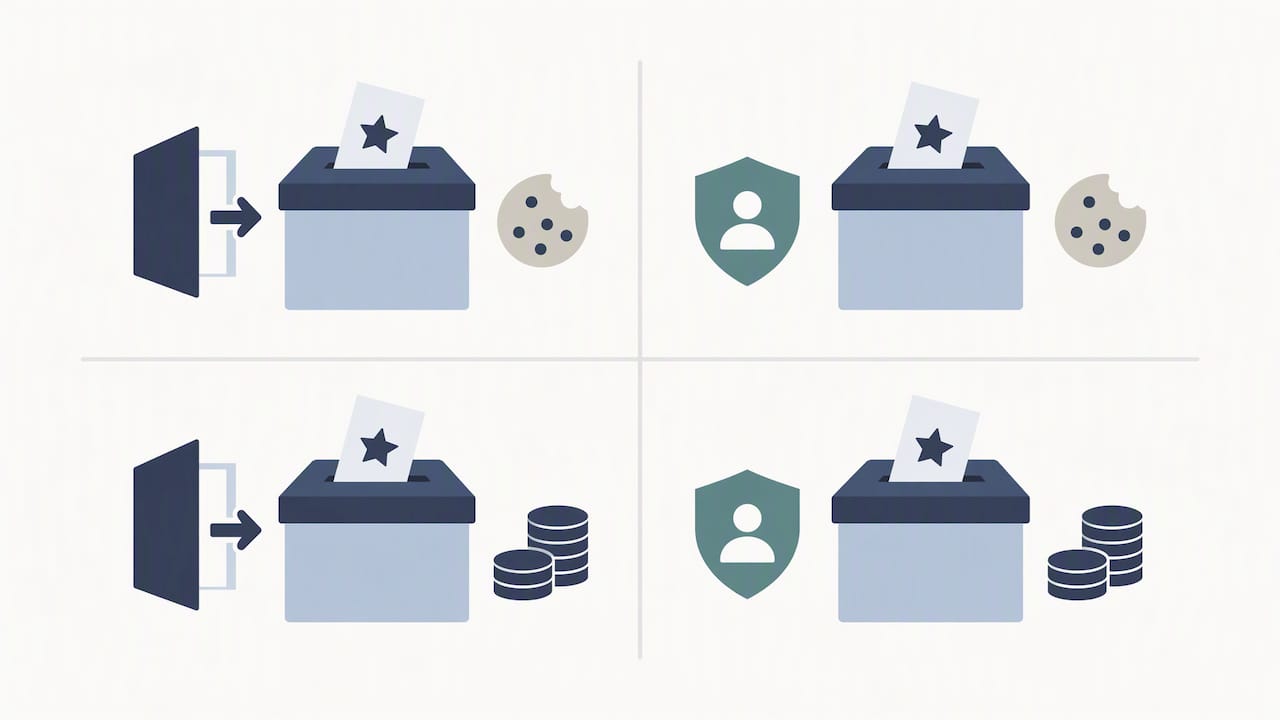
Open voting. Anyone with the link can vote, with no login. On Izivote, an anonymous voter is kept from voting repeatedly by a browser cookie. That is a light check, not a locked door. Someone who clears cookies or switches browsers can try again, which is why frequency limits and monitoring matter.
Paid voting. Each vote is purchased. The organizer sets the price and the platform handles payment. On Izivote, paid voting carries a 10% platform fee per vote, and the rest goes to your event or cause.
Login voting. Voters sign in, for example with a social account, before voting. This is the usual answer to “anonymous vs registered voting”: one account, one set of votes.
Identity voting. Only people you approve can vote, each with an identity you control. Izivote supports a manual list of voter IDs on every plan, plus SSO/SAML and OAuth methods on paid plans, currently in beta. Use it for student councils, member elections and staff votes where eligibility matters more than reach.
All four types also let you set how often a voter may vote in each category: once only, or once every hour, day or week.
Open, paid, login and identity side by side
| Open | Paid | Login | Identity | |
|---|---|---|---|---|
| Who can vote | Anyone with the link | Anyone willing to pay | Anyone with an account | Only people you list or approve |
| Cost to voter | Free | Per vote | Free | Free |
| Friction | Lowest | Medium (checkout) | Medium (sign-in) | Highest (must be on the list) |
| Duplicate control | Browser cookie | Payment is the filter | Account | Assigned identity |
| Main benefit | Reach | Revenue and commitment | Accountability | Verified eligibility |
| Best for | Community polls, quick fan votes | Fan awards, pageants, fundraisers | Public contests where you want fewer duplicates | Elections, staff and school votes |
No column wins everywhere. The right choice depends on what a “good result” means for your event: the most participation, the most money, or the most defensible outcome.
When open voting is the right call
Choose open voting when reach matters more than precision and the stakes are low.
- Community and club polls. A neighborhood “best local business” poll or a club’s favorite-photo contest does not need ID checks.
- Early-stage nominations. If you are collecting suggestions or running a first round, friction only costs you participants.
- Brand new events. You have no audience data yet, so you want as many people as possible to try the page.
- Small budgets. Open voting works on a free plan, so a first event costs nothing to run.
There is research behind the idea that letting the crowd decide draws people in. A study of crowdsourcing contests found that each 10% increase in the share of prize money decided by crowd voting was associated with a 7% rise in the odds of user participation. That is an association in one setting, not a promise for your awards, but it supports the instinct that audience voting energizes entrants.
The tradeoff is integrity. With no sign-in, the cookie is your only safeguard. If a nominee has a large and motivated following, expect them to push votes hard, and expect some of those votes to come from automated tools. Online polls have a long record here: researchers writing in The Conversation note that some polls are susceptible to bot manipulation, and that a black market for buying online votes exists.
If you go open, reduce the risk with a sensible vote frequency (once per category, or once per day rather than once per hour), a defined voting window, and a habit of watching the dashboard for sudden spikes.
When paid voting is the right call
Paid voting makes sense when votes express real enthusiasm and you want that enthusiasm to fund something.
Fan awards and pageants. Supporters of a performer, a contestant or a team already want to do more than click once. Letting them buy extra votes channels that energy into your budget instead of into workarounds.
Fundraisers. Schools, nonprofits and clubs can treat each vote as a small donation toward a cause, with the leaderboard as the incentive.
Events with costs to cover. Venue, production and prizes are real expenses. Paid votes can offset them without ticket price increases.
A worked example of the economics
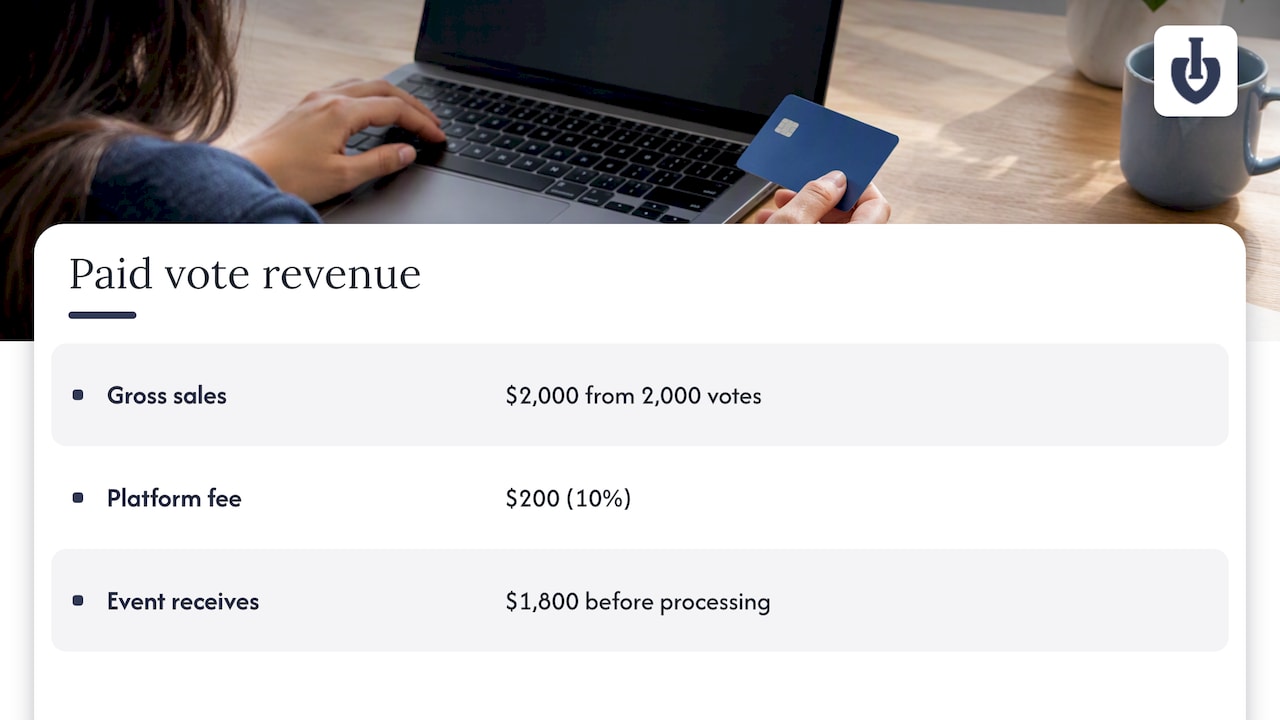
Suppose you price a vote at $1 and the event collects 2,000 paid votes. That is $2,000 in gross vote sales. With a 10% platform fee, $200 goes to the platform and $1,800 reaches you, before any payment processing charges your payment provider may apply. These figures are illustrative; you set the real price. The point is that the fee is tied to usage: if nobody buys votes, you owe no vote fee.
Plan subscriptions are separate. Izivote’s Free plan has no published price, Pro is $6 per month or $60 per year, and Premium is $14 per month or $140 per year. Check the pricing page for what each plan includes before you commit.
What paid voting does to integrity
Paying changes the incentive in both directions. Mass-producing fake votes now costs real money, which discourages casual abuse. But paid votes also let the best-funded fan base win, so a result reflects willingness to pay as well as popularity. That is fine for a fundraiser and awkward for an award that claims to name the “best”.
Three habits keep paid voting credible:
- Say it plainly. Tell voters that votes are paid, what a vote costs, and where the proceeds go.
- Separate prestige from money where it matters. Some organizers run a paid fan-favorite category alongside a free or judged category.
- Publish the rules. Voting window, vote caps if any, and how ties are handled should be on the page before voting opens.
For a closer look at how charging per vote works, see our paid voting platform page.
Where login and identity voting fit
Many readers searching “open vs login voting” are really asking whether to require accounts. The question comes down to what you are protecting.
Anonymous vs registered voting
Anonymous voting removes barriers and protects privacy, which suits light, fun contests. Registered voting ties each ballot to an account, which cuts duplicates and makes it harder for one person to cast dozens of votes. The cost is drop-off: every extra step loses some voters, and some people will not sign in to vote on a trivia poll.
A useful rule: if a duplicate vote would embarrass you, require a login. If it would not, keep it open.
Login vs identity voting
These sound alike but solve different problems.
- Login proves that a vote came from an account. It does not prove the person is eligible.
- Identity proves that a vote came from someone on your approved list. You decide who is eligible, and each identity gets its own vote.
An identity page is the better fit for a student council election, a board vote, an employee-of-the-month ballot or a members-only award. You build the list of eligible IDs, and anyone outside it cannot vote. Our pages for student elections and corporate and employee polls cover typical setups.
One practical note: the identity method you choose is permanent for that voting page, so decide before you publish.
Secrecy and transparency
There is also a question of whether people’s choices are visible. Historically, open ballots, where voters voted openly, were the norm before the secret ballot spread. For awards, the equivalent question is whether you publish who voted for whom. In nearly every public contest the answer should be no: show totals, keep individual choices private, and tell voters that up front.
Live results: a boost with a catch
Showing a live leaderboard is one of the best ways to keep voters returning. It turns the contest into a race. It also changes how people vote.
As researchers explain in The Conversation, live results can boost participation but invite “cascades”, where early, possibly manipulated votes steer later voters toward the apparent average. If a nominee jumps ahead on day one, genuine voters may follow the crowd rather than their own view.
What to do about it depends on the mode:
- Open voting: consider hiding totals until the final days, or showing rankings without raw counts, since it is the mode most exposed to early manipulation.
- Paid voting: live totals usually help, because they drive extra purchases. Just be clear that the leaderboard reflects paid votes.
- Identity voting: manipulation risk is low, so show or hide results according to how formal the election is.
The way you present results is part of your survey design too. If you want a refresher on question and response design, this guide to designing effective surveys covers principles that apply to any poll.
How to choose: a short decision path
Work through these questions in order.
- Does the result need to be defensible? If the winner will be treated as an official outcome (an election, a staff award), use identity voting and stop here.
- Do you want to raise money? If yes, and your audience is enthusiastic, use paid voting. If your audience is lukewarm, a paid model may suppress participation, so test with an open early round.
- Is reach your top goal? If you need maximum participation and the prize is bragging rights, use open voting with sensible frequency limits.
- Is duplicate voting a worry you cannot monitor? Add a login, or move to identity.
- Will outsiders try to game it? Assume yes if a nominee has a large online following. Pick a mode with a stronger gate, and watch the dashboard.
Quick matches
| Scenario | Suggested mode |
|---|---|
| Local “best of” community poll | Open |
| Fan favorite award for a streamer or band | Paid, or open with a login |
| Pageant with a charity beneficiary | Paid |
| High school student council | Identity |
| Employee of the year | Identity |
| Conference audience poll in the room | Open or login |
Mixing modes in one event
You do not have to choose once for the whole event. Common combinations:
- Open nominations, paid finals. Let anyone put names forward or vote in a free semifinal, then open paid voting for the top finalists, when fans are most invested.
- Free category plus paid category. Offer a free “community pick” next to a paid “fan champion”, so people who do not want to pay still have a voice.
- Identity for judges, open for the audience. Combine a verified panel vote with a public vote and report both.
Izivote supports multi-category pages, nominee photos and profiles, self-nomination, embedding the voting page on your own site, and automatic vote closing, so these hybrids do not require stitching tools together. See how it works for people’s choice awards and awards and competitions.
Set up your first vote with Izivote
Izivote is built for public audience awards: you can launch a voting page quickly on the web, choose open, paid, login or identity voting, add nominee profiles, watch results on a live dashboard and close voting automatically. A Free plan is available for smaller events, and paid voting is charged as a 10% fee per vote. Compare plans on the pricing page or start from the Izivote homepage.
FAQ
Is paid voting fair?
It is fair when everyone knows the rules. Paid voting rewards enthusiasm and funds the event, but it means a larger or wealthier fan base can outspend others. If your award claims to name the best, consider a free or judged category alongside it.
Can I run open voting without people voting twice?
Not perfectly. On an open page, a browser cookie stops casual repeat voting, but determined people can work around it. Set a conservative frequency, such as once per category, and watch for odd spikes. If duplicates would damage trust, require a login or use identity voting.
What is the difference between login and identity voting?
Login confirms that a vote came from a signed-in account. Identity confirms that the voter is on a list you control, such as enrolled students or members. Choose identity when eligibility matters.
Should I show live results?
Often yes, because a visible race keeps people voting. But early leads can influence later voters, so for open polls consider revealing rankings only near the end.
Can I switch the voting type after I publish?
No. The voting type is fixed for the life of an Izivote page, so choose it before you publish. If your plans change, create a new page for the next round.
Sources
- Voting Types & Voter Identity, Izivote Help
- Izivote pricing
- Effect of Crowd Voting on Participation in Crowdsourcing Contests, University of Minnesota
- Online polls are everywhere: here’s why we should be wary before trusting them, The Conversation
- Open ballot system, Wikipedia
Leave a Reply