
Transparent voting results mean anyone can understand how a vote worked, who could vote, how ballots were counted and why the winner won. For an online award or contest, that comes down to four things: published rules, live totals that match the final tally, a record that can be checked afterward, and a plain-language results page. Do those four and most arguments about “rigged” votes never start.
This guide is for people who run fan awards, people’s choice contests, school elections and community polls. It borrows standards from election administration, scales them to the size of an awards program, and shows where a platform helps and where the organizer still has to act.
Key takeaways
- Transparency is about making the system, the procedures and the reasons for the vote understandable. Secrecy about how votes are counted is what breeds distrust, not the loss itself.
- Publish the rules before voting opens: who can vote, how many times, what counts as a valid vote, and how ties and disputes are handled.
- Give voters evidence, not just a number: live totals, a clear close time, a results page that explains the count, and a record you can audit if challenged.
- Protect privacy while you do it. Show totals per nominee, never a public list of who voted for whom.
- Decide your dispute process before you need it, and label interim numbers as unofficial.
Table of Contents
- What “transparent” means for an online award
- What to publish before voting opens
- Choose a voting mode that matches the trust you need
- Show live results without distorting the vote
- Build a record that can be checked
- Protect voter privacy while showing the count
- Write a results page people can understand
- What to do when totals are disputed
- Features to look for in a transparent voting platform
- Run a transparent vote with Izivote
- FAQ
- Sources
What “transparent” means for an online award
Most pages ranking for this phrase are about government elections, but the definition carries over. The Council of Europe’s guidelines describe transparency as making the voting system, the surrounding procedures and the reasons for choosing electronic voting understandable to voters and stakeholders, which in turn supports public confidence.
Translate that to a fan award and you get a simple test. Could a skeptical nominee, with no inside access, explain to their followers how the winner was decided? If the answer relies on “trust us,” the vote is not transparent, however honest it was.
A public award has a particular weakness. Nominees are competitors, and they bring their own audiences. Every loser has an incentive to question the result, and every winner has an incentive to be defensive. Transparency protects both sides.
What to publish before voting opens
The cheapest transparency measure is a rules page written before the first vote. The Council of Europe guidelines recommend that observers can reach election documentation, such as minutes, certification, testing and audit reports and detailed system documentation, preferably online and well before voting. You do not need a certification file for a regional awards night, but the principle holds: put the documents out early.
A useful rules page covers:
- Eligibility. Who may vote: anyone with the link, only logged-in users, verified identities, or a closed list such as students or members.
- Vote limits. One vote per person, one per category, one per day, or unlimited paid votes. State it exactly.
- Paid votes. If votes can be bought, say so, say what a vote costs, and say where the money goes. Hidden monetization is the fastest way to lose a community.
- Opening and closing times, with time zone. Automatic closing removes the suspicion that someone kept the polls open for a friend.
- What is shown live. Totals, percentages, or ranking only. Decide this up front, because it changes voter behavior.
- How invalid votes are handled, such as duplicates, bots and refunded payments.
- Tie-breaking and dispute rules, covered below.
Post the link on the voting page itself, not buried in an email.
Choose a voting mode that matches the trust you need
The more a result matters, the more the voting mode should limit who counts. Open voting is easy and generates reach, but it is the easiest to game. Login-based and identity-based modes make it harder to stuff the ballot box, at the cost of some friction.
Here is how the modes compare in practice:
| Mode | Best for | Main risk | What to disclose |
|---|---|---|---|
| Open voting | Low-stakes polls, social contests | Repeat votes, bots | Any limits per device or per day |
| Paid voting | Fundraising awards, fan contests | Perception that money buys the win | Price per vote, fee, and where proceeds go |
| Login voting | Communities, member groups | Fake accounts | Which login methods are accepted |
| Identity-based voting | School elections, member votes | Privacy concerns | What identity data is collected and who can see it |
Izivote supports open, paid, login and identity-based modes on the same platform, so you can match the mode to the event. You can see the full list on the features page. For schools, the student election setup is built around identity-based voting.
Show live results without distorting the vote
Live public results are the strongest transparency signal an online award can give. Voters see their vote register. Nominees see the race. Nobody can quietly adjust the totals at the end.
Live results have a trade-off, though. A visible leaderboard can discourage voters for trailing nominees, or encourage a last-minute rush of paid votes. Neither is a flaw; both are behaviors you should expect and describe in the rules. Some organizers show live rankings while a contest runs and reveal exact numbers at the close. Whichever you choose, say so before voting starts, and keep it consistent.
The Center for Civic Design, in its guidance on displaying election results, advises that displays summarize how votes accumulated for the winner and that interim results be labeled as incomplete and unofficial. Both ideas fit awards well. A banner reading “Voting is open. Totals are live and not final” prevents the screenshot that goes viral on day two and gets quoted as the outcome.
Build a record that can be checked
Transparency is not only what voters see. It is what an independent person could verify later.
Ronald Rivest and colleagues argue that a trustworthy voting process should provide evidence so voters and observers can check the result, rather than simply trusting it. The same paper sums up end-to-end verifiability in three steps: cast as intended, recorded as cast, and counted as recorded.
For a fan award you will not run cryptographic ballots, but you can apply the same three questions:
- Cast as intended: Does the voter see a clear confirmation of which nominee they picked?
- Recorded as cast: Is every accepted vote stored with a timestamp and a status (valid, duplicate, refunded)?
- Counted as recorded: Does the public total equal the sum of valid stored votes, and can you export the data to prove it?
Official guidance on auditable e-voting systems points the same way. Thailand’s Electronic Transactions Development Agency, for example, requires that systems detect and record errors and make changes to stored votes traceable, and that access logs record items like user identity, access time and successful and failed attempts, with protection against alteration. That is a national standard for formal elections, not a rule for your contest, but it shows what a defensible audit trail contains. When you pick a platform, ask whether you can export vote records and whether changes leave a trace.
The Council of Europe’s guidelines also suggest, where feasible, archiving configuration and tallying protocols and letting observers watch testing. At a small scale, that translates into something easy: take a screenshot or export of your settings (categories, nominees, vote limits, close time) before voting opens, and keep it.
Protect voter privacy while showing the count
Transparency about totals must not become exposure of individuals. Publish how many votes each nominee received, never who cast them.
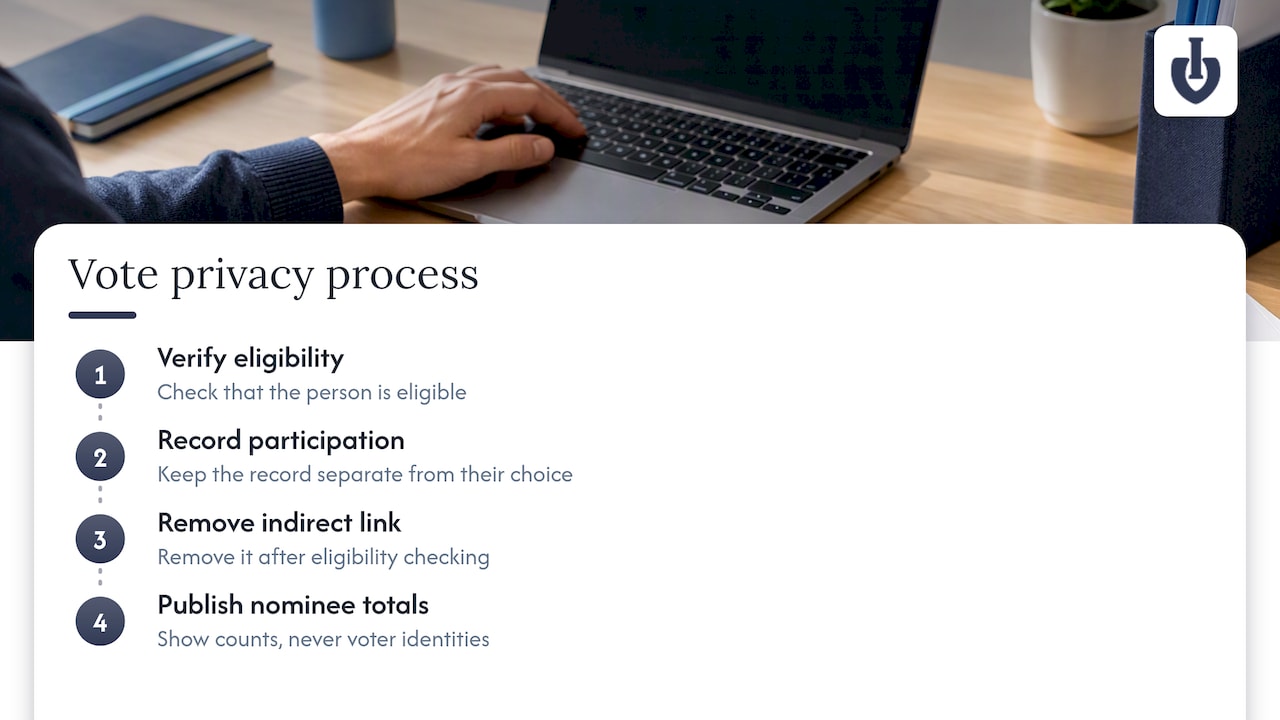
The same Thai guidance says votes should not be directly linked to voter identity or personal information. It allows an indirect link, such as for checking eligibility, only temporarily, and requires that the link be removed afterward. For an identity-based school or club vote, the practical version is: verify that a person is eligible, record that they voted, and keep that record separate from what they chose in any public view.
Tell voters in plain words what you collect and why. If you use identity verification, explain what the organizer can see and what the public can see. Izivote has described how it presents voter identity in its post on the enhanced voter identity experience.
Write a results page people can understand
A transparent count that nobody can read is not transparent. The Center for Civic Design recommends that a results page identify the winner first, then explain how counting worked, and use both words and visuals. That order suits awards well: readers want the answer, then the proof.
A solid post-vote results page includes:
- The winner and the final vote totals for every nominee, by category.
- The exact close time and time zone.
- The voting mode and any vote limits that applied.
- A line on how many votes were removed as invalid and why, if any.
- A short “how we counted” paragraph in everyday language.
- A contact for questions, with a response window.
Interface choices matter more than most organizers expect. Clear labels, readable charts and consistent wording help voters understand what they are looking at, and voting system examples for communities show how presentation shapes trust in a reported outcome.
Keep the results page live permanently. A page that disappears after the ceremony looks like something was hidden. Izivote gives each vote a public page with nominees and results; the classicvote page is an example of how a finished vote can look.
What to do when totals are disputed
Disputes are rare, but they come at the worst moment: right after the winner is announced. Decide the process in advance, and put a short version in your rules.
- Set a challenge window. For example, a few days after the close, with a named contact. State the window in the rules, not after the first complaint.
- Ask for specifics. A dispute that names a category, a time range or a pattern (hundreds of votes in minutes) can be checked. A general accusation cannot.
- Check the records. Compare the public total with your exported valid votes, look at timing spikes, and look at duplicates and refunded payments.
- Correct and explain. If you find an error, fix the result, mark the earlier figure as superseded, and publish what happened. A visible correction builds more trust than a flawless-looking page that nobody can question.
- Keep the original export. Archive the data from the moment of closing so you can show what changed and why.
- Name a decider. In close or contested votes, a neutral person, such as a board member, teacher or outside accountant, should rule on the evidence rather than the organizer who benefits from the result.
The same logic applies to errors you discover yourself. Announce them promptly, say how many votes were affected, and state the corrected totals. Silence is the worst option.
Features to look for in a transparent voting platform
If you are comparing tools, resist the pitch about “security” in general. Ask for specifics, which map to the official guidance above:
- Rules and system information available to voters, ideally before voting begins.
- Live public totals that come from the same data as the final result.
- Automatic closing, so the end time cannot be moved quietly.
- Exportable vote records with timestamps, so you can audit when challenged.
- Controls for who can vote, from open to identity-based.
- Clear handling of payments if you run paid voting, including the fee.
- An organizer dashboard to watch votes as they arrive and spot odd spikes.
Alternatives fall into rough types. Form builders collect responses but are not designed for public leaderboards. Judged-only award software focuses on scoring by panels, not open audience votes. App-based voting services require voters to install something. A purpose-built audience voting platform covers public setup, embedding, live results and several voting modes in one place, which is the gap Izivote was built for.
Run a transparent vote with Izivote
Izivote is an online voting platform for fan and people’s choice awards. You set up categories and nominees with photos and profiles, choose open, paid, login or identity-based voting, embed the vote on your own site, and watch results in a live dashboard. Voting closes automatically, and results are public in real time.
The Free plan suits small events. Pro costs $6 per month or $60 per year, and Premium costs $14 per month or $140 per year. If you run paid voting, the platform fee is 10% per vote; the post on monetizing fan voting explains how to present that fee and sponsorship fairly to your audience. When you are ready, you can create a vote for free, or look at the people’s choice awards setup first.
FAQ
What does transparent online voting mean?
It means voters and stakeholders can understand how the voting system works, who was eligible, how votes were counted and how the result was reached. In practice that is published rules, live or final totals, and a record that can be checked if someone challenges the outcome.
Should I show live results during voting?
Usually yes, if the rules say so from the start. Live totals show that votes are registering and that nothing changes behind the scenes. Label them as unofficial until voting closes, and consider hiding exact numbers if you think a visible race will skew behavior.
Can results be transparent and still protect voter privacy?
Yes. Publish totals per nominee and the rules for the count, but never a list linking people to their choices. If you verify identity, use it only to confirm eligibility and keep it apart from the public view of results.
Is paid voting compatible with a fair, transparent result?
It can be, if you disclose it. State the price per vote, the platform fee and where the money goes, and show totals as they are. Problems arise when paid votes are hidden or when the rules change mid-contest.
Sources
- Guidelines on transparency of e-enabled elections, Council of Europe
- Electronic voting self-assessment manual, Electronic Transactions Development Agency (Thailand)
- Rivest and colleagues, end-to-end verifiable voting paper (MIT)
- Best Practices for Displaying Election Results, Center for Civic Design
Leave a Reply