
You prevent vote rigging in an online contest by doing four things in order: write the eligibility and voting rules before launch, pick a voting mode that fits the risk of your contest, watch the vote count while voting is open, and close and explain the results openly. A purpose-built voting platform handles much of this for you. Izivote offers open, paid, login-based and identity-based voting, live analytics and automatic vote closing, so an organizer can match the mode to the stakes without building anything from scratch.
This guide is for people running fan awards, people’s choice awards, pageants, school elections and community contests. It is not about government elections. It is about the practical steps that keep a public vote believable.
Key Takeaways
- Rigging in online contests usually means repeat voting, bots, shared or sold credentials, and hidden or changing rules. Each has a matching control.
- Fix eligibility, verification and closing rules before the first vote, and publish them where voters can read them.
- The higher the prize or the more public the contest, the stronger the voter identity check should be. Low-stakes polls can stay open and light.
- Watch results live. A sudden spike is a prompt to investigate, not proof of cheating.
- Paid votes can be fully transparent when the price, the fee and the tally are all visible.
Table of Contents
- What vote rigging looks like in online contests
- Set the rules before the first vote
- Match the voting mode to the risk
- Watch the count while voting is open
- Make paid voting transparent
- Keep voting fair and accessible
- Close the vote and explain the result
- Put it into practice with Izivote
- FAQ
- Sources
What vote rigging looks like in online contests
A contest vote is rigged when the result reflects effort spent gaming the system rather than real audience support. The common forms are easy to name:
- Repeat voting. One person, or a script, casts the same vote many times from one browser, one email or several devices.
- Bots and vote farms. Automated traffic floods a single nominee. Research on a large public AI-model ranking, which used about 1.7 million historical votes, showed that rankings could be improved by rigging only hundreds of new votes. Small, well-aimed manipulation can move a close race.
- Credential sharing and vote buying. When access depends on a code or login, someone can pass it on or sell it. A European Commission report on remote voting notes that online identification codes can be handed to another person, which makes vote-selling and trading easier.
- Hiding the evidence. Researchers describe attacks that suppress the information voters need to check their own ballots, such as withholding the QR codes used for a second-device check. In a contest, the equivalent is a results page that shows nothing, changes without explanation, or is closed to scrutiny.
- Moving the goalposts. Rules that change mid-contest, nominees added late, or a closing time that drifts all invite accusations, even when nobody cheated.
Notice that the last two are organizer problems, not attacker problems. Most disputes in fan awards start there.
Set the rules before the first vote
The cheapest protection is a clear rulebook. The U.S. General Services Administration’s 2026 prize and challenge toolkit recommends establishing eligibility requirements and verification processes before launch, including checking participants before they spend time on submissions. That advice is written for federal prize competitions, but it applies just as well to a pageant or a community award.
Write down and publish these items before you open voting:
- Who can be nominated. Define categories, nominee criteria and whether self-nomination is allowed. Izivote supports self-nomination, so you can open the field and still apply your criteria before a nominee goes live.
- Who can vote. Anyone, only people with an account, only verified people, or only members of a group such as students or employees.
- How many votes each person gets. One per category, one per day, or unlimited if votes are paid.
- When voting opens and closes. Use a fixed closing time and let the platform enforce it. Izivote closes votes automatically, which removes the temptation to extend a deadline when your favorite is behind.
- What counts as a violation. Name the behaviors you will investigate (scripts, purchased accounts, vote-trading groups) and say what happens: removal of votes, disqualification, or a review.
- How disputes are handled. Give a contact address and a decision window.
Post the rules on the voting page itself. A rule nobody can find does not deter anyone and cannot be enforced fairly.
Match the voting mode to the risk
There is no single setting that stops all rigging. The European Commission’s report on remote voting makes the point that every remote option has vulnerabilities and that design should balance convenience against secrecy, security and integrity. The NIST Cybersecurity Framework profile for election infrastructure takes a similar risk-based view: put your security effort where it matters most for your mission.
For an awards organizer, that means choosing the mode by what is at stake. Izivote’s help pages explain each option in voting types and voter identity. In summary:
| Voting mode | How it works | Best for | What it deters |
|---|---|---|---|
| Open voting | Anyone can vote with no sign-in | Low-stakes polls, social media engagement, quick community votes | Little by itself; pair it with live monitoring |
| Login-based voting | Voters sign in before voting | School elections, member votes, corporate polls | Anonymous repeat voting |
| Identity-based voting | Voters are tied to a verified identity | Contests with prizes, pageants, high-visibility awards | Duplicate accounts and casual ballot stuffing |
| Paid voting | Each vote is purchased through handled payments | Fundraisers and fan awards | Mass free spamming, since every vote has a cost |
A few practical rules of thumb:
- If a winner receives a trophy and bragging rights, open voting with live monitoring is often enough.
- If a winner receives money, a contract or a title that matters publicly, move to login or identity-based voting.
- If the contest raises funds, paid voting turns the incentive around: pushing a nominee up costs real money, and the money goes to your cause.
If you want a deeper look at how email checks work, see this guide to email verification voting. To understand sign-in setups, read about login-based voting. For the specific problem of repeat voters, the Izivote guide on how to prevent duplicate votes goes step by step.
Guard against shared credentials
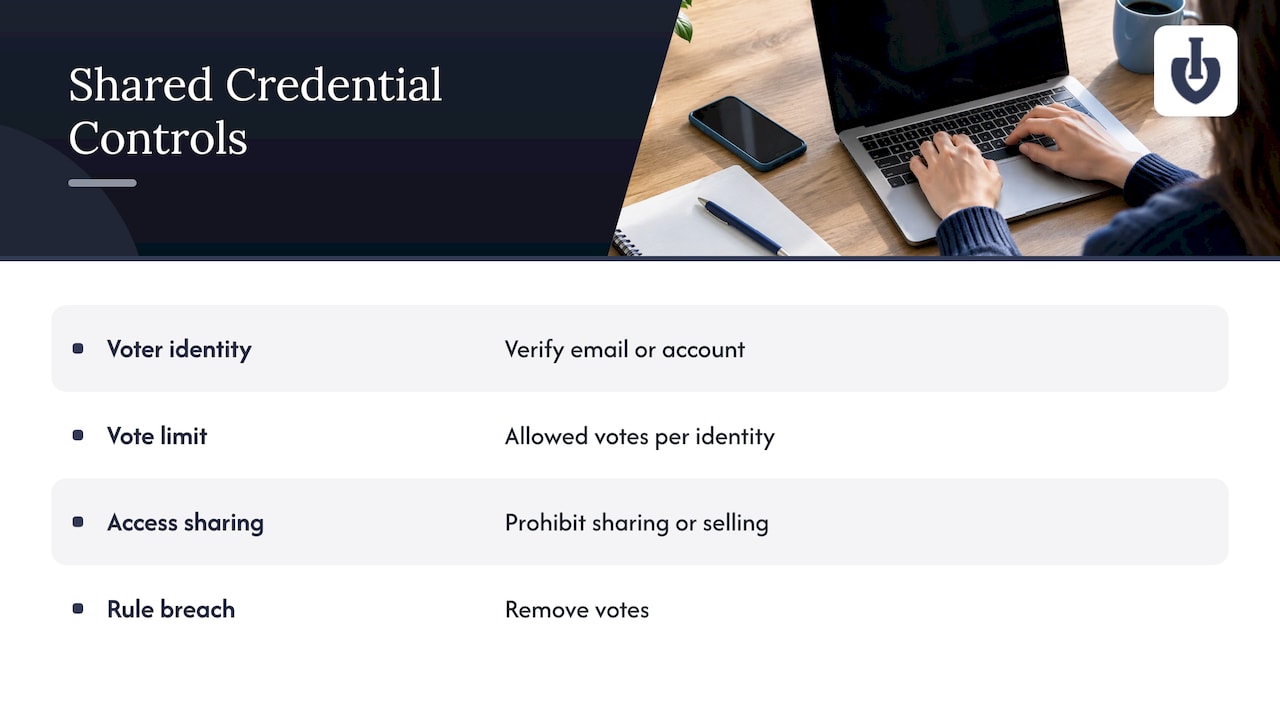
Any system that gives voters a code, link or login has one weak point: the voter can give it away. Controls that help are simple. Tie access to something personal such as a verified email or account, limit each identity to its allowed number of votes, and state in your rules that sharing or selling access is grounds for removing votes. Where you scan a QR code to reach the voting page, remember the code gets you to the page, not past the identity rules; Izivote’s piece on scan-to-vote contests covers how to use it.
Watch the count while voting is open
Rigging is far easier to stop while it is happening than to unwind afterward. The European Commission report lists result manipulation and double voting among the risks of remote voting, so your plan should include someone looking at the numbers.
What to look for on your dashboard:
- Sudden jumps. A nominee who gains hundreds of votes in minutes, with no matching social post, event or email, deserves a closer look.
- Odd timing. Votes arriving at perfectly regular intervals, or in the middle of the night for a local contest, can point to a script.
- Lopsided categories. One nominee dominating a category while the others sit flat, when the audience overlap suggests a closer race.
- Clusters. Many votes tied to similar email patterns or arriving in the same short window.
Treat each signal as a reason to investigate, never as a verdict. A nominee with a large following can legitimately surge after a single post. Compare the spike against what the nominee did publicly, and decide with several clues, not one.
Izivote gives organizers a dashboard with real-time analytics so you can follow the count as it changes, and its guide to real-time vote monitoring shows how to build a routine around it. For a view of what a full dashboard offers, see voting dashboard features.
Set a daily check
For a contest that runs a week or longer, a short routine works better than occasional panic:
- Open the dashboard at the same time each day and note the top three in each category.
- Record any jump you cannot explain.
- Ask the nominee’s team what they did to drive votes. Honest campaigns are usually happy to explain.
- Act under your published rules, and write down what you decided and why.
That log becomes your evidence if anyone challenges the result later.
Make paid voting transparent
Paid voting sometimes draws the accusation that the biggest wallet wins. That is a design question, and it has a clean answer: state the model openly and show the results.
- Say in the rules what a vote costs and where the money goes.
- Show the totals publicly in real time, so nobody suspects hidden adjustments.
- Cap or tier the offering if you want to keep it competitive, for example by limiting the votes per purchase.
On Izivote, paid voting runs through the platform with payment handling built in, and the platform fee is 10% per vote according to the pricing page. Since every vote is a recorded transaction, the vote count and the money line up, which gives you a simple record to reconcile. You can compare the models in open voting versus paid voting, or see how the paid voting setup works.
The same European Commission report that warns about transferable credentials points to the need for controls against credential transfer and coercion when identity-linked or paid voting is used. In a contest, that means writing the rule down and applying it consistently.
Keep voting fair and accessible
A strict check that locks out real fans is its own failure. Identity rules should protect the result without shutting out legitimate voters.
The UK Electoral Commission’s work on proof-of-identity schemes says identity checks must balance security with accessibility and privacy, and recommends that identification be freely available and that there be accessible ways to apply. IFES, an election-assistance organization, notes that online voting can help voters with disabilities but must come with accessible registration, identification and voter information, and that people without internet access or digital skills can be left out.
For a contest organizer, the lessons are practical:
- Choose the lightest check that covers your risk. A school election does not need what a televised pageant needs.
- Ask only for the data you will use. A voter who must hand over more than the contest requires will often walk away.
- Write plain instructions on the voting page. Mobile-friendly pages and clear steps help voters who are not tech-savvy.
- If your audience includes people with little internet access, add an offline way to take part or announce the contest in channels where they are.
Izivote’s voting pages show nominee photos and profiles and can be embedded on your own site, so voters can reach the ballot from the place they already trust.
Close the vote and explain the result
A fair result still needs to be seen as fair. Researchers at the 2026 CHI Conference argue that the hard part of verification is human behavior: voters must be willing to check, notice problems and report them. In a contest, that translates into giving people something to check and a way to speak up.
A clear closing routine:
- Let the platform close the vote. Automatic closing at the published time avoids any claim that you extended or cut voting to favor someone.
- Freeze and export the final tally. Keep a copy of the final numbers with the date and time.
- Review flagged activity. Go back through your daily log, apply your rules to anything suspicious, and record the decision.
- Announce the result with the facts. Share the totals, the voting period and the rules that applied. If you removed votes, say how many and why, without naming individuals.
- Offer a short challenge window. Give a deadline and an email address, and answer every challenge in writing.
Showing results live also helps. A public results page lets nominees and fans watch the race, so a surprise at the end is rare. You can even show the count on a screen at an event, as described in this guide to live event voting display.
Put it into practice with Izivote
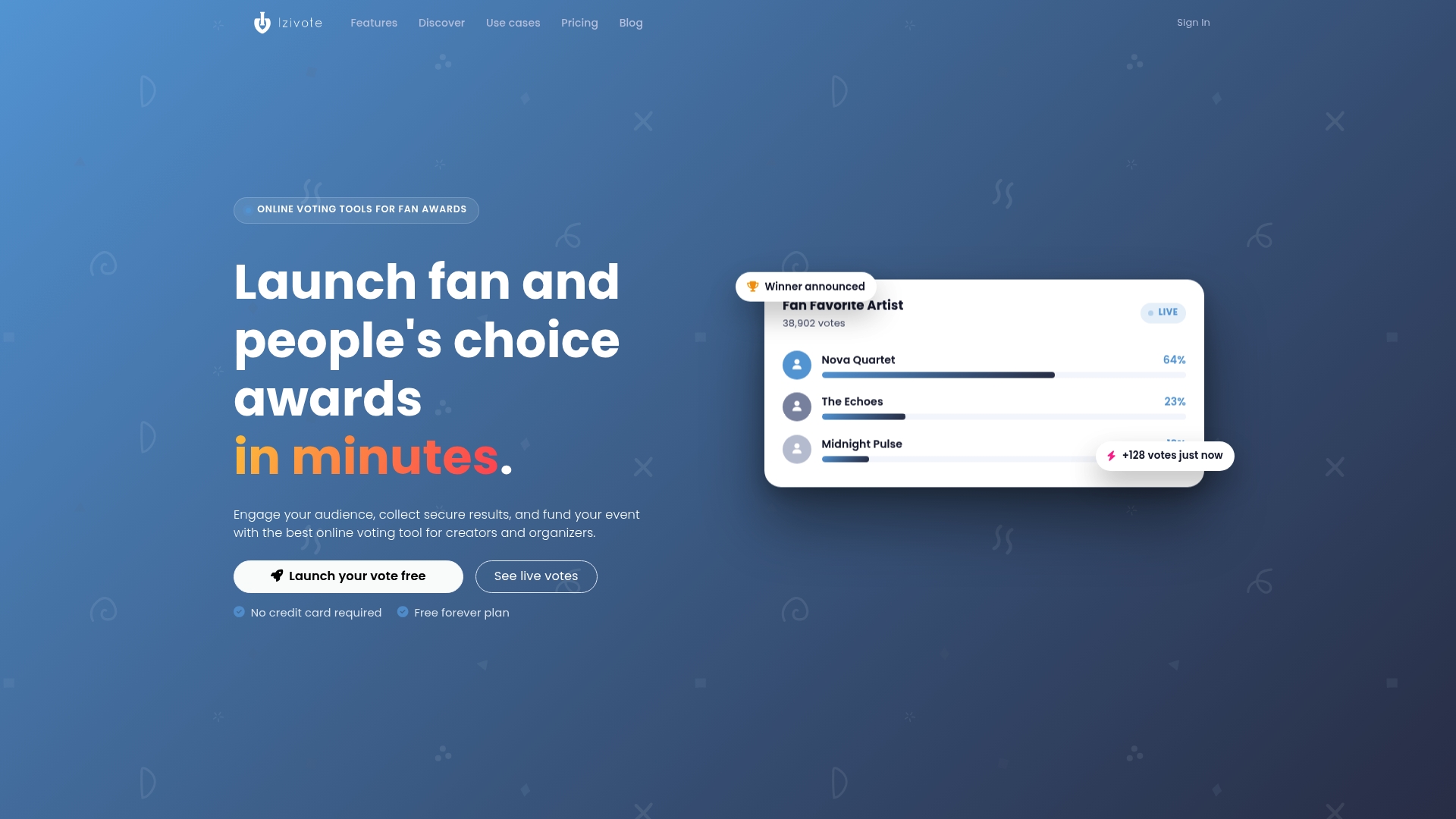
If you run fan awards, a school election or a charity contest, the controls above can be set up in one place. Izivote is built for public audience awards: you launch a voting page, choose open, paid, login or identity-based voting, add nominees with photos and profiles, set the closing time, and follow the count on a real-time dashboard. Votes have been cast across 500+ events in 20+ countries.
The Free plan suits small events. Pro costs $6 per month or $60 per year, and Premium costs $14 per month or $140 per year. Paid voting carries a 10% platform fee per vote. Full details are on the pricing page. If you are planning a specific kind of contest, see the setups for awards and competitions, people’s choice awards and student elections.
To see what real organizers have run, browse the Izivote customers page, or look at the full feature list.
FAQ
How do I stop people from voting multiple times?
Decide how many votes each person may cast, then require a sign-in or identity check that matches the stakes of your contest. Open voting suits casual polls, while login-based or identity-based voting suits contests with prizes. Watch the dashboard for repeated patterns while voting is open.
Is paid voting a form of vote rigging?
No, not when it is open and rule-based. State the price per vote, say where the money goes and show the live totals. Because each paid vote is a recorded transaction, the count and the payments can be reconciled afterward.
What should I do if I think a nominee is cheating?
Compare the spike against what the nominee did publicly, such as a post or an event. Apply the violation rules you published, and record your decision. Tell the nominee what you found and give them a chance to respond before removing votes.
Do I need a strict identity check for every contest?
No. Pick the lightest check that covers your risk. A casual social poll can stay open, while a contest with money or a public title is better served by login or identity-based voting. Strict checks can also keep out honest voters, so keep them proportionate.
When should I publish the voting rules?
Before the first vote opens, on the voting page itself. Eligibility, vote limits, closing time and the dispute process should all be visible, so that any decision you make later rests on rules everyone could see.
Sources
- Chatbot Arena vote-rigging experiments, PMLR 2025
- Drawbacks of Remote Voting, European Commission 2018
- Why Johnny Checks but Doesn’t Alert, ACM 2026
- Prize and Challenge Toolkit 2026, U.S. General Services Administration
- Cybersecurity Framework Election Infrastructure Profile, NIST 2024
- Proof of identity scheme report, UK Electoral Commission 2016
- Considerations on Internet Voting, IFES 2020
Leave a Reply